
175+ Years of Cancer | The Big Picture the Establishment Doesn't Want You to See
NeedToKnow.news | Dr. Andy Kaufman
Sasha Latypova | substack.com/@sashalatypova
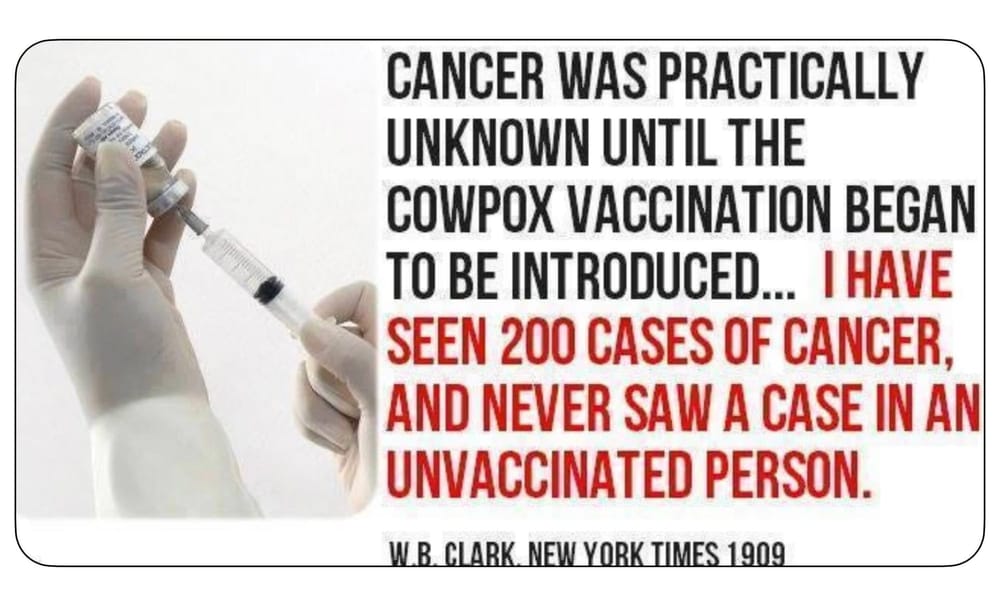
I am going to publish series of articles with in depth research about vaccinations (more generally, injections of various “biologics”) as the primary and the most important driver of cancer burden on society.
Let’s start with the premise that the purpose of a system is what it does. This article is a review of what the system of modern science, medicine and public health has done “fighting cancer” over the past 175+ years of the so-called “scientific medical progress”. We shall quickly realize the system wasn’t so much fighting cancer, but rather creating MORE cancer as a vast business opportunity on which to feed itself.
In this post I am going to quote a very extensive (800+ pages) actuarial report, widely considered the single most influential cancer text published in the United States in the early twentieth century, the Hoffman Prudential Report from 1915. [link not working] Data like these are gold, and I suspect are being scrubbed off the internet as we speak. Those who do not learn from history are bound to repeat it. Those who do not learn from the history of medicine are bound to experience premature death from cancer or some other “ancient and baffling scrouge of humanity” that turns out to be very recent and iatrogenic, i.e., induced by the establishment medicine in the last century or so in the first place.
The Hoffman Prudential report makes an unimpeachable case that the steadily increasing rates of cancer in the US and many other countries are “real” and cannot be explained away by the commonly used socioeconomic or demographic adjustments. The authors clearly demonstrated that this increase was not due to aging population, not because of improved diagnostics, not attributed to occupational hazards and exposure to toxic materials, not because of “racial disparities” (or lack thereof, as the system will use in whichever version is more convenient), and not because of lacking access to care, but rather in strong correlation to its roll-out. Curiously, while discussing an exhaustive list of demographic variables, ethnic/racial differences, and numerous theories of cancer causation, the Hoffman Report does not mention the word “vaccine” even once. This curious omission, and sticking to “anything but vaccines” narrative speaks louder than anything else.
I will address the various theories of cancer causation in future articles, this one is already long. You know my working theory - “it’s the vaccines, stupid! (ITVS!)”
This post is not about me saying ITVS! again, but for you to examine the historic data and see for yourself that none of the commonly attributed environmental or demographic causes can explain the terrifying onslaught of cancer on society during the past century and a half. I am currently compiling information on vaccination policies and coverage in 1800-early 1900s and, unlike what you may think (i.e. “barely anyone was vaccinated before 1960s”), universal vaccination and high coverage was already wide spread in the Western world by late 1800s. Keep that in mind while reading this post.
To assess the historical rates of cancer per 100K population, first, let’s look at the past 50 years. Here are the cancer trends in the United States, post 1975, using data from the CDC Seer database:
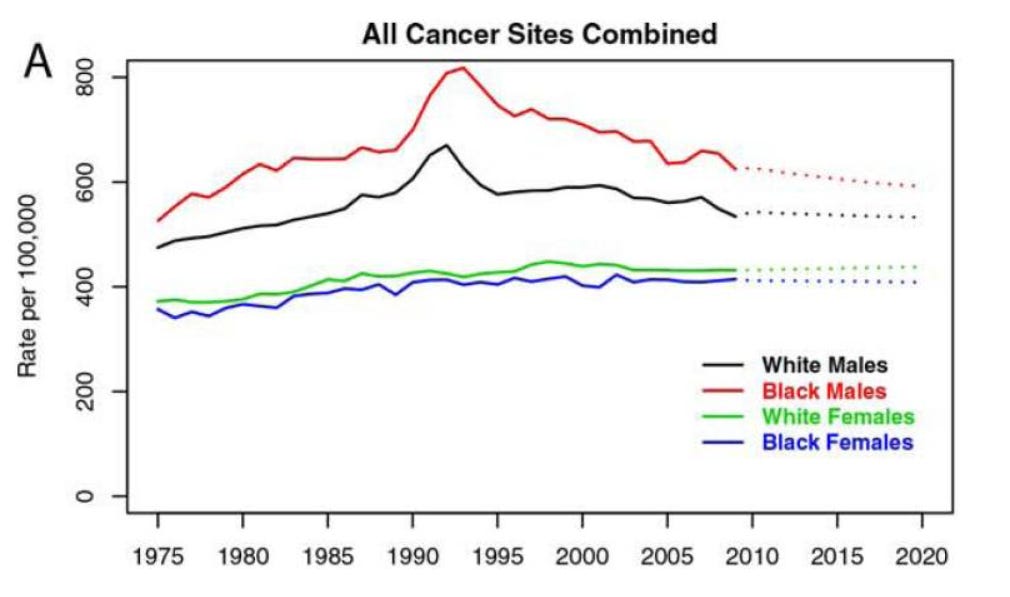
From this graph, it is evident that since 1975, cancer is predominantly male, and predominantly black male. The major increase in the cancers in men of both races which peaked in the 1990s is commonly attributed to smoking. The “smoking” bump is entirely driven by cancers in men, while women seem largely unaffected. This is strange, since there was a fairly large % of smokers among women around the same time, but no “bump” appears in the female charts. More about that issue in future articles. Also note a very strange clear racial difference between black and white men, and practically no difference between black and white women, albeit, the rates in white women appear slightly worse. These differences are bizarre! How come, an allegedly “ancient scrouge” of humanity is so curiously selective and capricious by gender and race?
These curiosities aside, the data since 1975 gives a perception that cancer has always been a major malady occurring at a pretty constant rate, and that smoking is a bad, risky behavior, which makes one’s chances of getting cancer substantially worse. While smoking is consistently claimed a major risk factor for cancer, the establishment is in no hurry to explain a rather “baffling” long term trends of consistent increase in cancers at younger and younger age groups and in children, who do not smoke, nor are exposed to smoke.
Let’s look at the older cancer statistics, prior to 1975. The Hoffman report provides many datasets for U.S., Europe and some states separately. I used Massachusetts data as it is one of the first settled and populous states with major obsessions with “public health”, “modern medicine” and (purely coincidentally!) witchcraft, too. Combining Mass data before 1920 with CDC data after 1975, gives this jaw dropping picture:
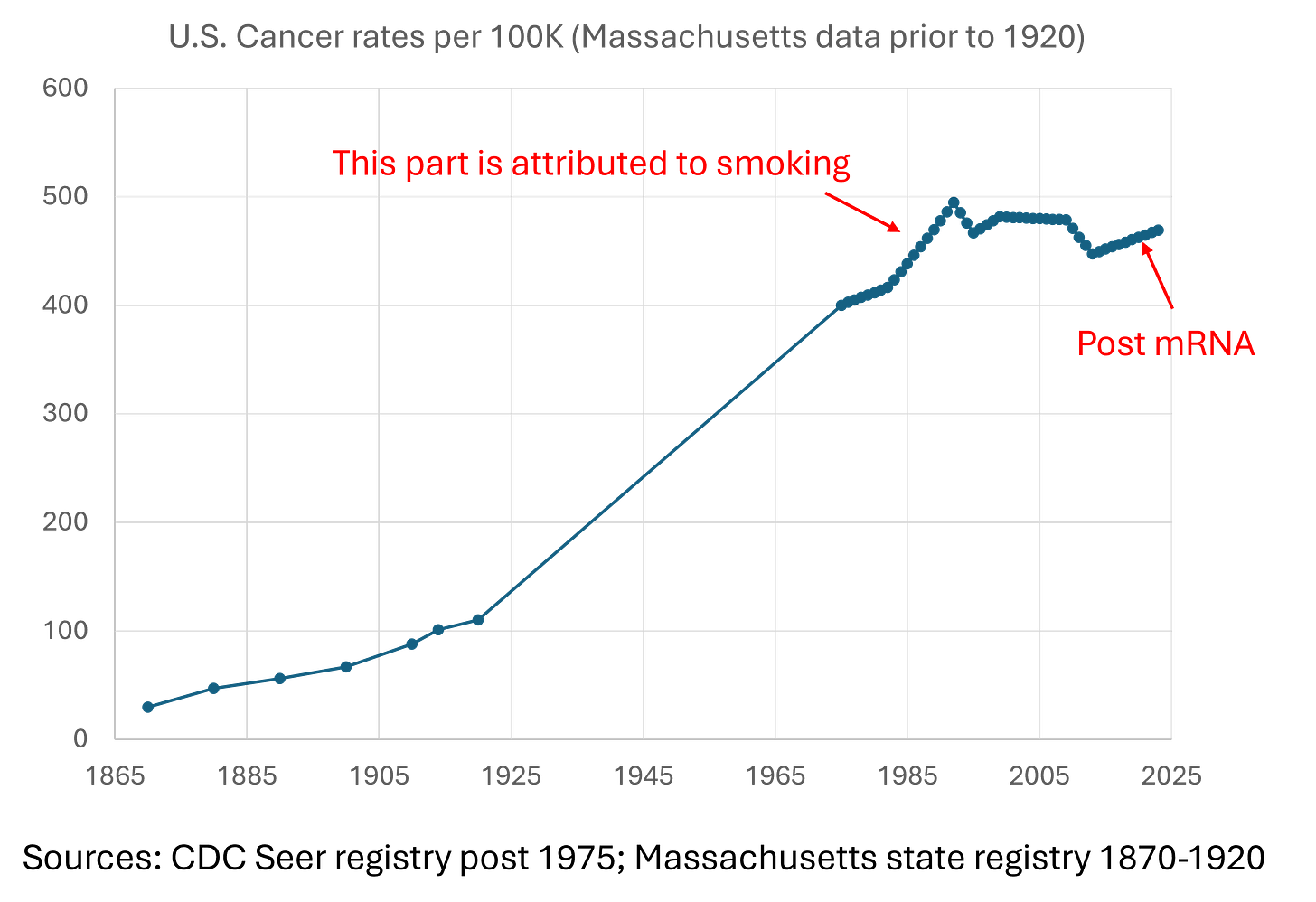
Stunning, isn’t it?
After compiling this information, there is very little doubt in my mind that cancer is not a naturally occurring human illness. It is a manufactured, induced illness, and its weaponization was the military-state goal before more elaborate tales of the invisible weaponized flying viruses were even invented!
1915 Mortality, Statistics, and the Rise of Cancer
Frederick L. Hoffman, statistician at the Prudential Insurance Company of Newark, published The Mortality from Cancer Throughout the World in 1915, a 826-page volume drawing on death-registration data from more than thirty countries. Hoffman concluded that cancer mortality in the registration areas of the United States and Western Europe had been rising at roughly 1%-2% per annum for at least two decades and that the rise could not be explained away by improvements in diagnosis, or any typical demographic or socioeconomic adjustments.
Hoffman’s findings rested on data that the U.S. federal government had only recently begun to collect. The Bureau of the Census had organized the original Death Registration Area in 1900, comprising the New England states, New York, New Jersey, Indiana, Michigan, and the District of Columbia—roughly 40 per cent of the U.S. population. Coverage expanded steadily and full national coverage was achieved only in 1933. The annual Mortality Statistics volumes published by the Bureau of the Census from 1900 onward provided, for the first time, a serial federal record of cancer deaths in the United States by age, sex, and state.
Let’s remind ourselves, that the “modern” cancer data published by CDC since 1975 shows prevalence of the disease as follows: 1) black men; 2) white men; 3) white women; 4) black women. Cancer rates get progressively higher in younger population as time goes on.
Here is where cancer statistics get rather curious, indeed:
In stark contrast to the late 20th century, in the early 20th century, cancer was predominantly white, upper class and female:
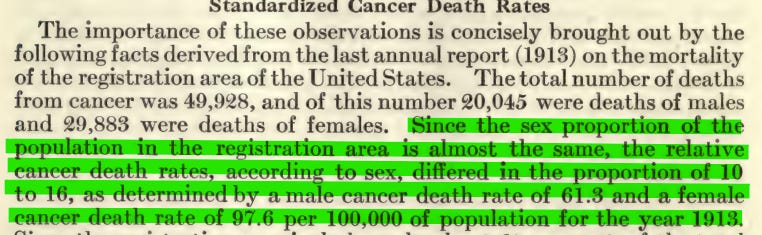
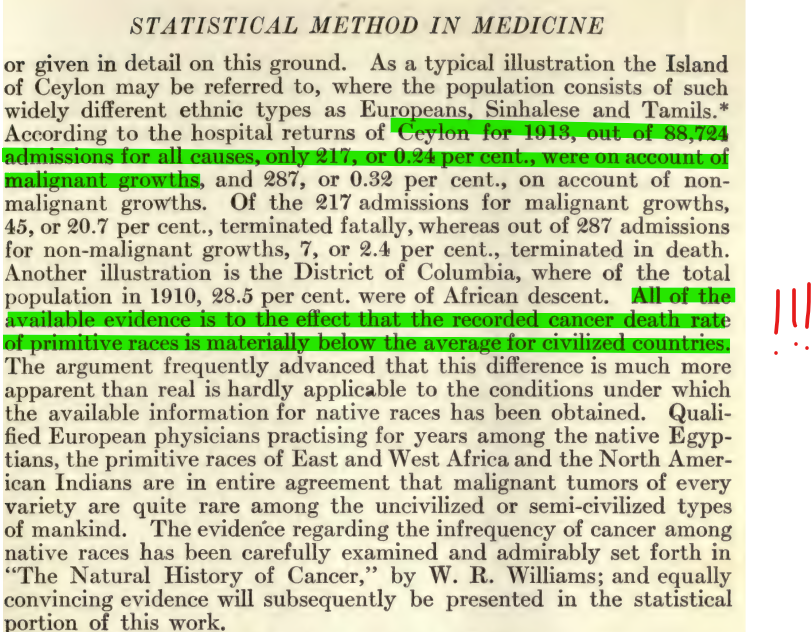
Cancer was nearly non-existent in black Americans or in “uncivilized” non-whites elsewhere in the world. How strange for an “ancient scrouge of humanity” to change its demographic preferences so capriciously.
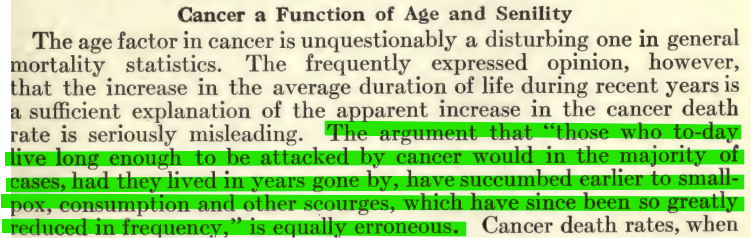
Hoffman found that the “aging population” narrative did not explain the data. He found consistent increase in rates of cancer already very clearly detectable in the decades preceding 1915 … were not explained by the “aging population” narrative:
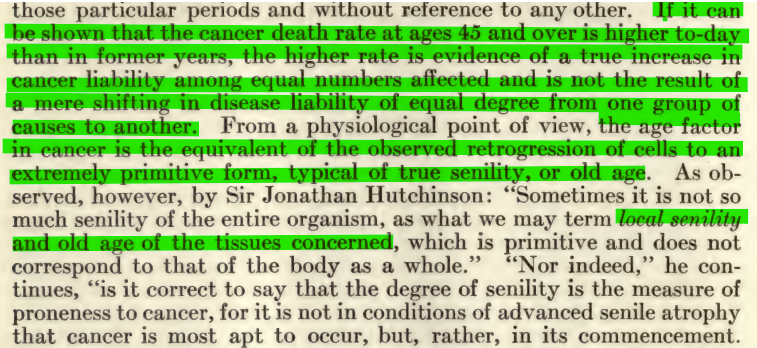
Simultaneously with a clear statement that the increase in cancer rates does not correspond to the aging population, Hoffman’s report suggests the “senility” rather than biological age being the driver of cancer. By “senility” they did not mean the old age and dementia, but specifically, the premature, ahead-its-time aging of certain cells, i.e. a curious phenomenon of “localized senility”):
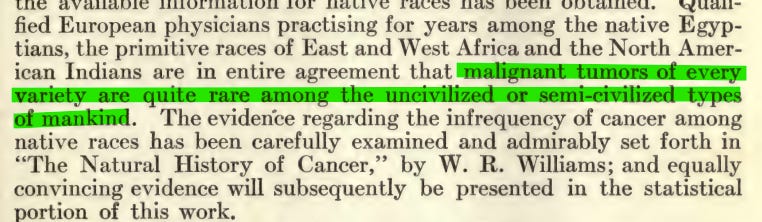
Another favorite deflection used in public health propaganda - “racial disparities and lack of access to care” - was found not to have the explanatory power, either. In fact, the opposite was true - less “civilized” races with practically nonexistent “access to care” demonstrated an almost total absence of cancer:
Furthermore:
Hoffman examined all available international health statistics and cited staggering increases in cancer observed throughout the “civilized” Western countries of the world. After discussing a lot of high quality international data, the author concludes that the increases in cancer rates are “real” and not just apparent, i.e. not due to changes in demographic factors:
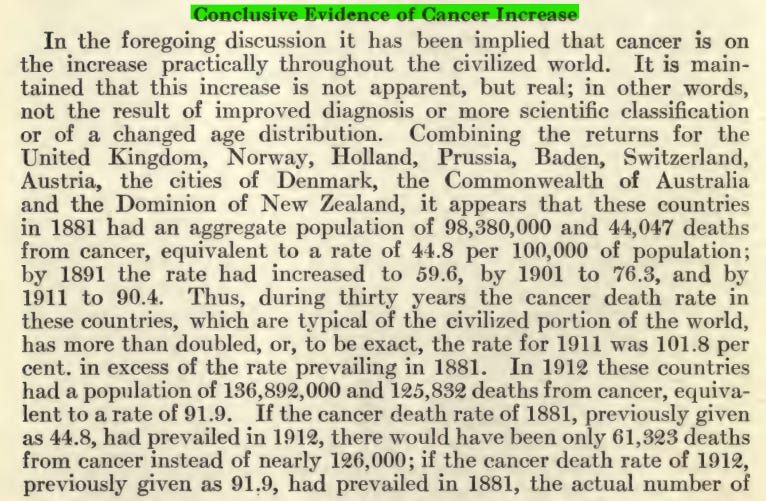
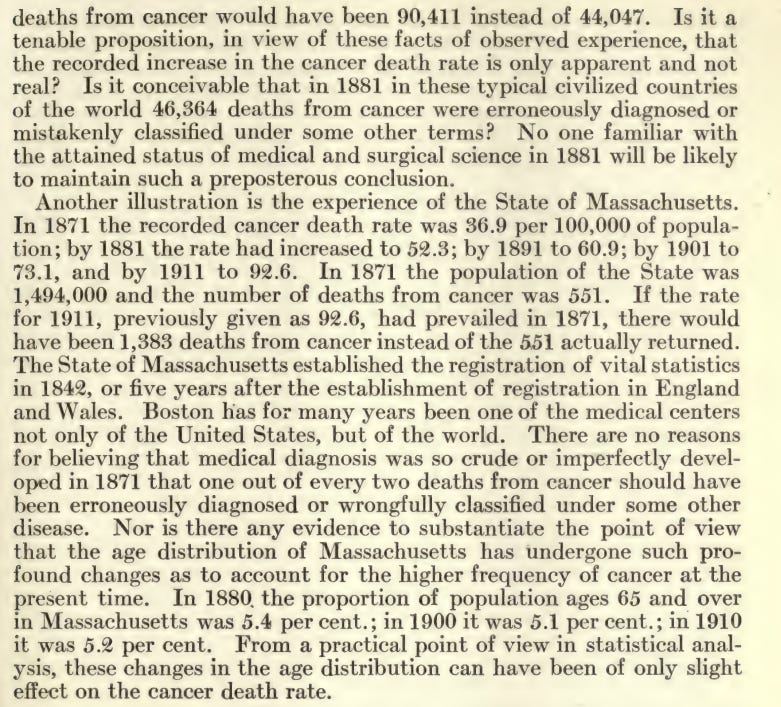
Hoffman looked at many other factors that may explain the rise of cancer, such as occupational hazards. Here, too, he found puzzling trends. While some lower class workers (chimney sweeps, pitch and tar mine workers, industrial professions exposed to fuels, chemicals, gasses and heavy metals, gardeners who used soot as pesticide, etc.) had specific risks of certain types of cancers, the incidence of those occupational cancers still paled in comparison to the rates among the white well-to-do classes who were never exposed to the same hazards. Remember, the highest rates were among white affluent women who didn’t work outside the home at all! Thus, it could not be concluded that an environmental toxic exposure would explain the constant trend of increasing rates of this disease. The environmental exposures were limited to certain areas and consistently declining during the same time:
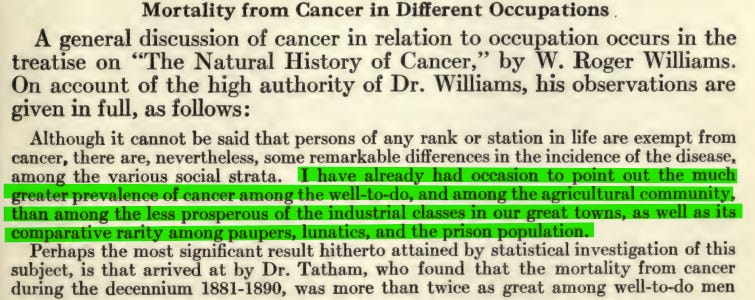
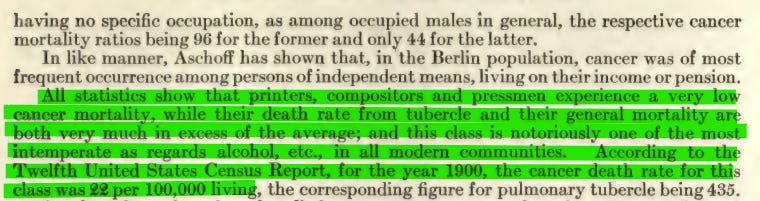
In other words, working in the dirtiest industries, with daily exposure to lead, arsenic, mercury, petroleum products, toxic gases, while smoking and drinking to excess would only put you at a 22/100K rate of cancer in early 1900s. For comparison, in 2023 U.S., 15-39 yo men (the vast majority of whom have never been exposed to the above occupational hazards) experience a 64/100K rate of cancer, i.e., somehow a 200% increase of cancer in this age/sex group has materialized over the past 100 years while the toxic exposures largely disappeared. If anyone needs a solid proof that cancer is not driven by the “toxic sludge we currently live in” (tell this to the chimney sweeps!) - look no further than the data above.
All data universally pointed to the sheer increase in the rates of cancer, and inability to adjust that increase away by any demographic, socioeconomic or other typically used actuarial factors. For the sake of brevity, I am not going to summarize all the fine points of the data discussed in the 800+ pages of the Hoffman report. After an excruciatingly thorough review of everything he could review (except vaccines!!!), the author concluded that:
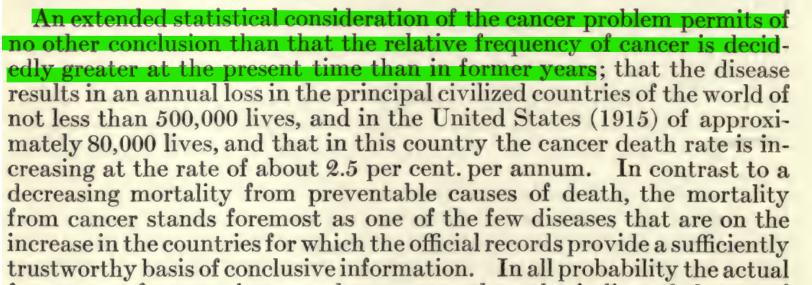
…while being exceptionally rare among the “primitive peoples”. Even more interestingly, the abolition of slavery, somehow, for a very unknown reason (!), gave the freed African American population cancer that they didn’t have before:
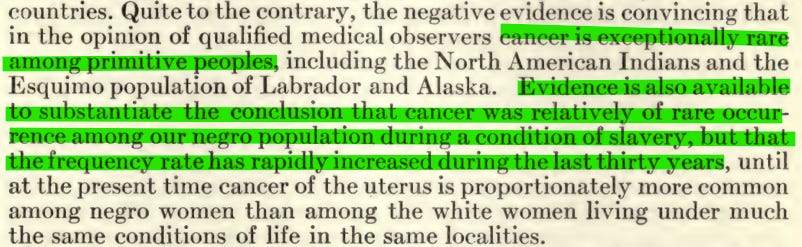
This definitively proves that it is not genetics, racial differences, or diets that are causing cancer.
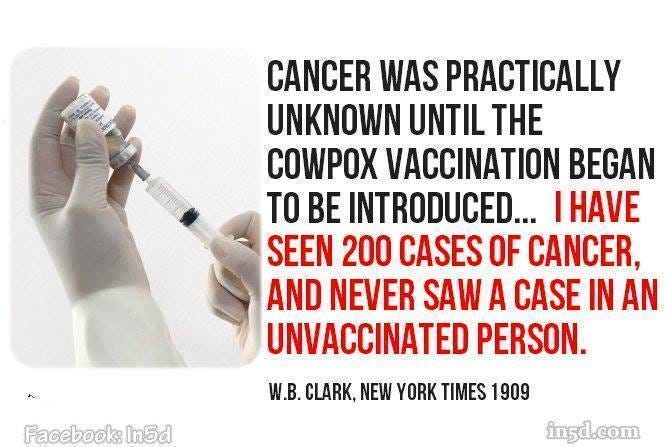
The Hoffman Report is an exhaustive, incredibly detailed and thorough statistical dataset, from many countries of the world. With all its exactness, the report does not mention the word “vaccine” even once… This is a very glaring (possibly intentional) omission, since, by late 19th century, many doctors recognized that cancer is caused by vaccines:
My guess on why the Hoffman report never looked at vaccinations as a possible cause of cancer - the insurance industry (together with the medical establishment) saw cancer as a business opportunity. If you are wondering why a life insurer like Prudential would see greater disease/death burden as an opportunity - they saw the potential to increased policy sales and increased premiums in the relatively affluent population if it could be propagandized to fear the unpredictable, baffling, “menacing” scrouge that could strike the people “out of the blue”, even in the prime of their life. Fear of the unknown sells insurance policies.
On May 9, 1913, Hoffman delivered an address before the American Gynecological Society in Norfolk, Virginia, titled “The Menace of Cancer.” The lecture brought together leading clinicians—among them Clement Cleveland, the gynecologist James Douglas, and the pathologist James Ewing—and at its close they agreed to organize the American Society for the Control of Cancer (ASCC), the body that became, in 1944, the American Cancer Society. Hoffman’s Norfolk address is considered the founding document of the American Society for the Control of Cancer.
Hoffman’s work entered an international debate. In Britain, the surgeon Charles P. Childe published The Control of a Scourge: Or, How Cancer is Curable in 1906, arguing that the apparent rise in cancer mortality reflected genuinely increasing incidence rather than merely improved diagnosis, and pressing for early surgical intervention as the principal public-health response. The American biologist Raymond Pearl, in The Biology of Death (1922) argued, against Hoffman, that age-specific cancer rates were considerably more stable than the crude rates suggested and that the apparent increase was substantially an artifact of an aging population and improved diagnosis. This line became a standard denial tactic to this day, despite undeniable evidence of skyrocketing rates of cancer having grown from <15 per 100K population in early 1800s to approximately 500/100K today, i.e. ~2000% increase in the rate!
Bibliography of Public-Health and Statistical Literature
Hoffman, Frederick L. The Mortality from Cancer Throughout the World. Newark, NJ: Prudential Press, 1915. archive.org/details/mortalityfromcan00hoffuoft.
Hoffman, Frederick L. “The Menace of Cancer.” Transactions of the American Gynecological Society 38 (1913): 397–452.
Pearl, Raymond. The Biology of Death. Philadelphia: J. B. Lippincott, 1922.
Childe, Charles P. The Control of a Scourge: Or, How Cancer is Curable. London: Methuen, 1906.
U.S. Bureau of the Census. Mortality Statistics, annual volumes, 1900–1933. Washington: Government Printing Office.
League of Nations Health Organisation. Report on Cancer Mortality. Geneva: League of Nations, 1927.
Imperial Cancer Research Fund. Scientific Reports, ed. E. F. Bashford et al. 6 vols. London: Taylor & Francis, 1904–1924. Wellcome Library: wellcomecollection.org.
Source: https://sashalatypova.substack.com/p/150-years-of-cancer-trends
Original Article: https://needtoknow.news/2026/07/sasha-latypova-and-dr-andy-kaufman-questioning-the-cause-of-cancer-what-youre-not-being-told/
Note: Comments placed in [ ] are added by Truth11.com editor. For example; [Flu]
Comments ()