
Canadians Now Being Harassed For Online Speech | A Violation Of The Canadian Charter Of Rights | Stand On The Right Side of History Police = Uphold Your Oath
Dylan Eleven | Truth11.com
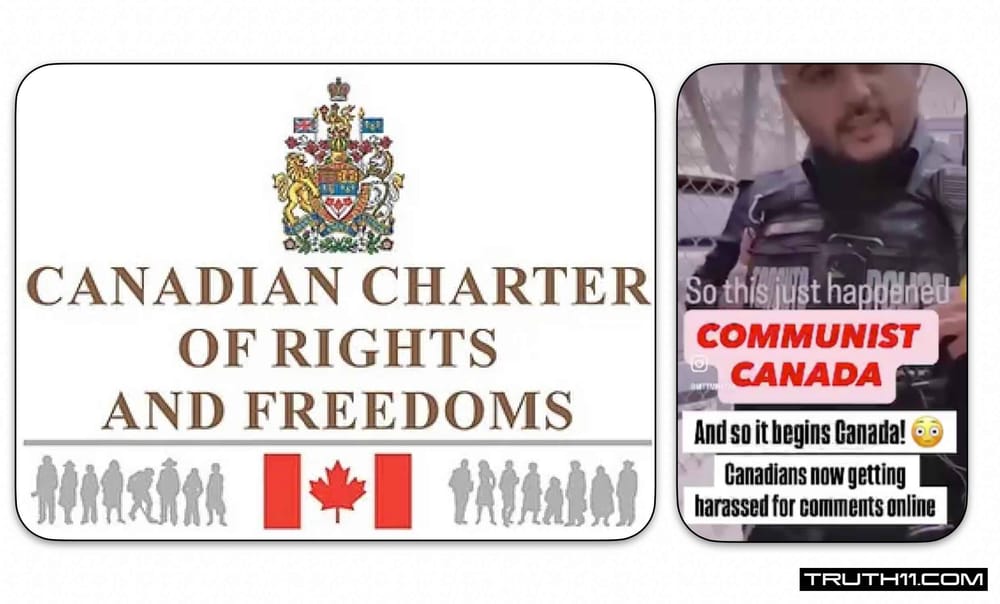
As has been happening in England now comes to Canada. Canadians are being harassed for comments online. As you can hear from the persons response in the video below; Canadians won't put up with this bullshit.
Free speech is in the Canadian charter which makes laws and bills like Bill C-9 trying to curb online speech invalid. They have exceptions with respect to hate speech. Opinions and the statement of facts are not hate or threats.
This lady is being harassed for making online quotes. For not liking the Canadian prime minister. Police stated her comments were threatening. She asks for clarification on what threats she made, and the police do not provide them, they repeat that her comments are threats. Not liking your Prime minister is a persons opinion, not hatred and it is not threatening. Yet they focus on that point to try to state they are in the right.
She repeatedly asks the police officer to show her what threats she made, and despite the police having the quotes on his phone, he does not show her and says if she continues to make threats she can be arrested and charged. Keeping the focus on the word threat. So he thinks he has a legal leg to stand on. Saying someone threatened in a comment is not the same as someone making a threatening comment.
She correctly points out the Police are threatening her with arrest if she continues to make comments about the prime minister, for her non threatening comments.
Bullying people, without proof of a specific threat is going against the oath of the police to uphold the Canadian Charter Of Rights And Freedoms.
Canadians Are Now Getting Harassed For Comments Online
Stand up Canada
A lot of Canadians resisted during the Covid scam despite the majority falling for the Covid lie. The right to free speech is a much clearer issue, no grannies to save, and there is no confusion.
The Canadian Charter Of Rights and Freedoms
The Canadian Charter of Rights and Freedoms guarantees the right to freedom of thought, belief, opinion, and expression, including freedom of the press and other media of communication, under Section 2(b). This right is a fundamental freedom protected by the Constitution, but it is not absolute.
While Section 2(b) provides broad protection—covering any act intended to convey meaning—Section 1 of the Charter allows for reasonable limits on this right if they are prescribed by law and can be demonstrably justified in a free and democratic society.
Key legal tests, such as the Oakes test, are used by courts to determine whether a limit on expression is constitutionally valid. This includes assessing whether the law serves a pressing and substantial objective, is rationally connected to that objective, minimally impairs the right, and is proportional to its benefits.
Common examples of legally justified limits include:
Hate speech (e.g., incitement to hatred against identifiable groups, under Criminal Code section 319),
Obscenity (determined by community standards and potential harm),
Defamation (civil or criminal liability for reputational harm),
National security and public order (e.g., during emergencies like the 1970 October Crisis under the War Measures Act). ~ Source: Brave AI Search
Therefore the person in the video who is being harassed for her comments that she does not like the Canadian prime minister and believe his alliances are Zionist does not violate the legally justified limits. The police are in the wrong for harassing her at her home. They threaten if she continues to speak against the Prime minister she can be arrested. This not correct.
Canadian laws that violate the Canadian Charter of Rights and Freedoms are invalid if a court determines they are inconsistent with the Charter.
Under Section 52(1) of the Constitution Act, 1982, the Constitution—including the Charter—is the supreme law of Canada. Any law that conflicts with the Charter is, to the extent of the inconsistency, of no force or effect. -Brave AI Search
Stand strong Canadians and expose this police abuse until it stops.
Police must join with the people and support their rights under the Canadian charter of rights and freedoms. You did not stand with the people during the Covid scam and the people know it. This is your second test. Remember your oath.
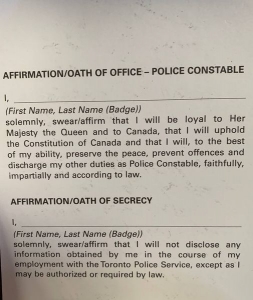
Affirmation/Oath of Office for Police Officers
PoliceGuard.ca | Police On Guard For Thee
We have been receiving many questions regarding the oath that police officers take. Inside the front cover of every officer’s memo book is a reminder of our oath. While the exact text may differ between jurisdictions and services, above all we have pledged to uphold the Constitution of Canada and that includes our Charter of Rights and Freedoms. For those officers who are silent while we are ordered to enact questionable policies, mandates, and by-laws, we hope you will #RememberYourOath and join us by adding your support. ~ Source: https://policeonguard.ca/category/general-news/
You Do Not Have To Answer Police Questions
In Canada, you have the right to remain silent and are not required to answer questions from the police, except in specific circumstances. This right is protected under Section 7 of the Canadian Charter of Rights and Freedoms, which ensures everyone has the right to life, liberty, and security of the person — including the right not to incriminate yourself.
You do not have to answer questions about your activities, whereabouts, or involvement in a crime, even if you are detained or under investigation.
Exceptions exist:
If you are driving a vehicle, you must provide your driver’s license, proof of insurance, and vehicle registration.
If you are stopped while riding a bicycle, you may be required to identify yourself.
If the police suspect you of committing a crime and are writing you a ticket, you may be required to provide your name and address.
If you are under arrest, you must provide your name, but you are not required to answer further questions.
Even if you say "I’m not talking", police can continue to question you — but they cannot use threats, lies, or coercion to obtain a statement. If they violate your rights (e.g., by lying about evidence or denying you access to a lawyer), any resulting statement may be excluded in court.
You have the right to request a lawyer at any time. Police must inform you of this right upon arrest and provide access to legal counsel — including free duty counsel if you cannot afford one.
Never make statements without a lawyer. Anything you say — even offhand comments — can be used as evidence. There is no such thing as “off the record” with police.
Bottom line: You can politely say, “I choose to remain silent” or “I would like to speak to a lawyer first.” Doing so protects your rights and prevents self-incrimination. ~ Source: Brave AI Search
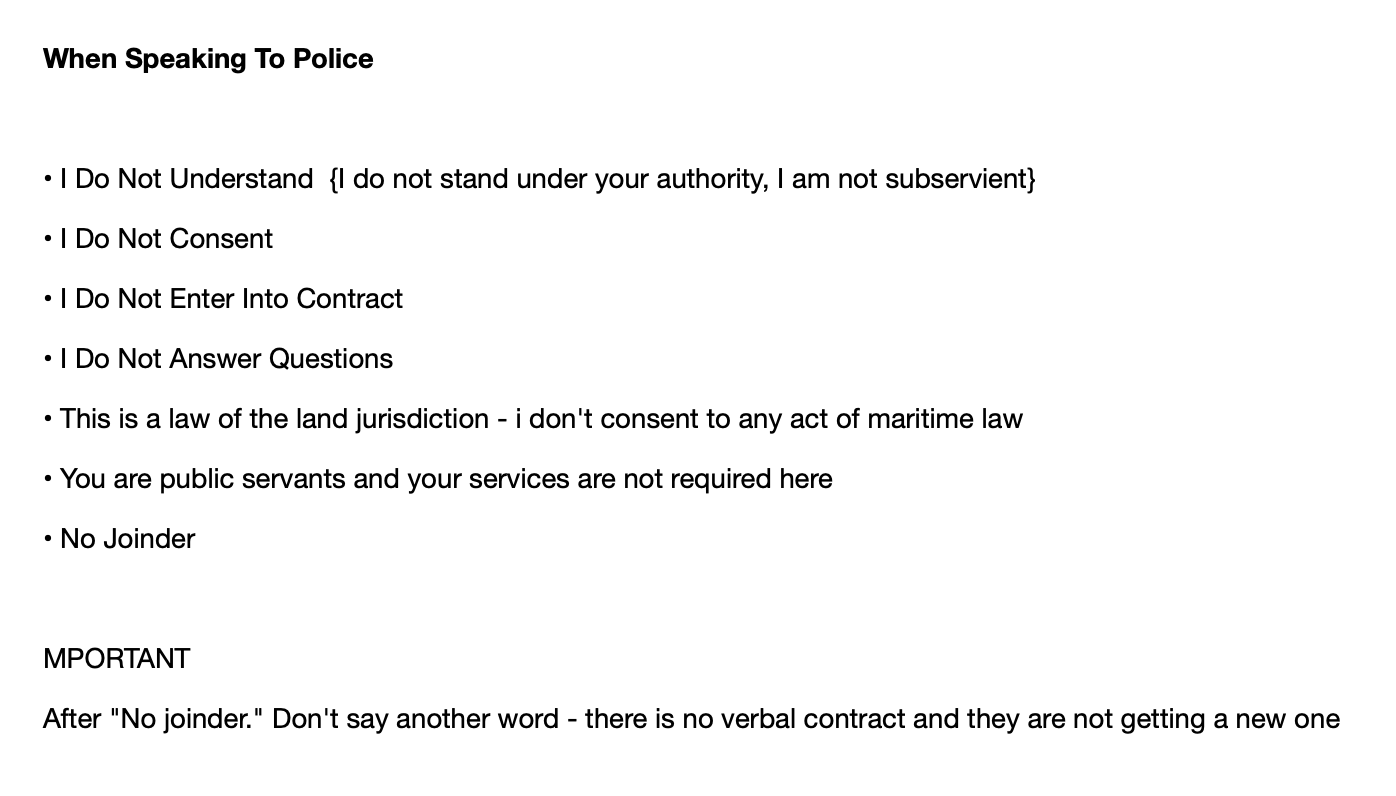
No joinder: There is no legal requirement to join or cooperate with police questioning. You can refuse to speak, and police cannot force you to do so. ~ Source: Brave AI Search
Related:
Comments ()