
FLOCK x 11 | The Flock Diversion Psyop + The Real Surveillance System
Dylan Eleven | Truth11.com
This is an eleven part in depth series looking into Flock cameras and other surveillance and data collection. Flock cameras are just a part of the big picture. In fact they seem to be a diversion psyop, the real surveillance is much more prevalent and intrusive.

Part 1 | HELP! I'm Being STALKED!
A deep dive into Flock cameras leads to unexpected places...
Agent131711 | chemtrails.substack.com
Wherever you think this series will end up, I assure you, it’s not what you think, but before we can get to the twists and turns in the story, we have to cover the basics….
I hear so many people say when referring to their personal data being collected by tech companies, or, in this case, law enforcement, “I don’t care because I have done nothing wrong.” Some add comments like, “Only criminals care if their data is collected.” Yet these same people will not take me up on my offer to plant a listening device in their bedroom or give me permission to sit outside their son’s school and video record him. Further, they refuse to provide me with access to their Google Photos album. Why is that? They’re not doing anything wrong, and I have no ill intent. I’m just a writer, and unlike Big Tech, I have no use for their data; I just want to cruise through it to see what I can learn about them for entertainment purposes; nothing malicious, nothing profitable. So I guess it is ok for strangers to read all of our communications, GPS track us, eavesdrop on our families, monitor how fast we drive, and log every purchase we make only if we don’t know who the strangers are or what they are doing with our information, but once we can point to an individual, whether that be our next-door neighbor, Uncle Jim, or an ex-lover, we call it spying, harassment, and stalking. And even if we have done nothing wrong, we still don’t want the guys from the oil change place to have access to our medical data. In fact, should they obtain it, we see this as both a data breach and a massive invasion of privacy. Strange how we think, isn’t it? Now let’s get into this Flock thing.
To begin, an overview of Flock is as follows:
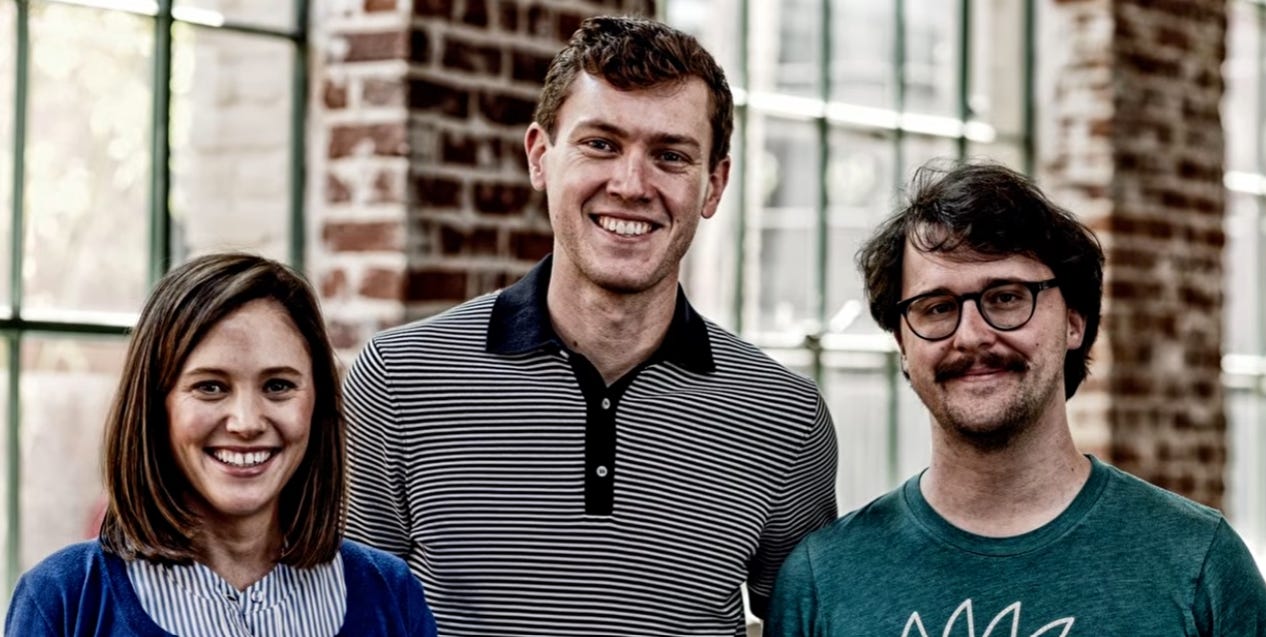
Flock Group Inc., DBA Flock Safety, was founded in 2017 allegedly by this trio of Georgia Tech nerds.
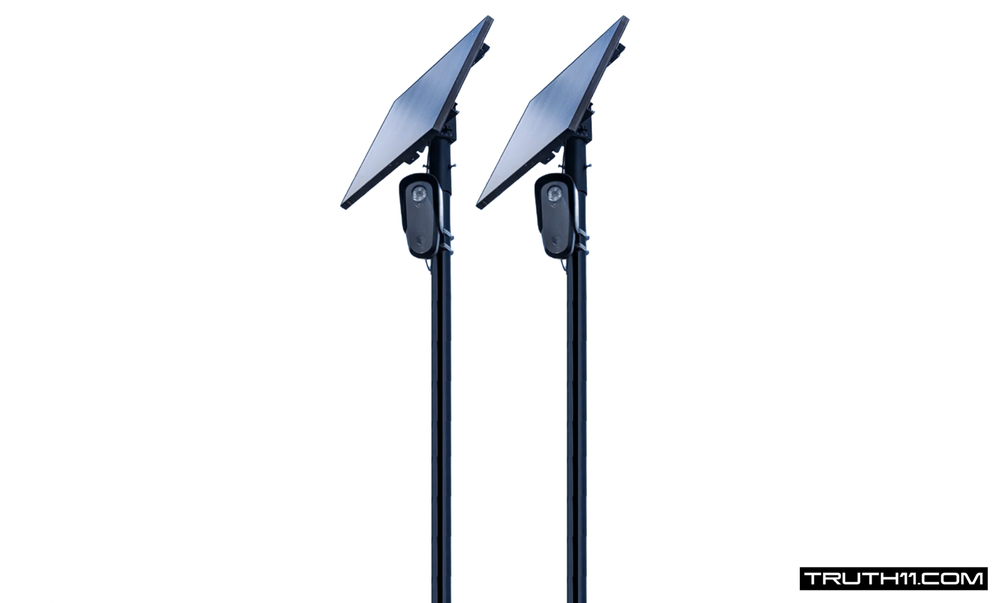
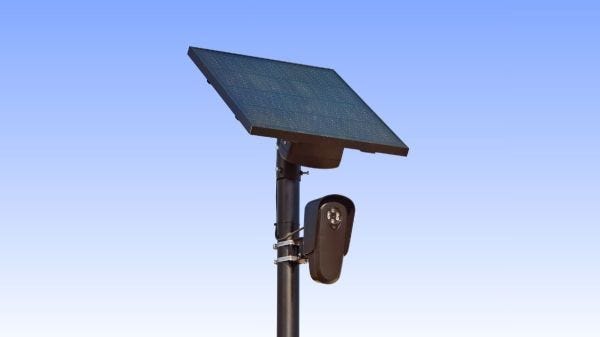
They started off by making automatic license plate readers (ALPR), which, as it turned out, read a lot more than license plates.
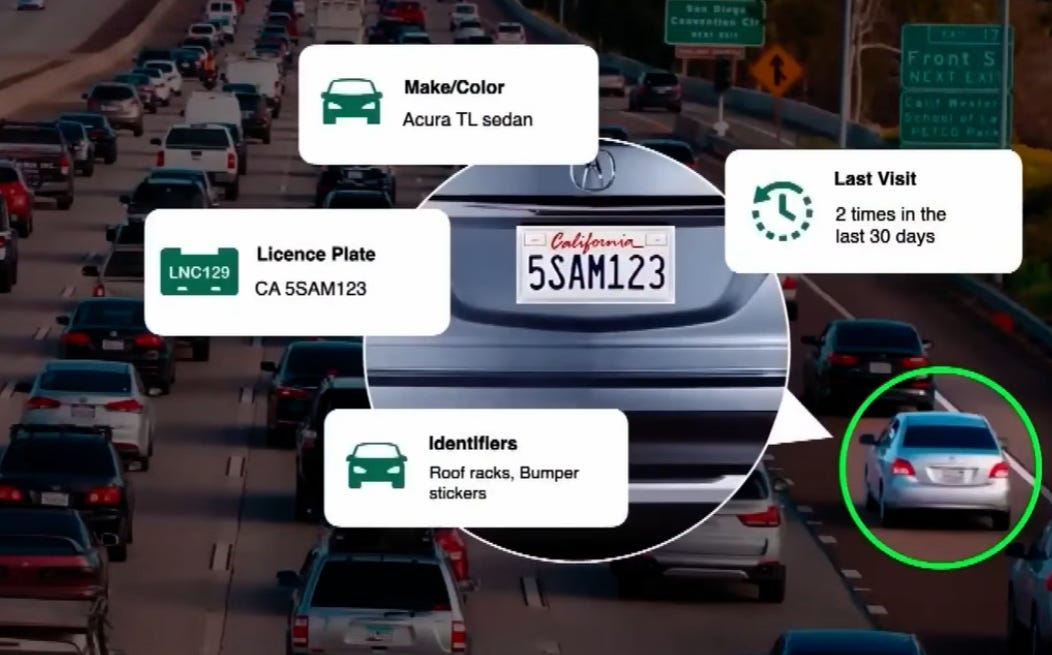
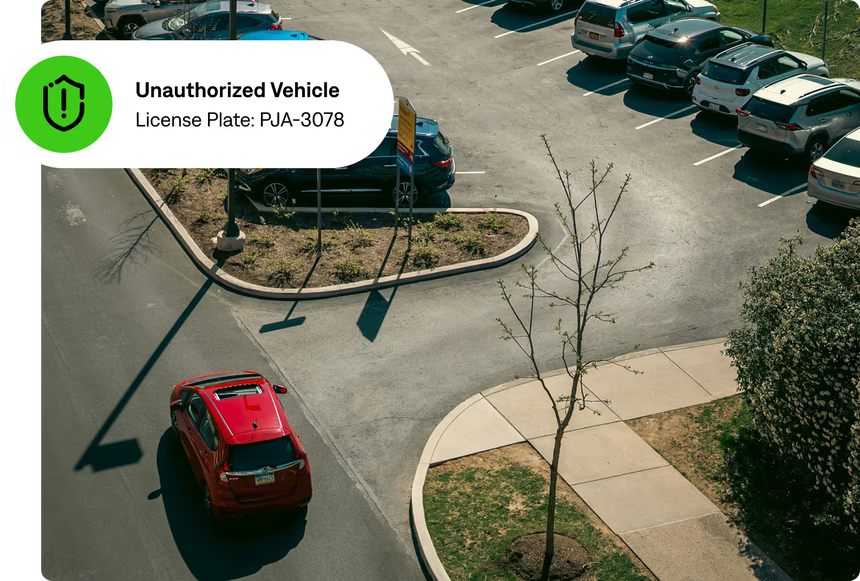
The cameras can also read and identify bumper stickers as well as damage to vehicles, which can be shared with insurance companies as well as thousands of other vehicle characteristics. All of the collected information, along with GPS coordinates, is then placed into a database where it is stored “ordinarily” for a month but can be kept “longer,” which means any amount of time.
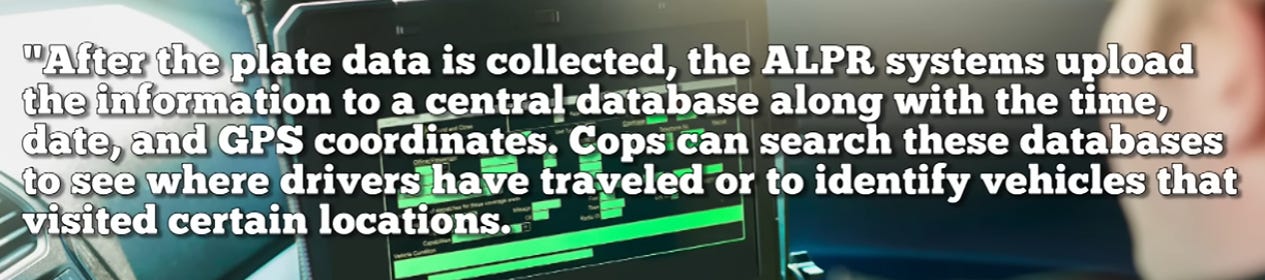
This data is then instantly searchable by law enforcement.
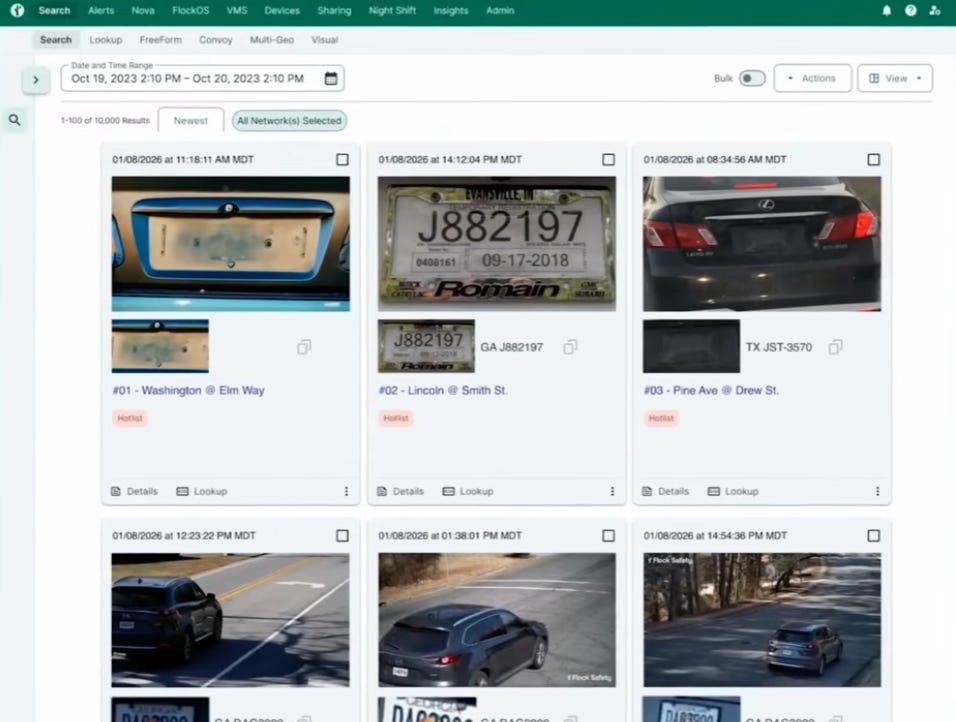
Additionally, police can add suspicious license plates to the system. So, for example, you threw an awesome “Don’t Commit Crime, The Government Doesn’t Like Competition” bumper sticker that you got from Shadowbanned Library on your F-150, and a cop sees it and deems you to be a potential conspiracy theorist.

He can now type your plate into the network so everyone can be on the lookout for the guy who might believe 9/11 was an inside job or that this piece of shit didn’t actually go to the moon.
A police officer on Reddit posted, “And here’s what bothers me about Flock: if you drive around the same city every day like most people do, those reads start adding up. Go to the same gym every morning? Same grocery store every Sunday? Same girlfriend’s apartment every weekend? Same office Monday through Friday? Over time, that history can reveal a pretty detailed pattern of your life. You weren’t being investigated. You just happened to exist in public while the government collected data on where your car was seen.”
The ACLU added:
There’s no reason the technology should be used to create comprehensive records of everybody’s comings and goings—and that is precisely what ALPR databases like Flock’s are doing. In our country, the government should not be tracking us unless it has individualized suspicion that we’re engaged in wrongdoing.
I’m not always the biggest fan of the ACLU, but they nailed it. We are supposed to have the right to privacy and peace.
Now for the people like my mother who think this really isn’t that big of a deal—after all, they’re just some standalone poles with license plate readers that are being used to catch criminals; let me tell you, it is way deeper than that. For starters, anyone can purchase one of these cameras, and they are going up everywhere. Public and private businesses and school buses are equipped with them, as are public safety vehicles, garbage trucks, and now package delivery trucks.
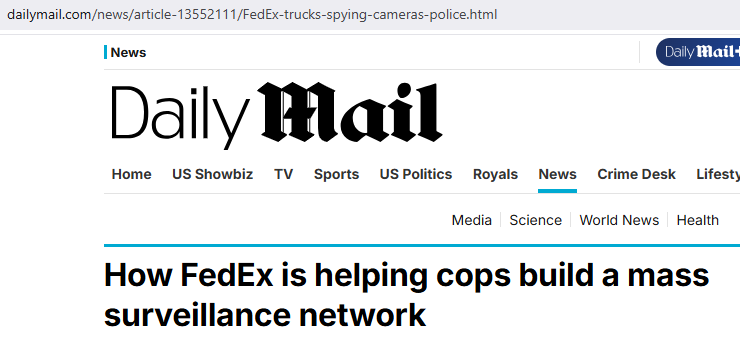
This means not only is your route to and from your job being surveilled and uploaded to the cloud (including each GPS coordinate as well as a photo of the ding in your back bumper), but now all day, every day, vehicles equipped with ALPRs are crawling every street in America, tagging every license plate in every private driveway, and storing that data.
Think about it more: At 7am, the school bus scans you, your wife, and your daughter’s cars on your property. Your daughter then leaves for college, so when the garbage truck comes by at 8am, the two remaining vehicles get scanned a second time. FedEx deliveries begin at 9, and it’s your day off, so your wife has left, but your vehicle is scanned. When lunch rolls around, you decide to order Uber Eats, and that driver is scanned from the burger shop to your front door. Folks, you’ve only been awake for five hours, and strangers, including your government, know exactly how you spent your morning, that you eat meat, and that you don’t mind ordering fast food through delivery services. This information was gleaned from a single morning. Imagine the abundance of data that can be gathered with 24/7 surveillance for a month, or a year, or a decade, let alone a lifetime—and this is all from watching your residence.
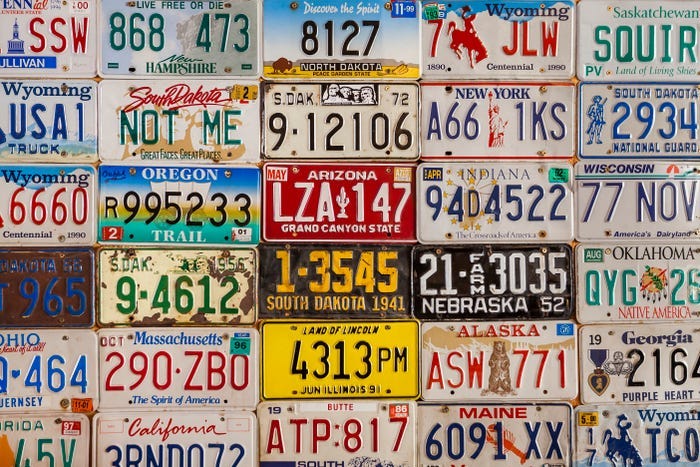
Representative Scott Perry of Pennsylvania added, “Flock cameras now log approximately 20 BILLION vehicle scans every month. That’s not targeted policing of bad guys. That’s mass collection and surveillance - not safety.” To put this into perspective for you, there are roughly 270 million adults in America. Assuming every single adult owns a vehicle, that means every single American is having their vehicle scanned by Flock over 74 times per month. Did you ask to be scanned at least twice per day? I sure didn’t.
But if you think it’s just license plates and scanning is harmless if you’re not doing anything wrong, check out what this individual from Corona, California, said in a Substack post,
“I want to be clear what these cameras actually are, and I say that as somebody with 20 years of experience in IT. I’ve served as the chief network architect for Fortune 500 companies, I’ve designed data centers, and today I work on cloud infrastructure for one of the largest loan origination companies in the country. I’m not speculating on how this technology works. I’ve read their patents and I know how it works.
Flock advertises these cameras as simple license plate readers. But their own patents tell a different story. They’re AI-powered surveillance machines that capture every passing vehicle and person and transmit that data to a private corporate cloud, making it queryable by a multitude of state and federal agencies. The city of Corona does not control that database, and Corona residents have no public record rights against a private company’s servers.”
It continued on, “Our daily movements are being harvested by a $7.5 billion corporation, that only answers to venture capital investors, not to us. Flock did not reach that valuation on their per-camera subscription fees. That math doesn’t add up.
The city council should also understand who they’re doing business with. Flock CEO was asked whether the company had any federal contracts. He said no. That was a lie. Public records revealed that Flock had been secretly running a pilot program giving the US Border Patrol access to local police camera data without the knowledge of the cities that paid for the cameras.
Now consider who’s behind the company and where your data flows. Flock integrates directly with Palantir, a data fusion platform, with a $30 million contract with ICE. Peter Thiel, the founder of Palantir, is also one of Flock’s primary investors. These are not separate companies with separate agendas. They are connected actors that are building a connected infrastructure. Palantir’s own CEO stated publicly just this month that his technology is being used as a political instrument, designed to reduce the political power of certain voters. And that’s the ecosystem that our Corona cameras are feeding into…”
The Substack post went on to say that the author looked into the Flock patents more and outlined “Patents describe broader object detection, including tracking people and pedestrians, patents like US11416545B1. The system uses a centralized cloud database for nationwide queries. Data goes to Flock’s private cloud, AWS-based, encrypted. Nationwide lookup is common, 75%+ of customers are enrolled enabling cross-jurisdictional searches. Residents have no direct public records access to the corporate servers. This creates a mass surveillance network feeding a private company’s infrastructure.”
I’d like to point out the importance of Flock being a private company. I have addressed this repetitively in my articles. Because it is private, there is no way to FOIA information. This means what is being done with the information Flock gathers is a total blackout. The best we can do is FOIA what local police are doing with it when they have access to use it and hope to get a response. More interestingly, when a Texas woman had her vehicle broken into and $4,000 worth of items stolen, including a handgun, she asked if San Antonio police could use all the local Flock cameras throughout the neighborhood to track the burglars. They said they do not have access to them and cannot use them. If that is the case, people in San Antonio are being watched and logged by people other than the police.
So this is the point in my article where those who are in the “I don’t care, I’m not doing anything wrong” camp now justify it by saying, “Flock stops criminals, so in this case it’s a good thing.” - And this is precisely what the agenda wants you to think because the only way they can pull this shit off is through “greater good” reasoning. Once “the greater good” is removed from the equation, nobody wants mass surveillance, right? So, to play to “the greater good” people—real people who really do think us all surrendering every last ounce of privacy will stop all crime and we will all be safe—a mass psychological operation must be run on the populace. This psyop involves the mockingbird media broadcasting half-truths. Here’s how this works:
It starts with a black psyop in which the folks in on the scheme themselves put into the media (which they are partners with) that Flock cameras are reading text messages and photos. They claim they are making copies of your phone contents. Content creators on TikTok, Instagram, and Twitter rush to share the information, so it becomes a popular topic; however, it is false. The media rush to debunk the rumor, which they themselves created. Through the debunking, they can accomplish several things.
First, they ease the public’s fears; no, Flock does not copy your phone. It doesn’t even read your texts. Phew!
Second, the media can then shift focus back to the license plate reading and stopping crime.
Third, they automatically diffuse future rumors. By debunking the current rumor, all of the people who were worried about their phones being copied now have been assured no such thing is happening; it’s tinfoil hat nonsense. So when people start screaming that the cameras are doing something else—something they really are doing—people automatically assume this is also false.
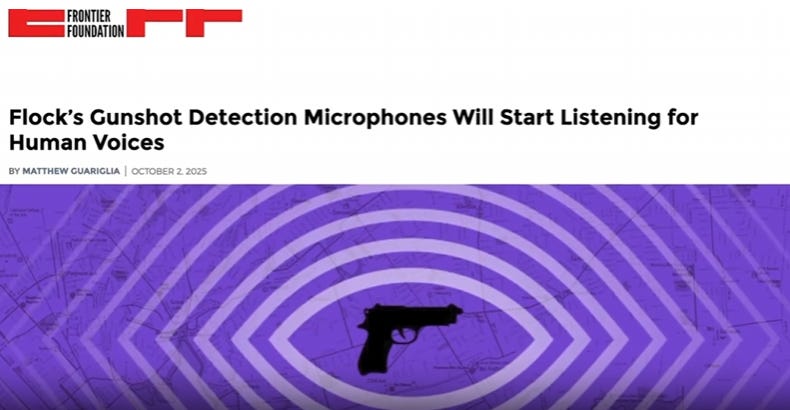
That said, what the media isn’t telling you is that the purpose of the black psyop was to use half-truths to manipulate public perception. Reality is, although the Flock license plate reading cameras are not reading your phone, there are Flock cameras everywhere that now have microphones to record audio. Flock claims the special audio is designed to record gunshots and screaming, but this is not the case.
Meet Isaac, a student who discovered his college was surrounded by Flock microphone cameras.
Transcript: “I’m Isaac; I’m just a student, and my school picked up, I think, 48 of these [Flock cameras] over the course of the last two years. I noticed on campus there were a bunch of these little devices with a Flock logo.

It turned out that they were microphones.
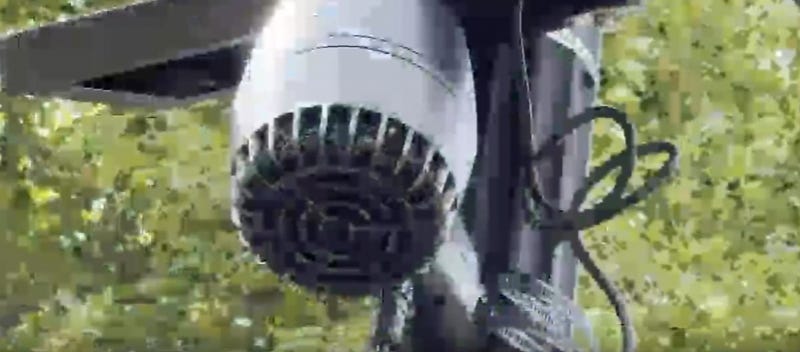
I looked into them, and I found a press release from Flock where they explicitly stated that they were only gunshot detectors and they would delete anything outside of a gunshot. I think about two months after I started looking into it, they sent a software update over the air, so now all of these microphones that are spread all over my college campus, they are just actively listening for voices now, which is very uncomfortable, and I’m not particularly happy about that.”
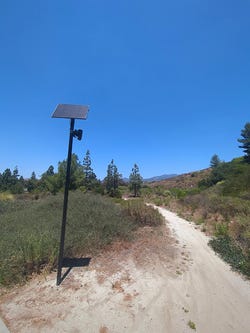
How creepy is that? If what you have heard so far isn’t bad enough, here is a Flock camera on an isolated hiking trail. Clearly the path isn’t large enough for a vehicle.

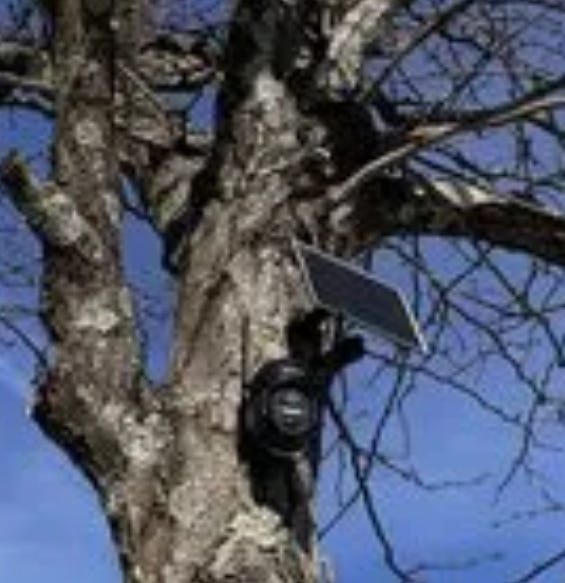
This person found one affixed to a tree.
This one is in a park, pointed directly at the slide.
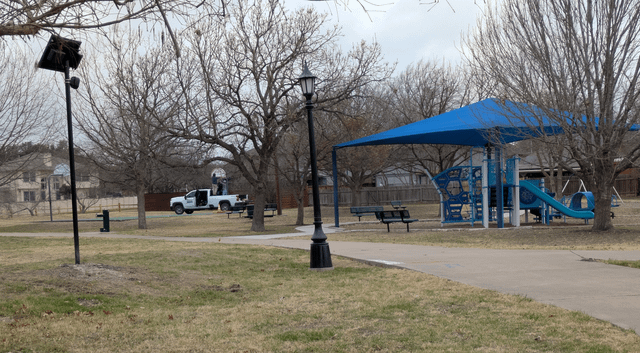
As you could have guessed, this is because they are not reading license plates; they are reading us.
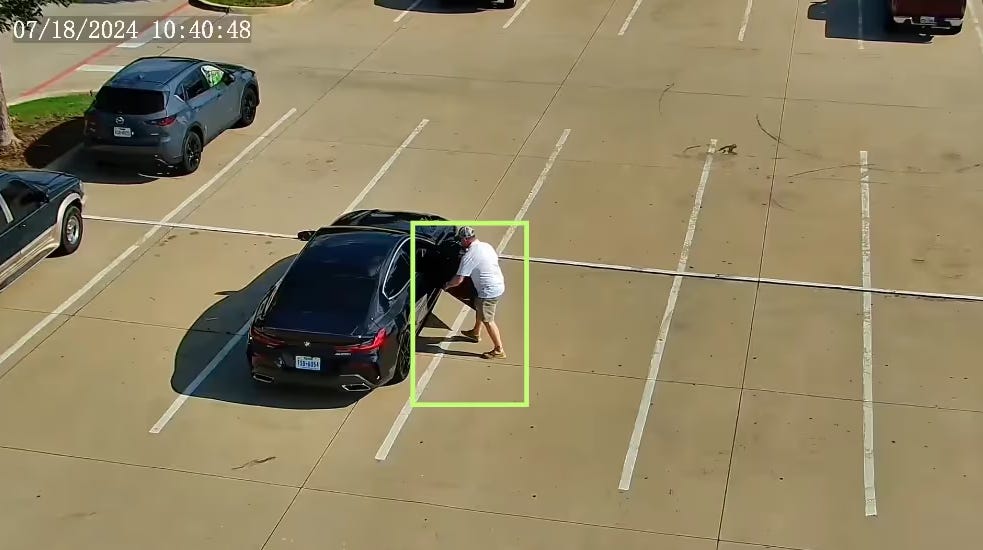
And here’s where the story gets even more disturbing. Remember how, at the very beginning of this publication, I asked why people who claim they don’t mind being surveilled because they are doing nothing wrong wouldn’t let me video their son at his school? Well, this situation has happened. Corporate Flock employees were caught watching live feeds of children at the Marcus Jewish Community Center. Although Flock now denies it, public records requests by resident Jason Hunyar proved that Flock employees viewed cameras labeled “Gym Mendel – 1” and “Main Pool Right.” Later, Vice President Bob Carter accessed the “Gymnastics” camera. But this didn’t happen only a couple of times. Hunyar claims Flock also remotely viewed his son’s daycare, and, in total, private cameras were accessed by Flock over 1,000 times—and this was what one dude from Georgia discovered. This is nowhere near the extent of what is going on. But it’s worse than that.
Back in 2025, Flock was in the process of developing a new product called Nova, which they referred to as a “public safety data platform” (Greater good! wink, wink). The purpose of Nova was to supplement all data collected during license plate scans with additional information. “What exactly is that additional info?” you ask. It turns out it’s everything—and I do mean everything. To be more specific about the types of information Nova compiles, think about your public internet searches, voting records, marriage records, home ownership details, current and past addresses, email addresses and phone numbers, roommates, children, relatives, social media accounts, and even your Strava bike rides. Basically, any data that is anywhere on the internet is instantly compiled into a nice big packet for whoever is running the query to thumb through, all without a warrant because Flock is a private company, and Flock does not need a warrant to compile your life’s story. Oh, and let me mention the supplemental data also included everything Nova could obtain from hacked websites and the dark web. So this would include your credit card information, passwords, social security number, health data, biometric and genetic data, financial records, and more. Nova was already in use by law enforcement in 2023 as part of an early access program. (*Flock claims they have ceased using hacked information, but since the company is private, there is no way to confirm this.) This means that when a police officer pulls you over because your white Honda Civic allegedly matches a vehicle used in a crime, before the officer even gets to your door, he knows you voted for Trump, you enjoy working out, you lease a small house, you are twice divorced, and you habitually search for gun videos on the internet because you are a massive advocate of the 2nd Amendment. Now the police officer can subconsciously form biases against you, not because your vehicle matches one allegedly used in a crime, but because his aunt was killed due to gun violence and he hates Trump. Do you see the problem here? And if you don’t, the city of Norfolk, Virginia, was concerned for the same. They pointed out that these cameras can be used “to create a suspect where one does not exist.” For example, a police officer casually flipping through camera footage suddenly realizes that you walk down a back alley every afternoon. Now the officer wonders why. He ponders if you could be getting narcotics. After all, police are aware that there is a dealer who has an apartment on that alley, and it’s not the best part of town, so there appears to be no legitimate reason for you to be frequenting the alley unless you are engaged in illegal activity.
Before you know it, you are being investigated for simply walking in a public place. Now that an investigation is open, police can begin subpoenaing your life. All of this is because of constant surveillance warrantless cameras. Little did the police know, there is an attractive woman that also lives in that alley. Every day at 3pm she leaves for work, so if you make it just in time, you can strike up a conversation with her in hopes of scoring a date.
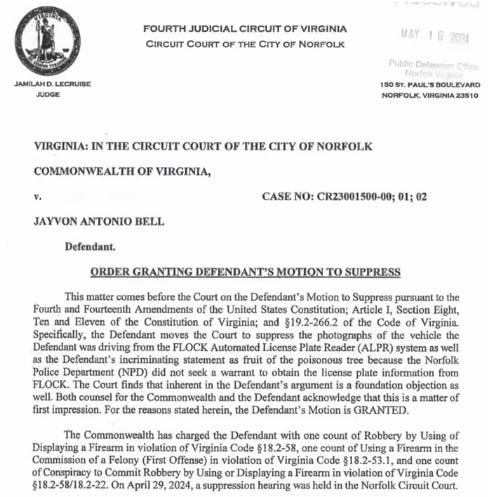
Flock’s defining feature is its nationwide network in which cities, without the permission of their citizens, opt in to share the information their systems gather with all other users of the technology. This means because the camera at the Taco Bell by your house picked you up on it, police in New Mexico can now learn your identity and watch footage of you. Being that you have never been to New Mexico, there is no reason why your identity should have ever come across their radar. But all of this is really only the beginning of the story—just a little insight into what many in the public already know.
Original Article: https://chemtrails.substack.com/p/help-im-being-stalked
Part 2 | Flock’s Secret Warehouse & The Front Company
There are some really bizarre things going on here, and I think I found the real reason why... the reason everyone missed...
Agent131711 | chemtrails.substack.com
In Part 1 of this series, we reviewed the basics of Flock cameras, which, as it turns out, are doing a heck of a lot more than scanning license plates. But that was just the introduction to the story…
This surveillance entity has their stupid cameras everywhere in America, yet they are hiding their office(s), warehouse(s), and who knows what else.
[The rest of part 2 is behind a paywall. It is the only part in the series that is. The rest are all published below. To access the paywall to read part 2 please visit Agent131711's site here: https://chemtrails.substack.com/p/flocks-secret-warehouse-and-the-front] Or continue below to part 3 and all other parts.]
Original Article: https://chemtrails.substack.com/p/flocks-secret-warehouse-and-the-front
Part 3 | Epstein, Ring Doorbells & Axon: Israel Controls America’s National Security
Agent131711 | chemtrails.substack.com
This series began by looking into these Flock cameras, which are installed all over our nation without our permission, let alone knowledge (finding out a camera was installed because we drive past it and there it is does not count as knowing the camera would be installed.) This led to a very strange discovery: Flock’s secret warehouse and front companies. And this is quite odd because this surveillance entity has their stupid cameras everywhere in America, yet they are hiding their office(s), warehouse(s), and who knows what else. Something didn’t smell right. Now here we are, continuing on with the investigation.
Although this publication was supposed to be about Flock, we have to talk about, of all people, Jeffrey Epstein. It is unbelievable how many times I have written about this guy because his name keeps popping up. That said, let’s get into it...
One of Epstein’s many ventures was a geolocation software company called Carbyne, which he founded with a former Israeli prime minister, Ehud Barak. The company’s executive team consisted only of former members of different branches of Israeli intelligence. While accused pedophile artist Jeff Koons and his pals control our nation’s Amber Alert system and are the owners of the private Center for Missing and Exploited Children, Epstein’s Carbyne controls the 9-1-1 emergency system in the United States.
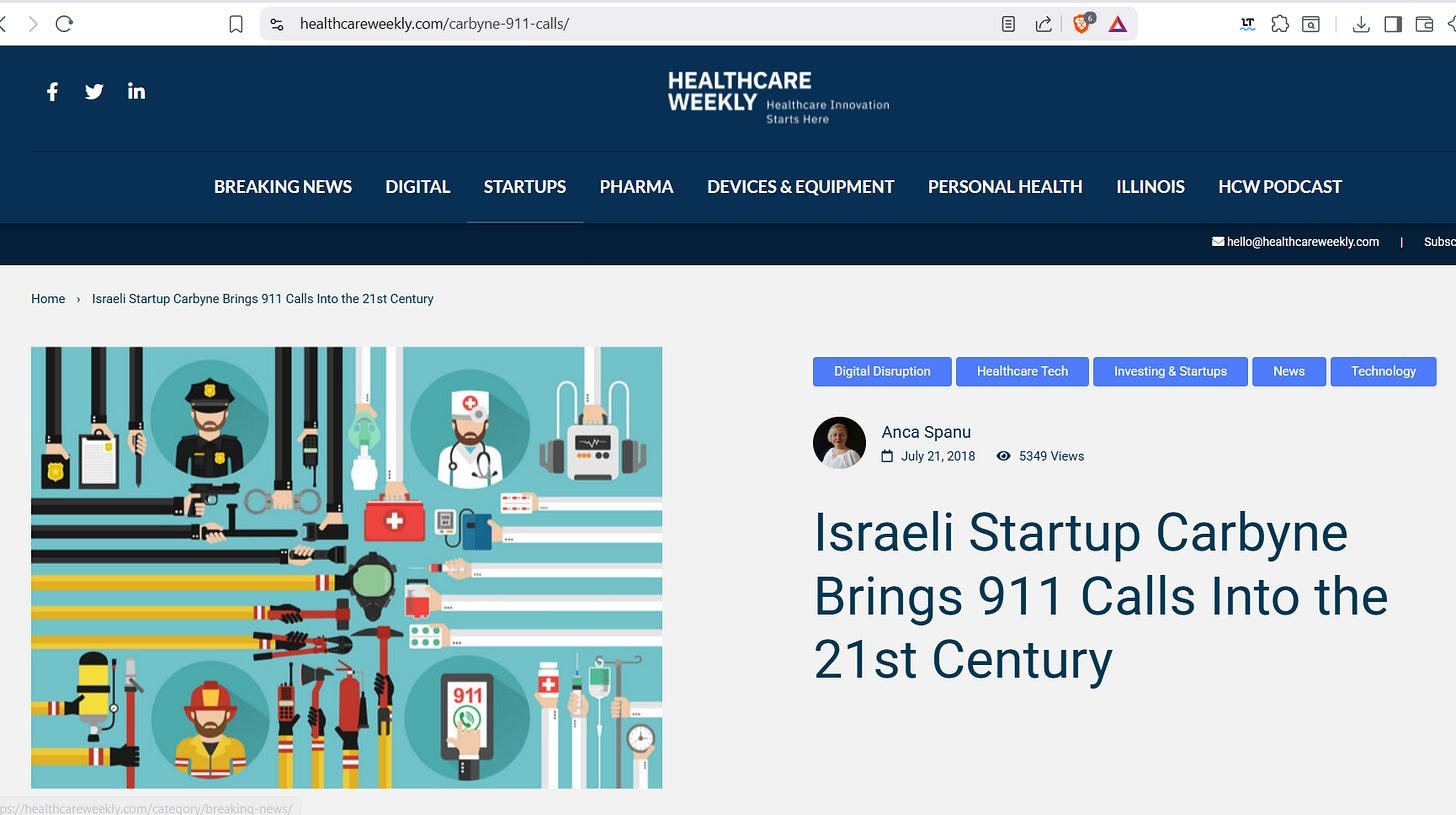
In case that didn’t sink in, let me repeat it: Jewish blackmailer and child trafficker Jeffrey Epstein founded a company with an ex-Mossad agent and an Israeli prime minister. They control our emergency call system through their company called Carbyne; meanwhile, an accused pedophile artist, Koons, is part of the entity that controls our Amber Alert system.
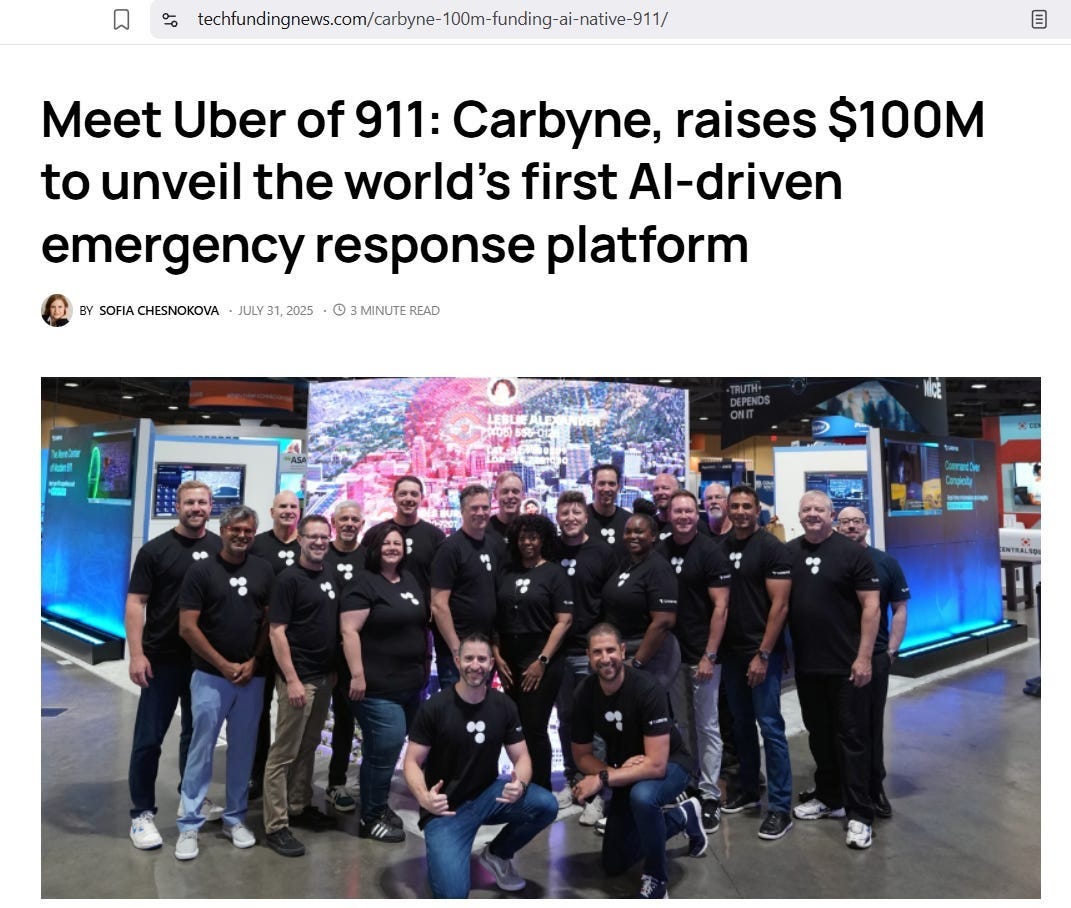
Carbyne’s platform, which is now the emergency response system in no less than 23 US states, integrates real-time video and texting and uses the location features on our smartphones. The Carbyne platform allegedly can pinpoint the location of a user within a radius of only 1 foot, and it appears they can turn on your cell phone’s camera. Yeah, they can turn on your cell phone’s camera.
As of 2025, a secondary system called “Prepared” was live in over one thousand centers across 49 states, and you can bet your bottom dollar that in a matter of years it will be factory installed onto all of our devices as one of these applications that doesn’t allow us to remove it. As of the time I released Pizzagate, they had already partnered with AT&T.
And AT&T is not Carbyne’s only partner. As you can see from the image below, they have a great many partners.
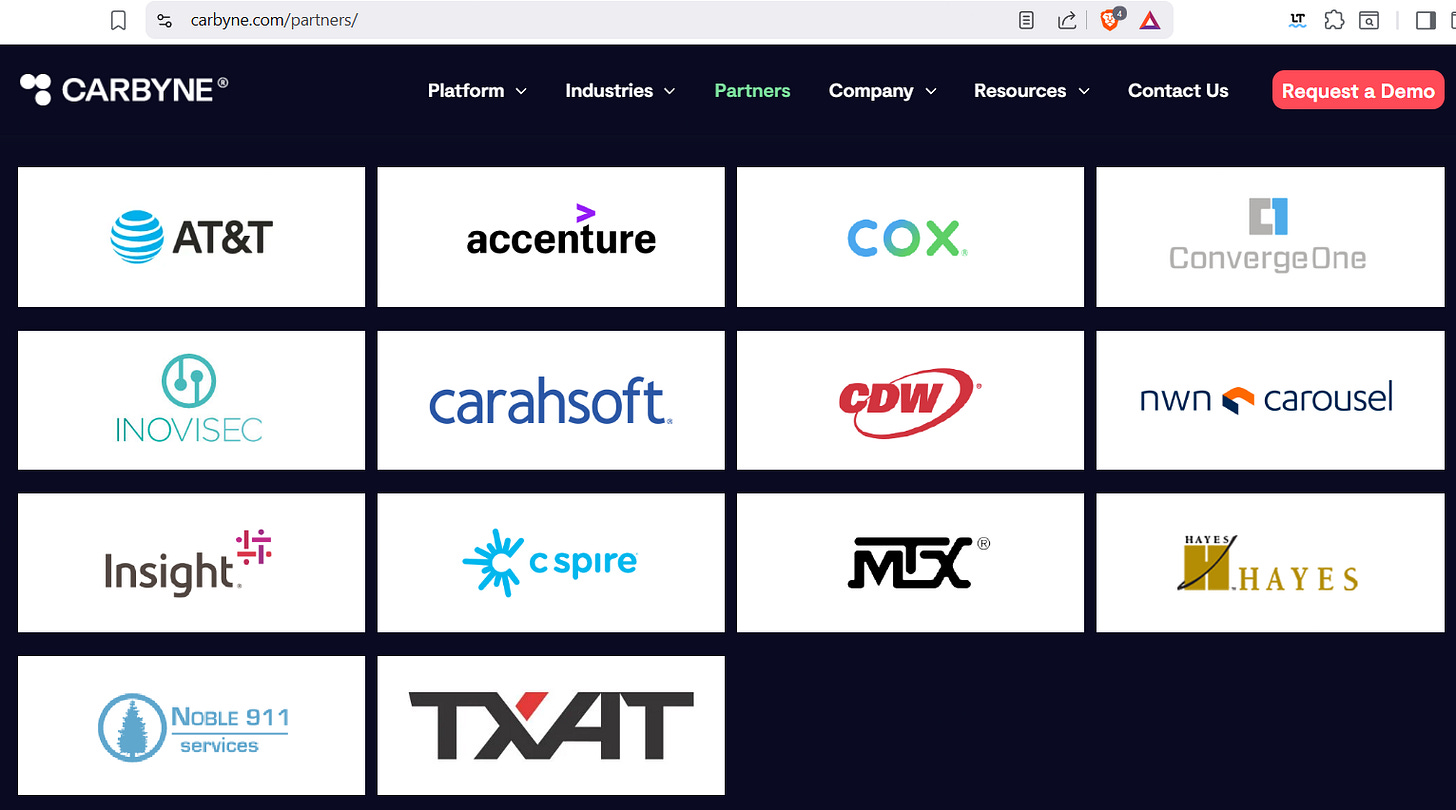
Carbyne is additionally partnered with Amazon Web Services, Google, Bosch, and more.
Suddenly, in November 2025, Carbyne unexpectedly sold the emergency platform to a company called Axon. Fun fact: an axon is a long projection on a neuron that conducts signals to other neurons, but in this instance, we are not talking about neurons. The company, Axon, started life in 1993 under the name Air Taser, and it jumped right into bed with NASA. The name was changed to Axon in 2017 (the same year the three college nerds founded Flock).
As soon as Axon came to be, it gave away a ton of body cams to cops. And, within a short time, it had secured business relationships with 17,000 out of 18,000 total law enforcement agencies in the US and controls 70 to 80 percent of the police body cam market. If that’s not a monopoly, I don’t know what is. And to ensure it is a monopoly, Axon bought out their biggest competitor, and our Federal Trade Commission, which is supposed to stop monopolies, along with our Supreme Court, both said, “okie dokie,” and then ordered a sandwich for lunch.
As you could have guessed, after the acquisition, the price of Axon’s body cams nearly doubled. Why? For no other reason than because they can.
Axon currently has over 15 billion dollars in future contract bookings. “How is such a thing possible?” you ponder. Answer: Because Axon, although still selling equipment, changed their business to a subscription model, so instead of just buying some body cameras, the customer now gets to purchase all of the additional services that come with a monthly bill, and, for reasons I cannot fathom, our governments have chosen to use our tax dollars to prepay for these subscriptions. More on this in a moment.
Axon not only provides our law enforcement with body-worn cameras, dashcams, and computer-aided dispatch software, but they also offer Evidence.com. What is Evidence.com? It’s a cloud-based digital evidence platform that allows law enforcement agencies to manage, review, and share digital evidence, especially video evidence captured with Axon-branded cameras. They offer this evidence platform free of charge for prosecutors (Gee, I wonder why? It couldn’t possibly be because it gives them access to all of the evidence of all crimes in America now, would it? No! Don’t be ridiculous!) Evidence.com has a special application just for citizens to upload their evidence to share with the government. This means if there is an incident, all of the witnesses can conveniently upload every trace of evidence they have. Now you might be thinking that this is nothing more than a quick and easy way for files to be transferred from a police officer to his superior or from a lawyer to a judge, but let me tell you this:
In 2017, a California criminal defense lawyer noted that the Evidence.com terms of service give the company a “non-exclusive, transferable, irrevocable, royalty-free, sub-licensable, worldwide license” to use photos and videos uploaded by its users, including juveniles. If the site is secure and they are unable to see the content, how might they be accessing it to transfer and sell it? Crime evidence, whether it is a child who reported his father for molesting him (such as in the case of accused pedophile artist Jeff Koons), or a woman who was caught embezzling, it certainly seems like fantastic material that could be used to bribe, threaten, or outright extort people. Imagine the opportunity a blackmailer would have if he obtained video evidence of a politician smacking around his wife. Try and wrap your mind around what is going on here.
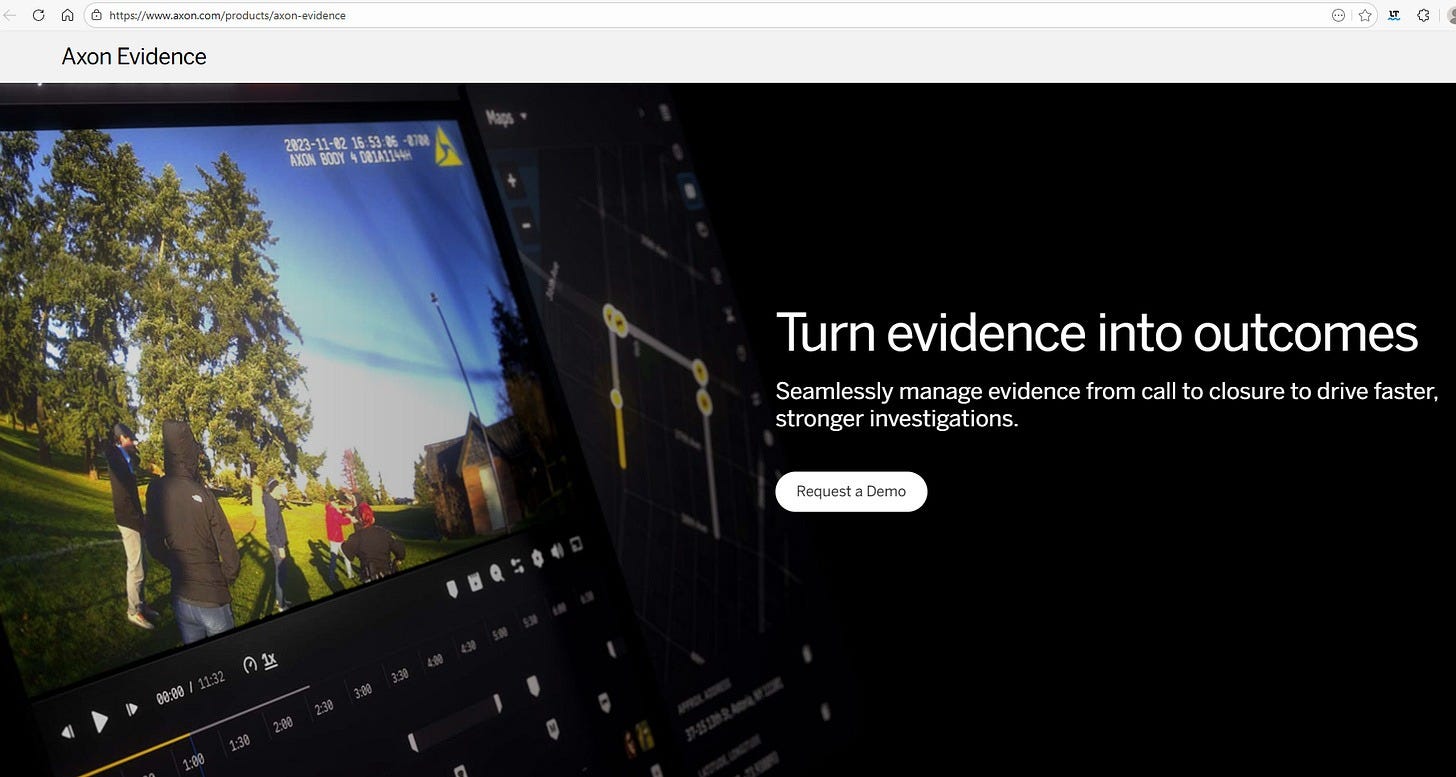
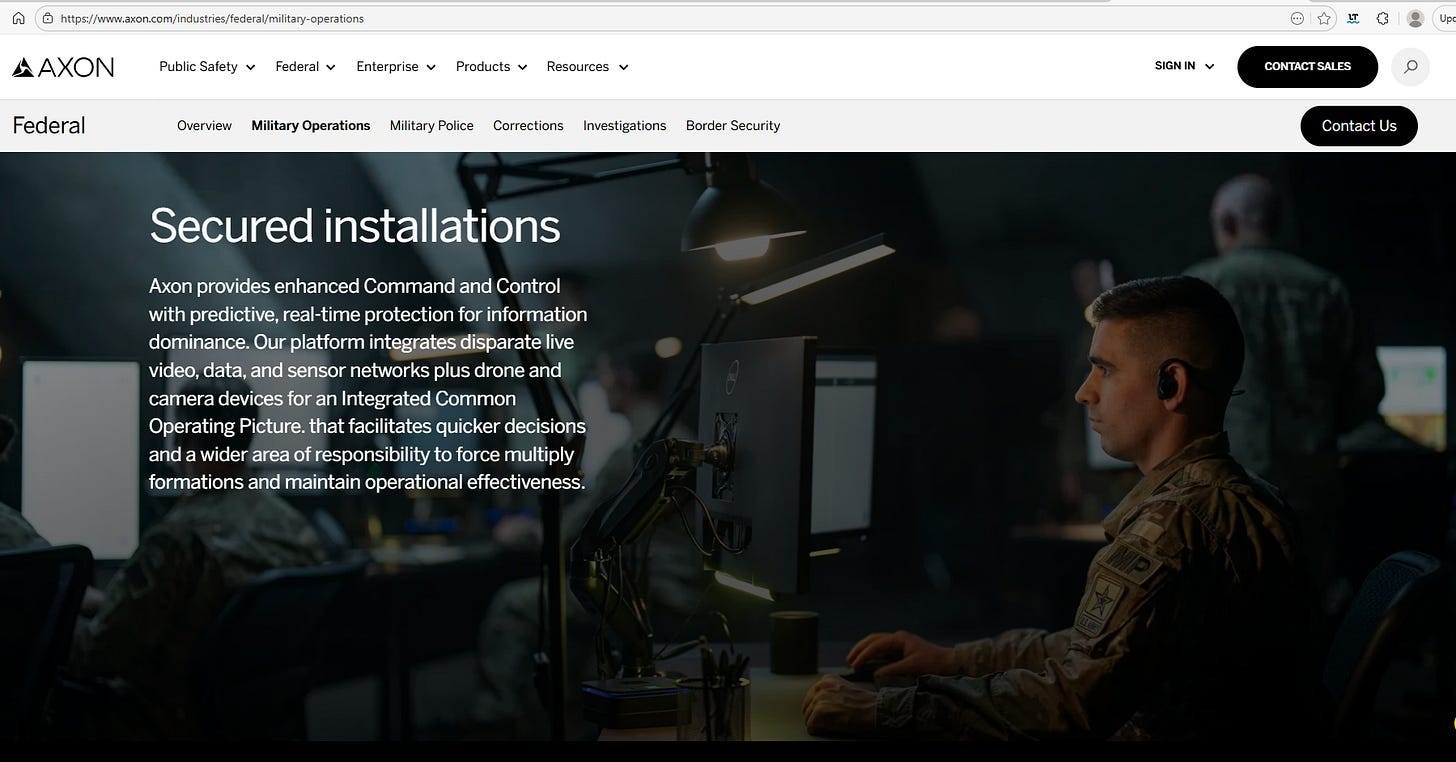
Axon isn’t just a technology developer; they are a military weapons developer. [Israel’s] Axon platform hosts our troops’ live data and sensor networks, plus live video, including drone and camera device footage. All of this valuable data is merged into one easy-to-view screen so that anyone with access can monitor everything our military is doing, whether it be during training or war.
And consider this: once a police department begins using Evidence.com as their primary cloud, it is incredibly difficult to ever cancel the subscription because that is where all of the files they need are located. Yes, they can all be downloaded and re-uploaded elsewhere, but when you are talking about a hundred terabytes of files, this is no simple task. This is why our governments are prepaying, and many have also determined that no Axon competitor should bother because moving the data to a competitor is too large of a job.
The next question is, just how much does it cost our towns and states to access their own evidence that is stored in the Axon cloud? Well, in the case of Everett, Washington, a city with a population of 113,567 people, a five-year Axon deal cost taxpayers around $80,000 in hardware and $780,000 in subscription costs.
And it doesn’t end there. Axon has a partnership with Ring, the video doorbell company. This means your doorbell is a part of the Axon web. And even if you don’t have a Ring, your neighbor does. Did I tell you that Axon’s legal counsel is Meitar Liquornik Geva Leshem Tal, the largest law firm in Israel? With that in mind, I think it’s pretty safe to say Axon is an Israeli company.
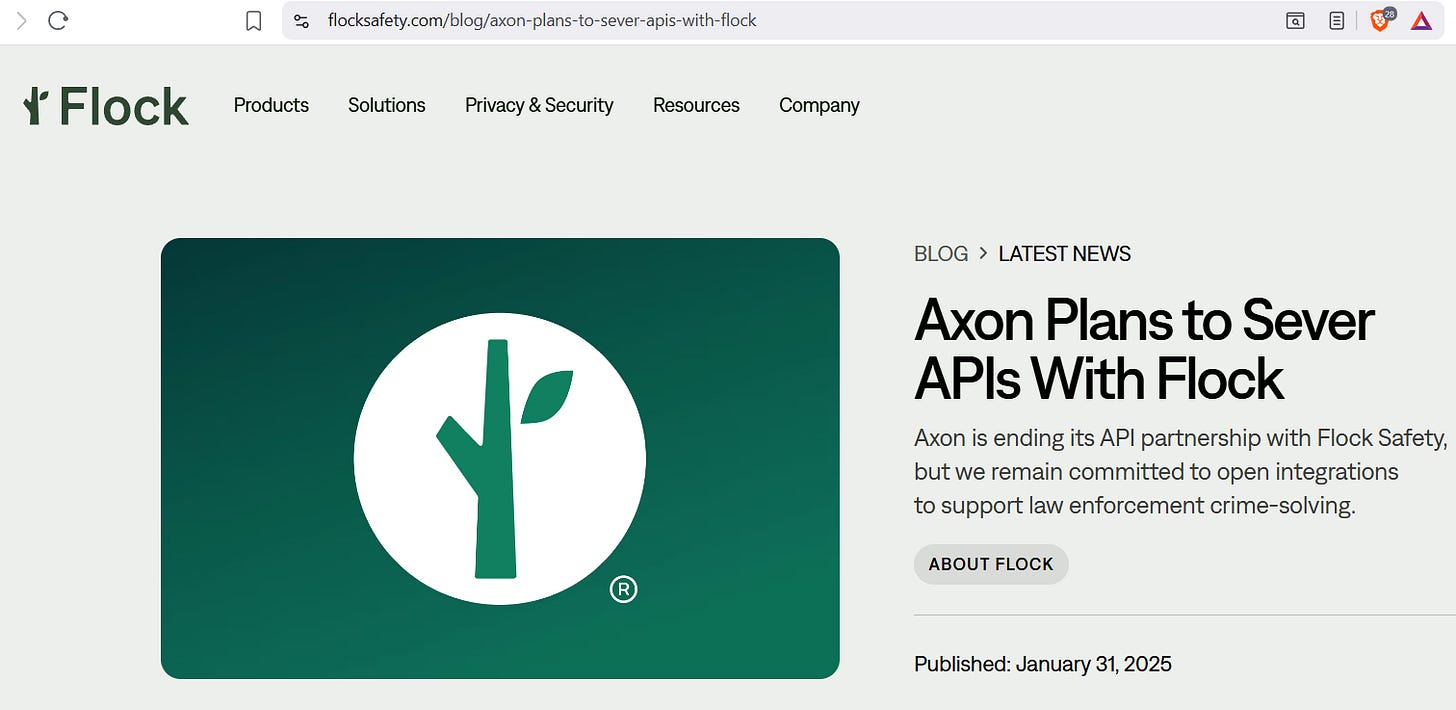
Why is this in a publication about Flock? Well, diving deeper into Axon, the company was partnered with Flock, but Axon just recently ended the business relationship.
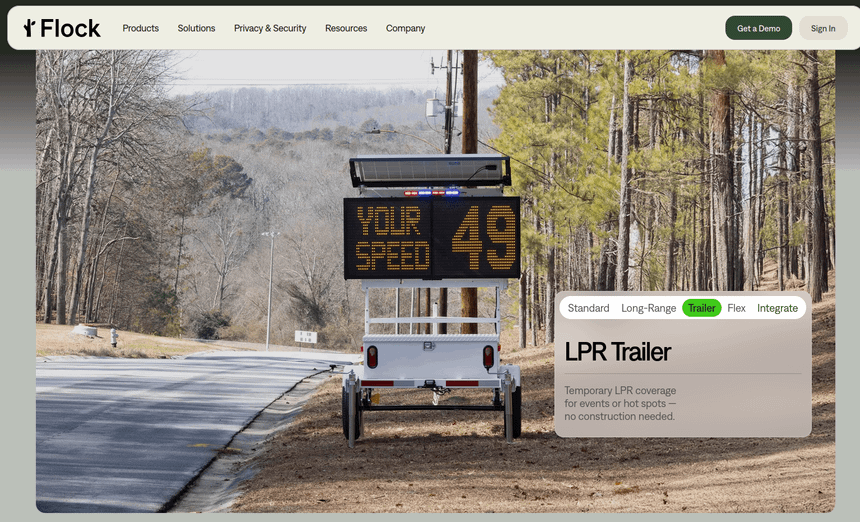
Before you cheer for victory, think again. Axon itself is making the same products as Flock. Here is the new Axon license plate reader camera disguised as a digital speed sign.
Like Flock, Axon also has unmanned drones, but unlike Flock, Axon created un-crewed ground vehicles. These are wheeled robots engineered for reconnaissance (aka spying). They are equipped with multiple low-light cameras and infrared LEDs. Axon even makes smart tasers that are incorporated into its web of connected products. Yeah, smart tasers. And all of the data collected from all of these spy devices can be integrated and viewed onscreen in real time using Axon’s Fusus system.
Now we must ask, “WTF is Fusus?” Fusus is a company Axon bought in 2024. It is being touted as the “real-time crime center.”
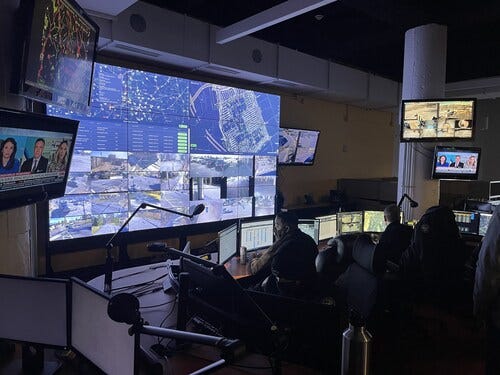
According to the press release, Fusus aggregates live video, data, and sensor feeds from virtually any source or device. I repeat, live video, data, and sensor feeds from virtually any source or device. These centers integrate various data sources, such as cameras, sensors, social media feeds, and other information systems, to provide what they refer to as, quote, “a comprehensive and immediate view of ongoing criminal activities or emergencies.” (Greater good!)
If we cruise on over to Axon’s website and check out their partnership directory, we discover they currently have 65 entities they are networked with. Let me run down a few of note.
4SightLabs specializes in biometrics. But don’t worry, folks, they are only using this stuff on prisoners. They would never, ever be doing this as mass testing before they roll it out on us.
AirData is a drone fleet that features video streaming. Another partner, DroneSense, does the same as AirData. Their partner Paladin deploys autonomous drones for spying (“intelligence gathering”) and emergency response.
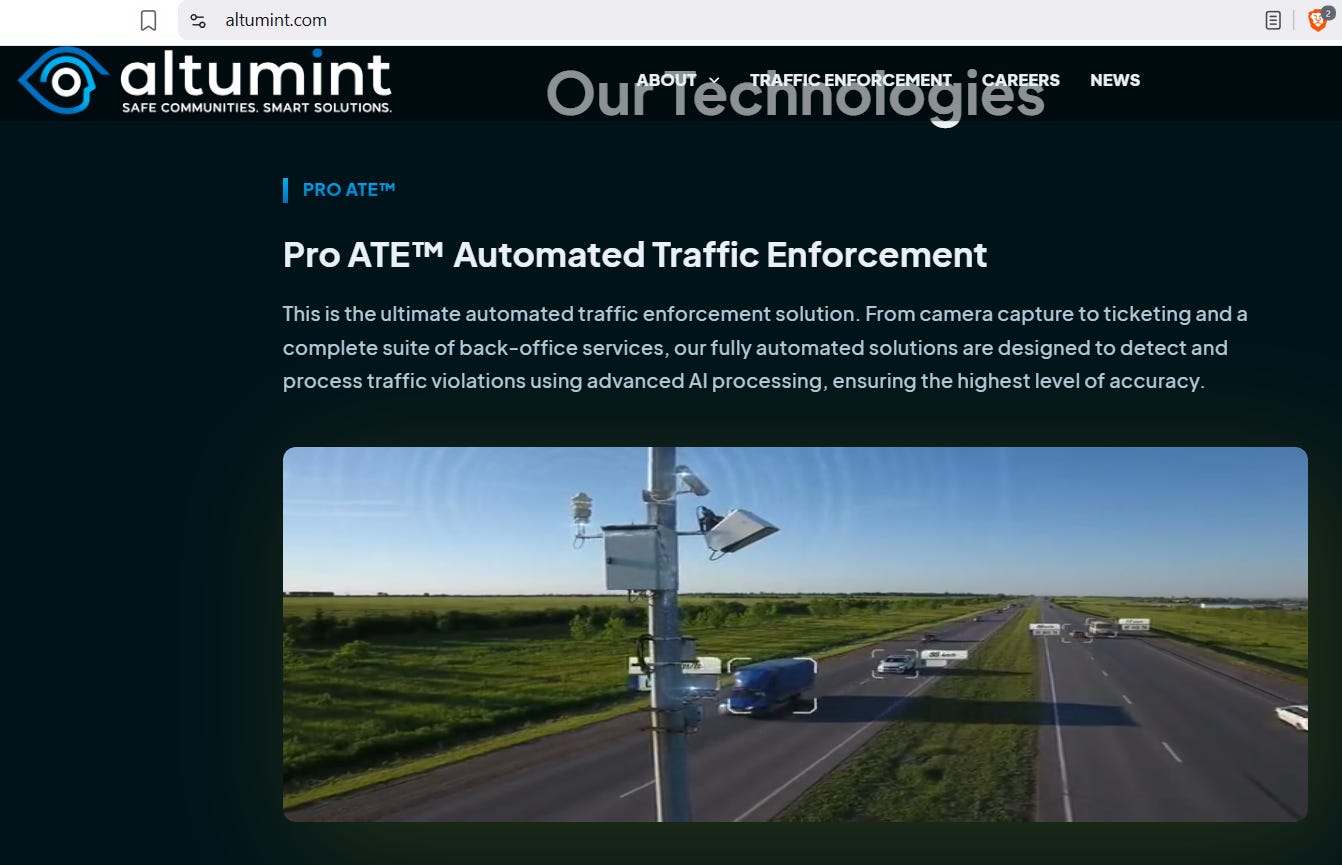
Altumint is a license plate reader company, but they’re more than just that. The Altumint cameras are basically Flock cameras that also act as law enforcement by printing tickets.
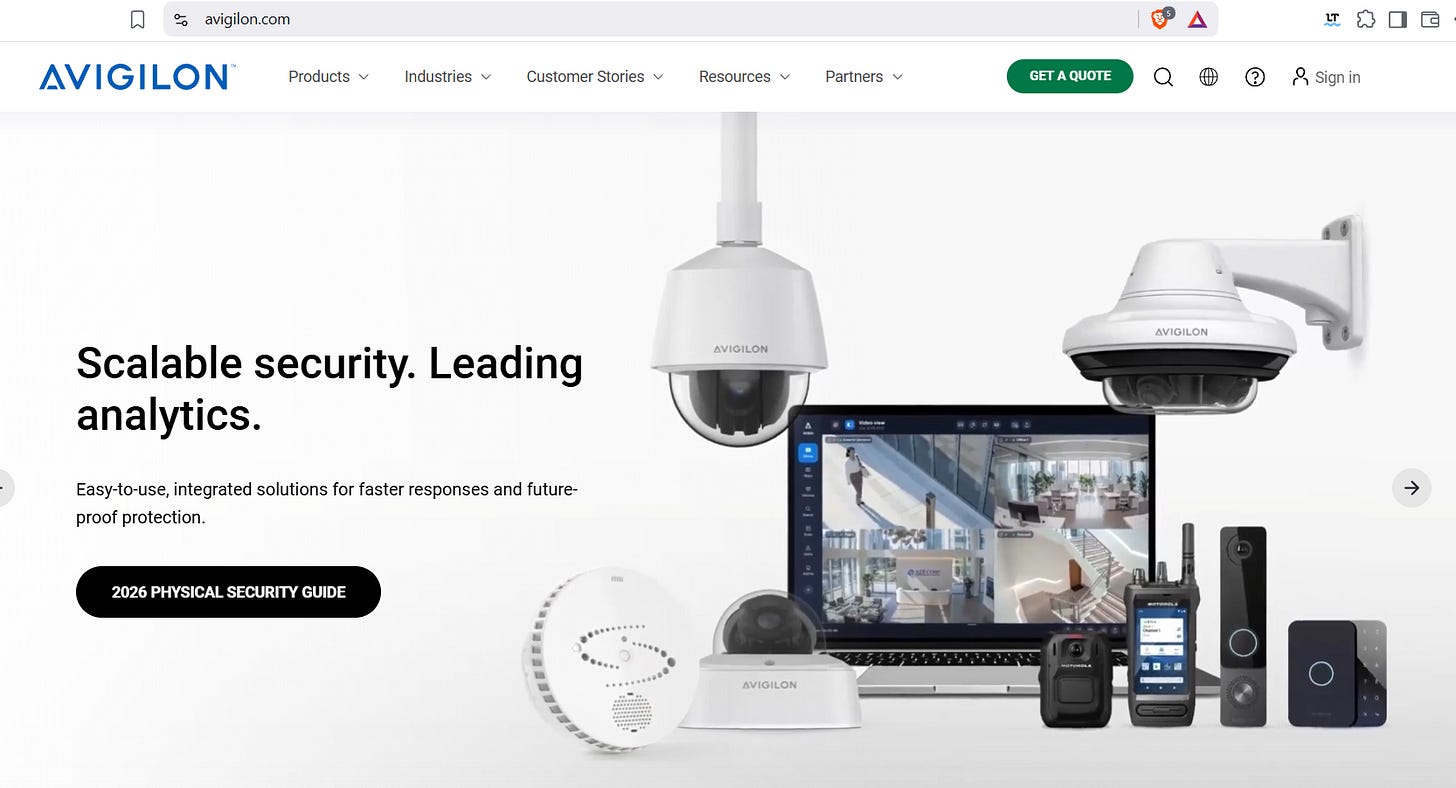
Avigilon specializes in 360-degree cameras and remote video monitoring.
And so much more.
Citizen is a company that claims to protect the world through their ability to compile videos from 15 million people.
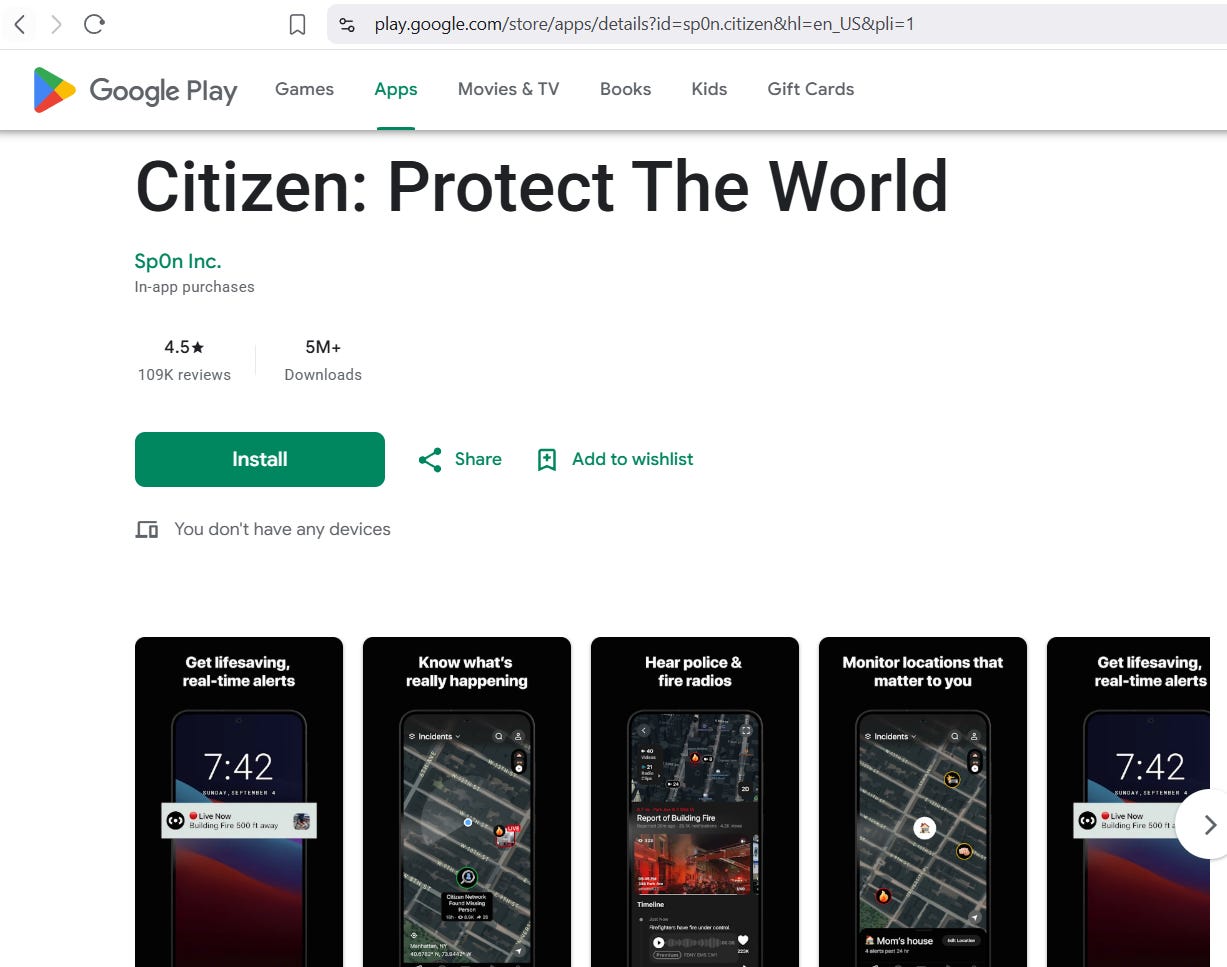
“Where are all of these videos coming from?” you ask because you don’t recall any website ever asking for you to record and submit videos of incidents to them. I assume they come from social media and news feeds, but additionally, they have an app in the app store, and I guarantee we grant this thing permission to access our camera, microphone, and image gallery, just like Epstein’s company. So the short answer is we are likely recording the videos, whether we know it or not.
Their partner, Robotic Assistance Devices, is also known as RAD.
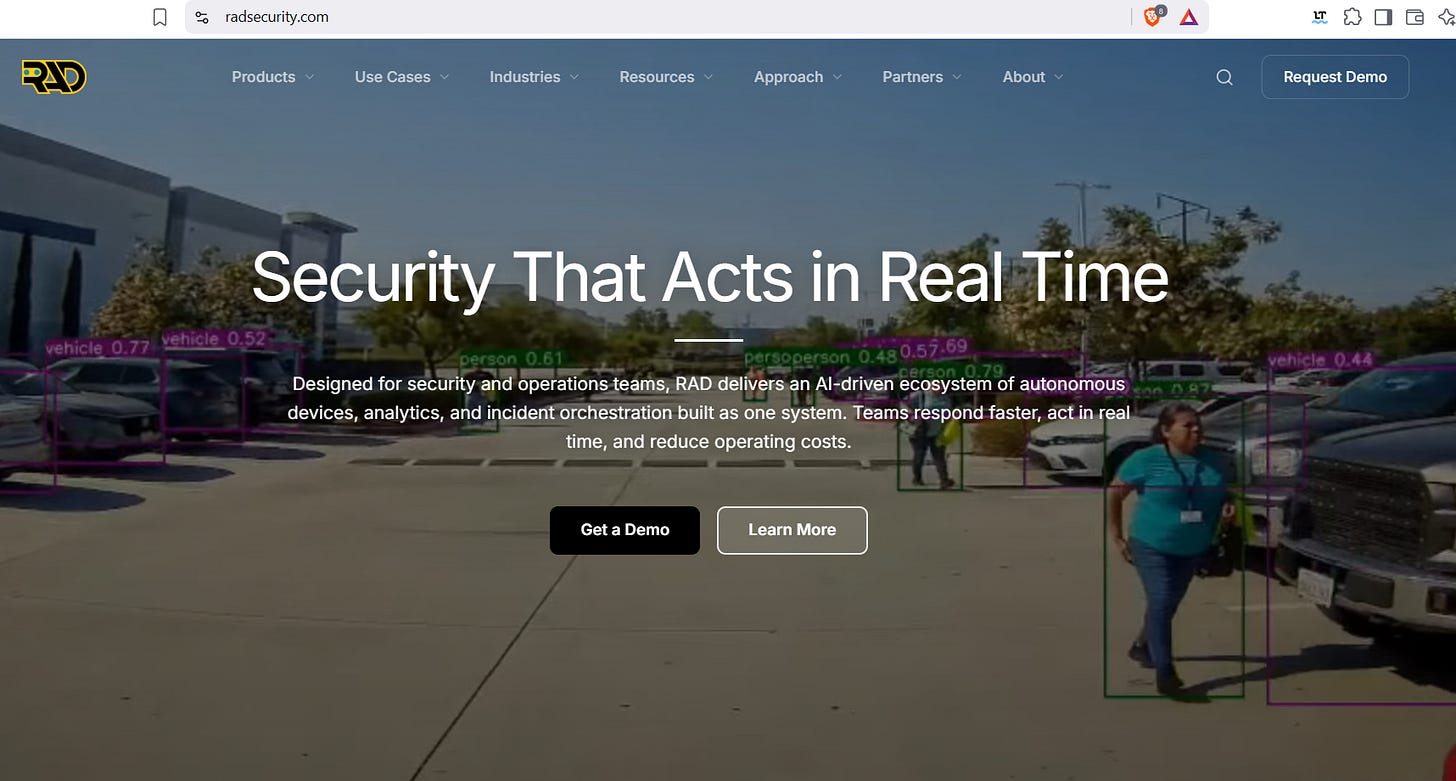
RAD combines facial recognition with license plate readers and God only knows what else to determine if we are threats.
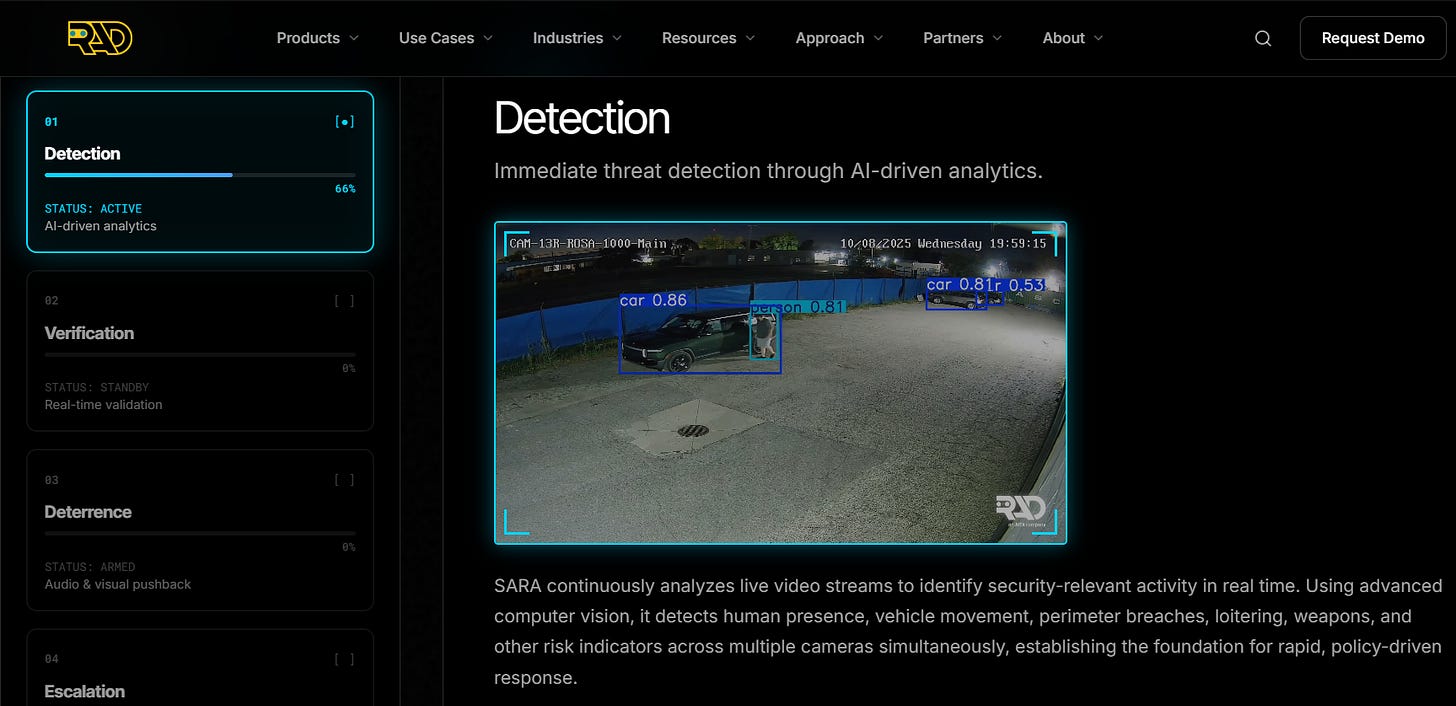
If we are deemed a threat, all of the information gathered on us is made into a packet that is easy to use in prosecution, so next time you lock your keys in the house, you’d better think twice about using the credit card in the door trick because the optics are enough to set off the “bad guy alarm.”
Then there is Ubiquia. Their sneaky cameras are being mounted directly to our already-existing streetlights and running off the same power source as the street lights.
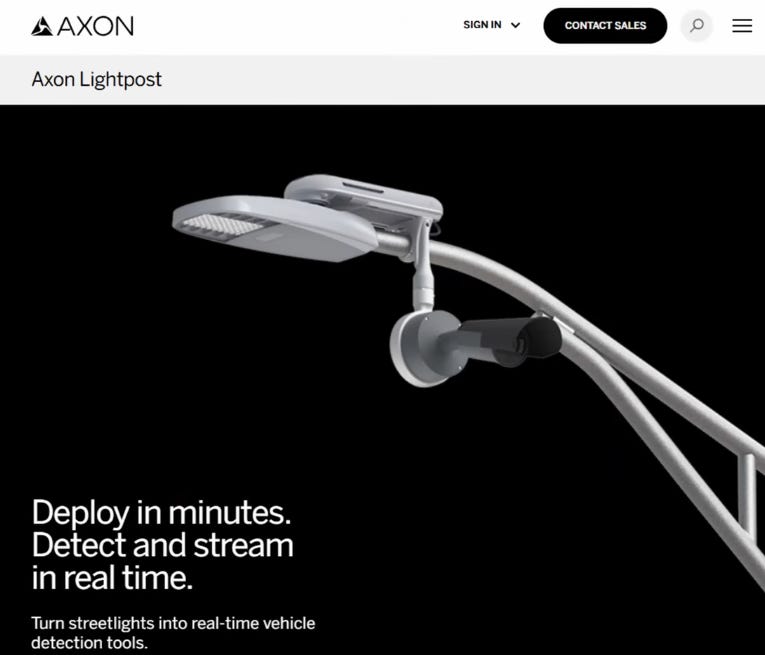
These stealthy cameras are wired directly to crime centers.

These cameras are also connected to autonomous drones. When the cameras get a hit, AI launches the drones into the sky. Once launched, the drone sends a live feed as it follows its target through the streets. And all of this can happen without the driver, biker, or pedestrian ever knowing they crossed the invisible line.
There are so many more partners, but let’s skip ahead to the most important.
Original Article: https://chemtrails.substack.com/p/epstein-ring-doorbells-and-axon-israel

Part 4 | Who the Fuck is Leonardo?
The truth begins to be revealed...
Agent131711 | chemtrails.substack.com
This is incredibly important…
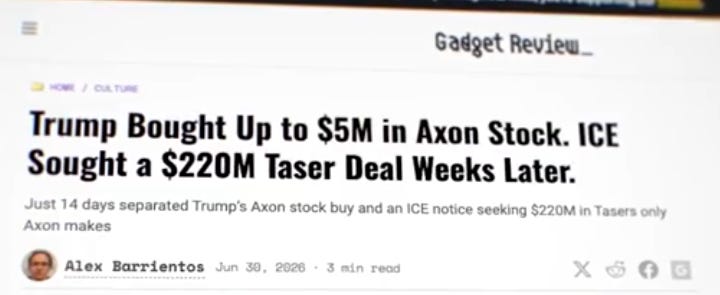
We just finished discussing Axon, but one thing I failed to mention is who is a massive stockholder in this insane, secretive spy tech that is being rapidly installed across our nation, and the answer to that is none other than the current president, Donald Trump. In fact, the sitting president got incredibly lucky because he invested as much as five million dollars into Axon only two weeks before ICE posted a notice seeking a five-year, $220 million Taser contract for about 17,800 devices, along with unlimited cartridges and training. Now onto Leonardo…
Leonardo is a lot more than an Axon [Israel] partner.
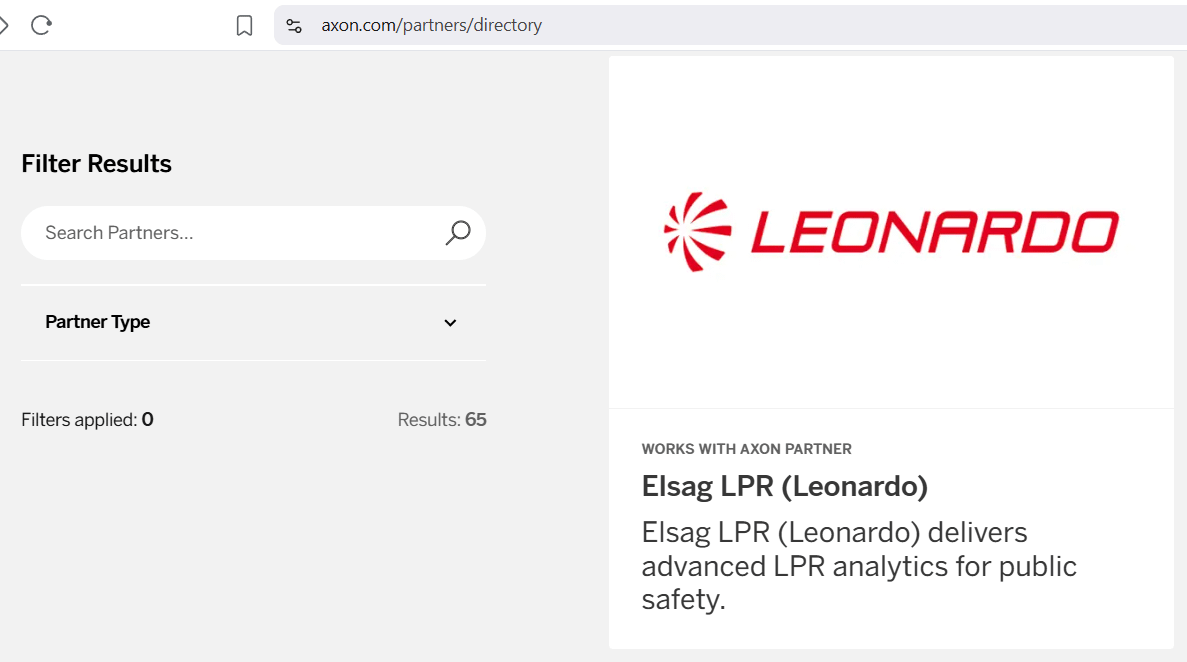
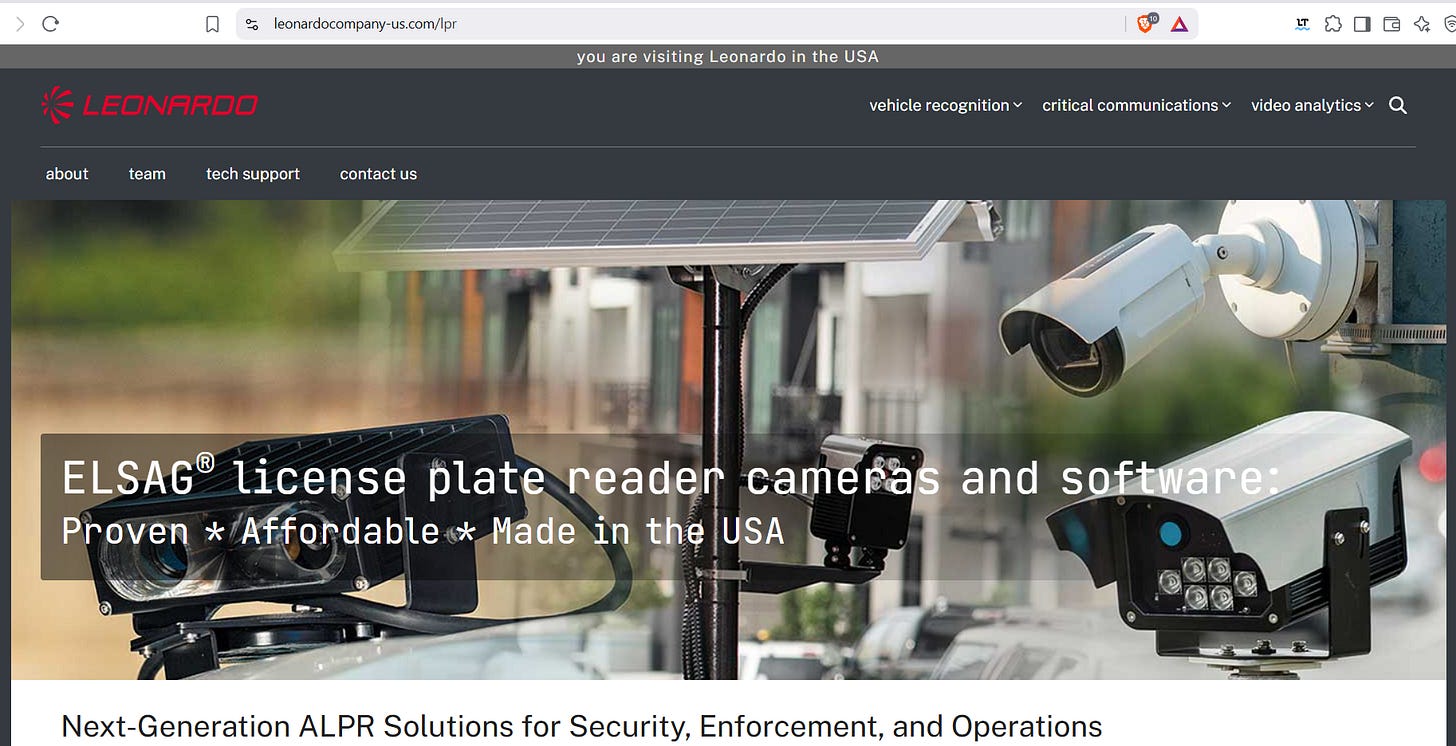
Leonardo specializes in something called “Elsag LPR.”We know LPR stands for “license plate reader,” but what is Elsag? I’ll give you a hint: an Elsag is not a bra for floppy tits.
Before I can tell you what it actually is, we have to discuss the linchpin of the whole surveillance network. What is the linchpin? You may be surprised to hear that it’s…
BLUETOOTH
By definition, Bluetooth is “a short-range wireless communication technology standard that allows devices to exchange data over radio waves without the need for cables or physical connections.” In layman’s terms, it is used to send and receive information without a cord. So, for example, if you have a computer and a printer, you would need to plug your printer into your computer to make it work, whereas with Bluetooth, you can wirelessly connect the two devices. When devices are linked together, they are referred to as “paired,” so you pair your printer with your computer one time, and you can wirelessly print all day, every day, without re-syncing it; it’s a one-and-done gig.
Regarding specifically what information is transmitted, it all depends on the device and the purpose of it. All smart appliances use Bluetooth. This means all cell phones, smart cars, fridges, video doorbells, watches, earbuds, the Amazon Echo and similar devices, televisions, gaming consoles, BBQ grills, and even coffee makers—all of these transmit data about us wirelessly. This data often consists of what is called “user profiling,” which can include a user’s past and present purchase records and daily routines, as well as GPS location data (think of Google Maps or AirTags). As the New York Times reported, many stores now use Bluetooth to track the location of individual shoppers down to the inch. That information is often sold or given to advertisers, who then use it to build data profiles on people who were just trying to buy a loaf of bread. How fucked up is it that our grocery stores are pimping us out? We never asked them to surveil us, let alone sell the data they harvested on us to a third party. It’s just so insane.
After the data is sold or given away, the companies that obtain it can then analyze it, share it, sell it, or provide it to the government entity of their choice, and all of this is 100% legal. Yes, it is 100% legal for the grocery store to spy on us and our children like private detectives and then sell every last stitch of evidence they gathered to some entity, which will then resell it, add it to databases, or do whatever their little greedy hearts desire with it.
Unless you’re into true crime like I am, you may not have known that the Bluetooth connections on Fitbits have been used to solve murders. In the Connie Dabate murder case (2015), Connie’s husband, Richard, claimed a masked intruder shot his wife, but Connie’s Fitbit data showed she was active and moving around a full hour after her husband claimed she was already dead. Because of the smartwatch, Richard was convicted of her murder and sentenced to 65 years in prison. This wasn’t a one-off. Fitbit data led to the arrest of a California man for the murder of his stepdaughter, Karen Navarra.
And even if you don’t have a Fitbit, your cell phone may have the same features as one. These features are sold to us as assorted health apps, which are often built into our devices. Some of these apps cannot be uninstalled. We are told these calculate our steps and provide other fitness data. What we are not told is this data can be examined and even used against us, such as in a criminal case in Germany involving a man named Hussein Khavari. Here, police accessed the suspect’s health app data and concluded that his phone showed “strenuous activity”, which investigators insisted was when he dragged the dead body and climbed stairs. So, without any real evidence, let alone eyewitnesses or a murder weapon, Mr. Khavari was sentenced to life in prison, all because of a health app.
But it’s not just smartwatches and health apps that are being used to track us; it’s also Wi-Fi router logs and geofencing. You see, when your phone connects to a Wi-Fi network, there is a record made of that connection because, of course there is a record. We can’t burp without there being a record of it somewhere. The wifi connection establishes that you were in the proximity of the Anderson’s house on Tuesday morning at 7 am. Geofencing is when a digital perimeter is created using GPS data. For example, a 600-foot perimeter around the Anderson’s house—that’s a geofence.
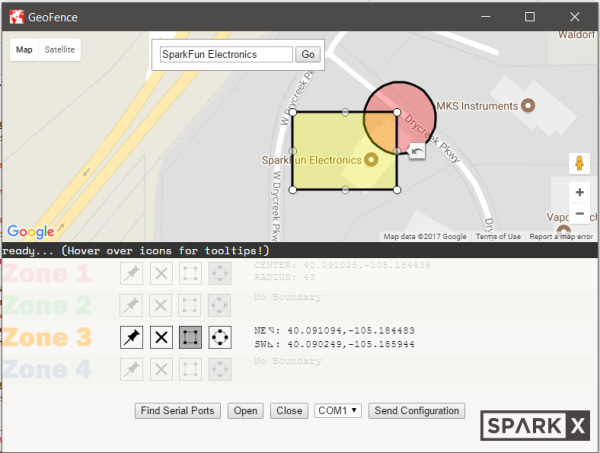
Law enforcement has utilized data from connected home and business routers, alongside device location information, to map out devices connected or active near a crime scene.
Google Database is a key player in the people-tracking industry, and it aids in geofencing. The tech giant stores location history in a database known as Sensorvault, and, according to the New York Times, these records span back at least a decade and include hundreds of millions of devices worldwide. If you think you can’t possibly be a part of this database, think again.
In 2018, the home of a couple in a small town in Minnesota was robbed. Google Database identified all devices that were active near the crime scene. Detectives then used the victims’ home Wi-Fi network to create a geofence. This information was used to identify people whose smartphones literally linked them to the area of the crime. Weeks later, three suspects were arrested in the burglary and charged.
Further, entities like MoocherHunter use unsecured wireless router signals to reverse trace the people using them. And even that isn’t the end of it. This next story will shock you. A man named Ross Compton said he was sleeping when his house in Middletown, Ohio, caught fire back in September 2016. He said he grabbed some possessions and jumped out a window. Investigators pulled data from, of all places, his pacemaker, which, according to a cardiologist, proved Compton was not asleep. Because of the pacemaker records, he was charged with aggravated arson and insurance fraud. As you can see, Bluetooth plays the key role in tracking us. Now let’s get back to Leonardo.
ELSAG
So, to get back to ELSAG, while America was worried about Flock cameras, Leonardo, a defense contractor, partnered with Axon and released their new system, ELSAG SignalTrace, which not only reads your license plate but also reads all of your Bluetooth devices and “other consumer electronics.”
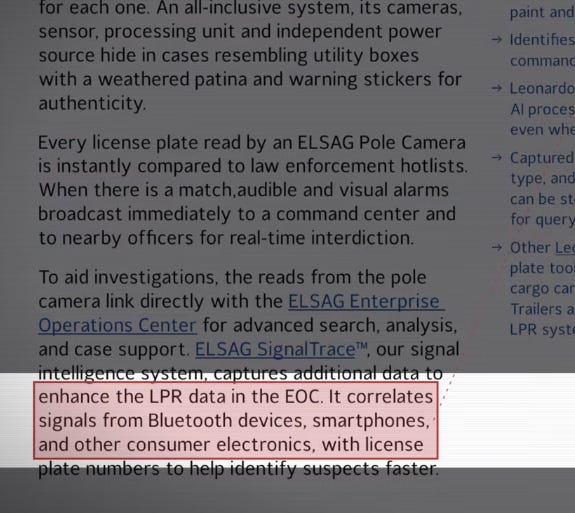
This means that when we drive past a Signal Trace device, it doesn’t just photograph the car. It grabs the wireless signals leaking out of every device inside it: our phone, smartwatch, earbuds, fitness tracker, the car’s own Bluetooth, the key fob, and even the dog’s microchip. This data, combined with our license plates, vehicle makes, models, damages, and bumper stickers, is then referred to as a “fingerprint,” which is stored for later use.
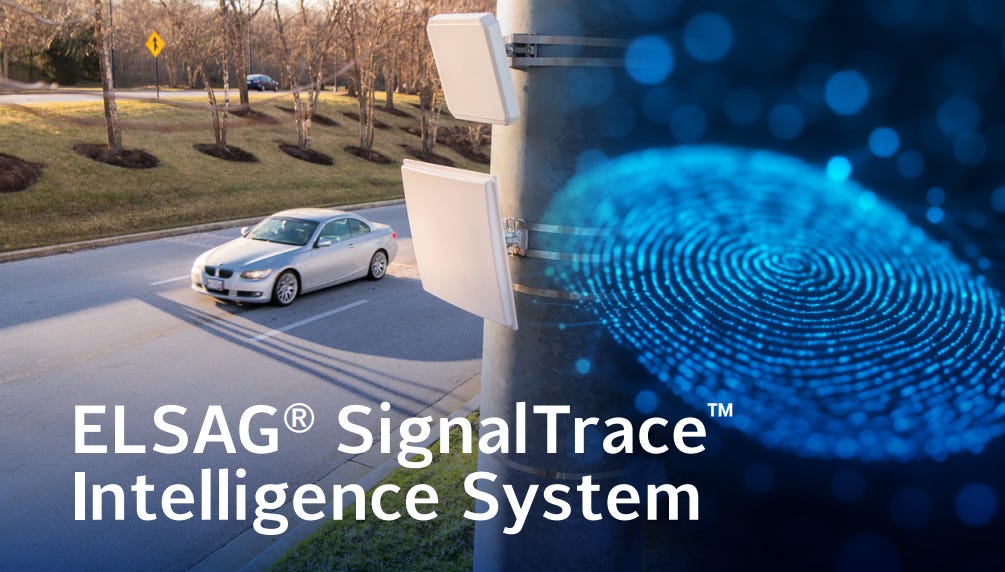
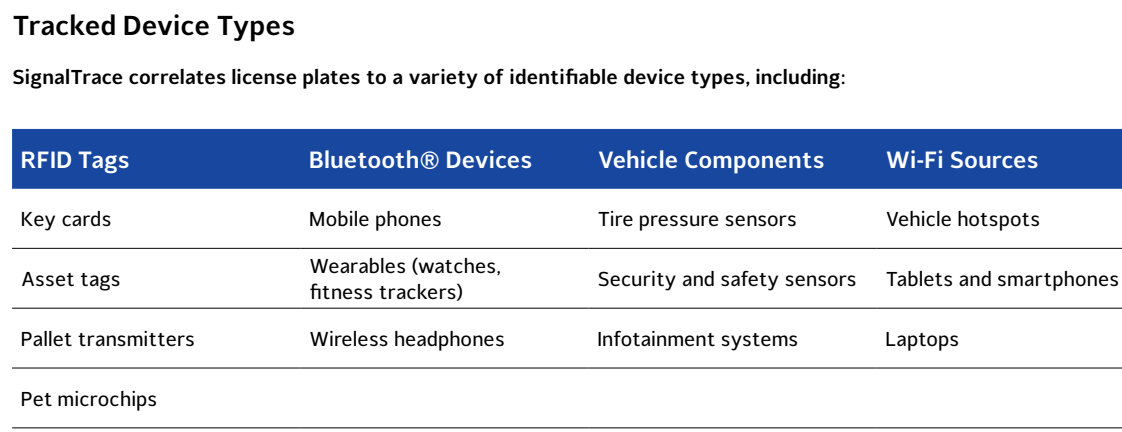
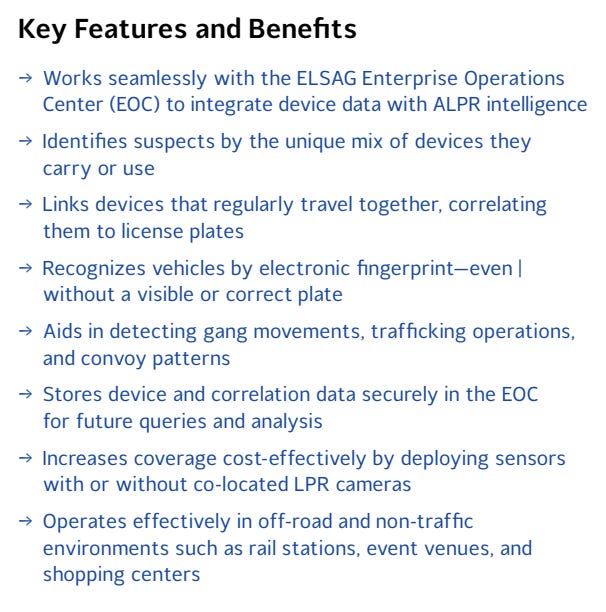
The reason they refer to it as a fingerprint or signature is because the information your vehicle emits is custom. As Leonardo says on their site, “While 70 cars in 100 may contain iPhones, only one will have an iPhone 13rev2, an Audi radio, a pair of Bose headphones, a Garmin sports watch, a key finder, and the license plate ABC-1234. The collection of data represented by these specific things is an electronic signature.”
This means these cameras know more about your personal life than your own mother. They know how many ladies you met off Tinder and where the two of you went, including the trip to Walmart to grab some wine. Further, they know what your dates did before and after they left. Creepy, isn’t it?
Earlier I mentioned pairing; once the devices are paired together, they don’t have to keep being re-synced. This leads fellow researchers to claim that once linked through Bluetooth, we can be tracked anywhere without having to resync. It’s like having an ankle monitor that the government and strangers watch in real time. Can we agree that these spy cameras make Flock cams look like a joke? More on this later in this publication.
All of this leads us to ask, “Who exactly is this Leonardo company?” and here is where the story takes an even more nefarious turn…
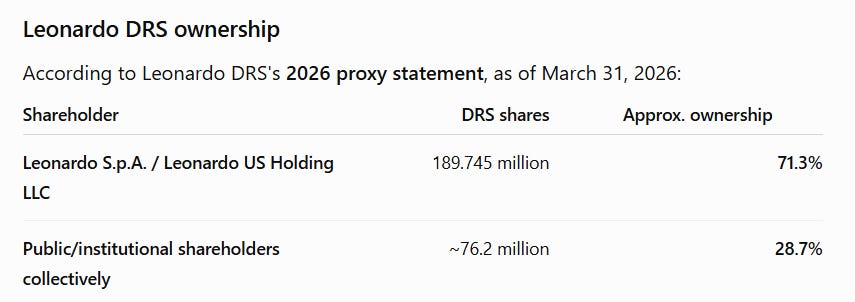
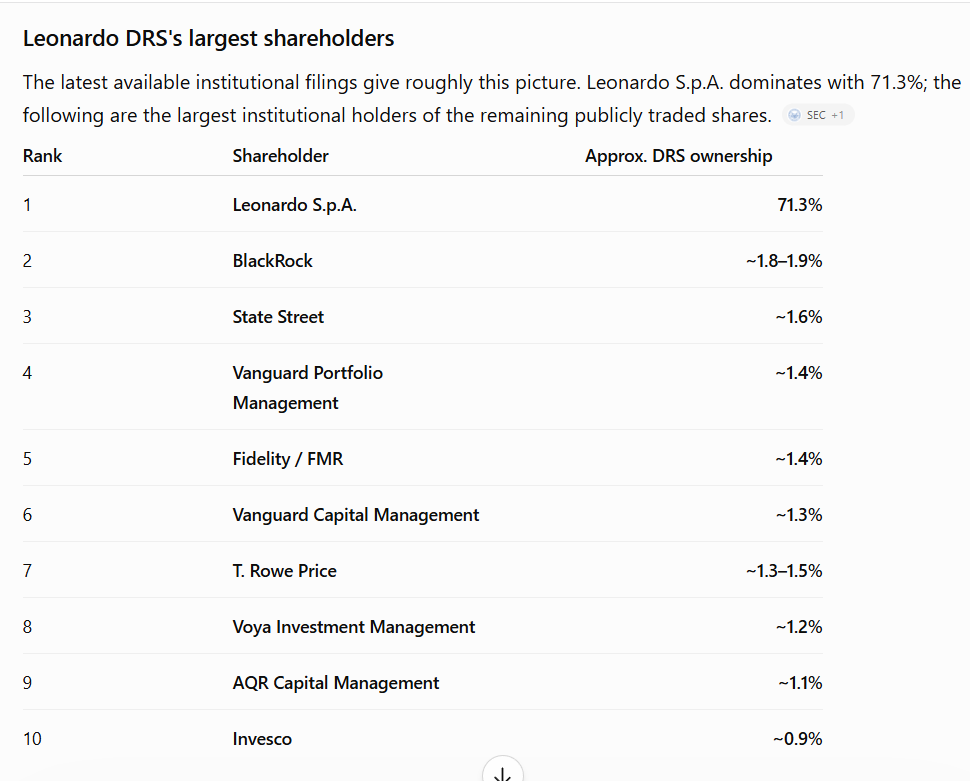
Leonardo is an Italian multinational company that specializes in aerospace, defense, and security. The company is headquartered in the pope’s Rome, but it has 180 sites worldwide. Leonardo is the 12th largest defense contractor in the world based on 2020 revenues. An even greater cause for concern is that Leonardo is partially owned by the Italian government. Fellow researchers will tell you the government owns 30.2% of the company, but that is only a half-truth. The Italian government owns approximately 30.2% of Leonardo S.p.A., which in turn owns approximately 71.3% of Leonardo DRS.
The second largest shareholder is BlackRock, with only 1.9%, which, although it sounds microscopic, is actually equal to over five million shares because this is a massive company.
Here’s where the plot thickens. Although Italy holds such a large share in Leonardo, the company is not an outright Italian company—and this is why it is always so important to rewind the clock as far back as possible to understand the deeper story.
Leonardo DRS traces its origins to two American engineers: Leonard Newman and David Gross. They founded the company that became DRS Technologies, which is now Leonardo DRS. So when you hear the name “DRS,” it means Leonardo. Capisci?
Leonard Newman was an electrical engineer at Loral Corporation before founding DRS with David Gross. Loral Corporation was a US defense contractor. Loral was purchased by Jewish businessman Bernard L. Schwartz. Fun fact: Bernard celebrated his 71st birthday with Bill and Hillary Clinton at the White House—remember that name, Bill Clinton, because it will come up again.
While employed by Loral, Newman was working on technology for the US Navy. One patent, which his name is on, was for an integrated display system for antisubmarine-warfare missions. This is of interest because this display included information obtained through sensors that helped operators make decisions. This patent dates back to the 1970s.
Skipping ahead to 2008: DRS was acquired by Italy’s Finmeccanica (now known as Leonardo S.p.A.). Finmeccanica shelled out approximately 5.2 billion dollars for DRS, and after acquisition, the company was made private—you know what that means (no FOIA requests). So right about now you’re thinking that if Italy’s company Finmeccanica bought it, then obviously this is an Italian-owned company, but if we peek under the hood, we find some startling details about this acquisition.
This sale is incredibly interesting because two competitors both made higher offers, yet Finmeccanica was chosen to sell it to. How much higher were those bids? Are we talking about a couple thousand dollars? No, we are talking about roughly 181 million dollars. And being that this was a public company that had shareholders to answer to, it would have been most logical to accept the highest offer, right? Yet the company that bid four dollars more per share was never even given a fair chance; their $85 a share offer was scoffed at, then DRS chose to sell to Finmeccanica at only $81 a share. Why would any company choose the lesser offer? “Make it make sense!” you shout. To which I reply, “Try this on for size.”
Acquisition negotiations were overseen by The Cohen Group, which is a Washington-based consulting firm founded by former Defense Secretary William Cohen. Who is William Cohen? A Russian Jew who served in the US Senate then served as secretary of defense from 1997 to 2001 under President Bill Clinton—see, there’s that name again.
To make a long story short, the United States claimed that, because DRS was a US military contractor, our military secrets could fall into the wrong hands. It was allegedly because of this fear that Finmeccanica ultimately agreed to a very unique business structure. To summarize without boring you with details:
“Sensitive Operations” would be placed under proxy ownership. A proxy means someone who is acting on behalf of someone else. In this instance, because of the United States military’s tight-knit relationship with DRS, a “FOCI” agreement was deployed. FOCI means Foreign Ownership, Control, or Influence. The resulting FOCI arrangement left Leonardo with ownership of the company but transferred the voting rights attached to its majority stake to five US proxy holders. Additionally, 35% of DRS’s revenues were to become a part of the proxy agreement if the Department of Defense wanted them to.
More specifically, the 2025 amended proxy agreement requires five U.S.-approved proxy holders to vote the shares owned by Leonardo US Holdings. These individuals must have the same rights as the owners of the company. So you see, things are not as they seem by outward appearance. Even though the company is owned by Italy on paper and even though the Italian government has a massive stake in it, it is not fully controlled by Italy.
I have been unsuccessful at figuring out who the original 2008 proxies were, but I can introduce you to the five current individuals.
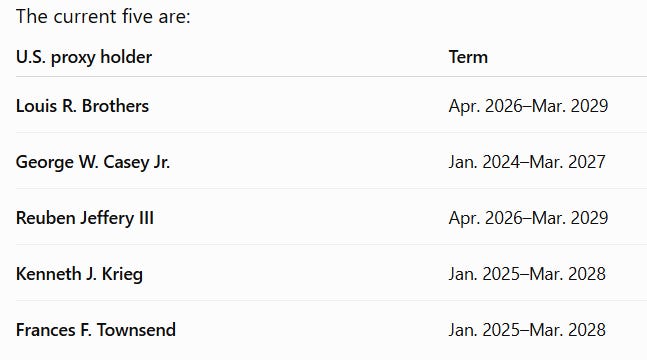
Reuben Jeffery III was a Goldman Sachs fellow who became the Under Secretary of State for Economic, Business, and Agricultural Affairs under George W. Bush, but now Reuben is the president, chief executive officer, and member of the board of Rockefeller & Co. and Rockefeller Financial Services, Inc. He is also a member of the International Advisory Committee of J. Rothschild Capital Management Limited. So this guy, aside from being a Rockefeller bro, is an investment firm fellow.
Louis R. Brothers served as Under Secretary for Science and Technology at the US Department of Homeland Security as well as Deputy Assistant Secretary of Defense for Research at the Department of Defense under President Barack Obama. He now serves as an operating partner at AE Industrial Partners, a massive investment firm that is contracted by the DoD. Yep, his previous employer, the Department of Defense, is now his client. So this guy is also an investment firm fellow. It’s quite strange how these investment guys go from a high-up position in the US government to an investment company and now are in control of a surveillance system that is being quietly installed across our nation. Let’s continue on with the proxies:
Kenneth J. Kreig is the founder of Samford Global Strategies, which appears to be yet another investment firm, and Kreig is also the former undersecretary of the Department of Defense for acquisition, technology, and logistics.
Then there’s Frances F. Townsend, who was an analyst for CBS News prior to becoming senior counsel at Activision Blizzard (the American video game maker who has produced games like Call of Duty and Candy Crush Saga). Townsend spent 13 years at the US Department of Justice under the administrations of Presidents Skull and Bones George H. W. Bush, Bill Clinton, and Skull and Bones George W. Bush.
The last proxy is George W. Casey, who is a retired four-star general who was also the 36th Chief of Staff of the United States Army under US Presidents George W. Bush and Barack Obama.
So that gives you an idea of who is controlling a substantial part of Leonardo. As you can see, it is not necessarily the Italian government that is behind the Elsag SignalTrace that will be used to push America into the age of AI policing; it is our own government doing so by proxy—and the majority of these individuals with control are in the investments industry. I should also point out that it is not the (air quotes) “Italian company,” Leonardo, that is selling this stuff to our cities.
According to fellow researchers, the sale of the surveillance tech is being carried out by an American company called Vetted Security Solutions as well as its sister company, Odin Risk Solutions. Both are owned by Vetted Holdings, which is based in St. Petersburg, Florida.
Vetted Holdings is a new company. Their legal paperwork was filed in 2020. They operate out of this warehouse. These entities sure seem to be popping up like daisies.
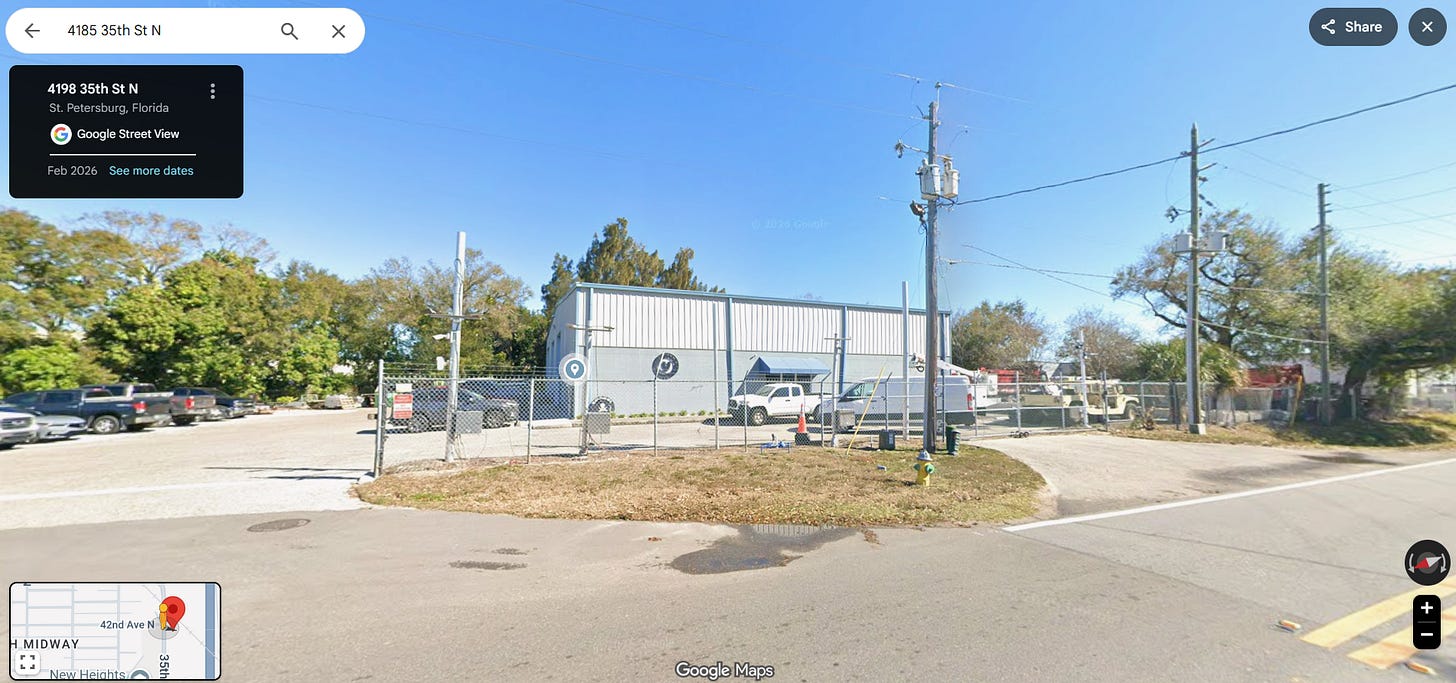
They haven’t posted on Facebook since 2021 and have basically no following, yet they are a massive company—a massive, quiet company.
Despite not having a following, this US company is the one who is pushing the surveillance tech into our communities by propositioning our local governments under the guise of safety and crime fighting. And being that Vetted and Odin are American companies, it looks good on paper.
Now let me point this out to you: on the Vetted Security Solutions website, they use this fucky font that is difficult to read.
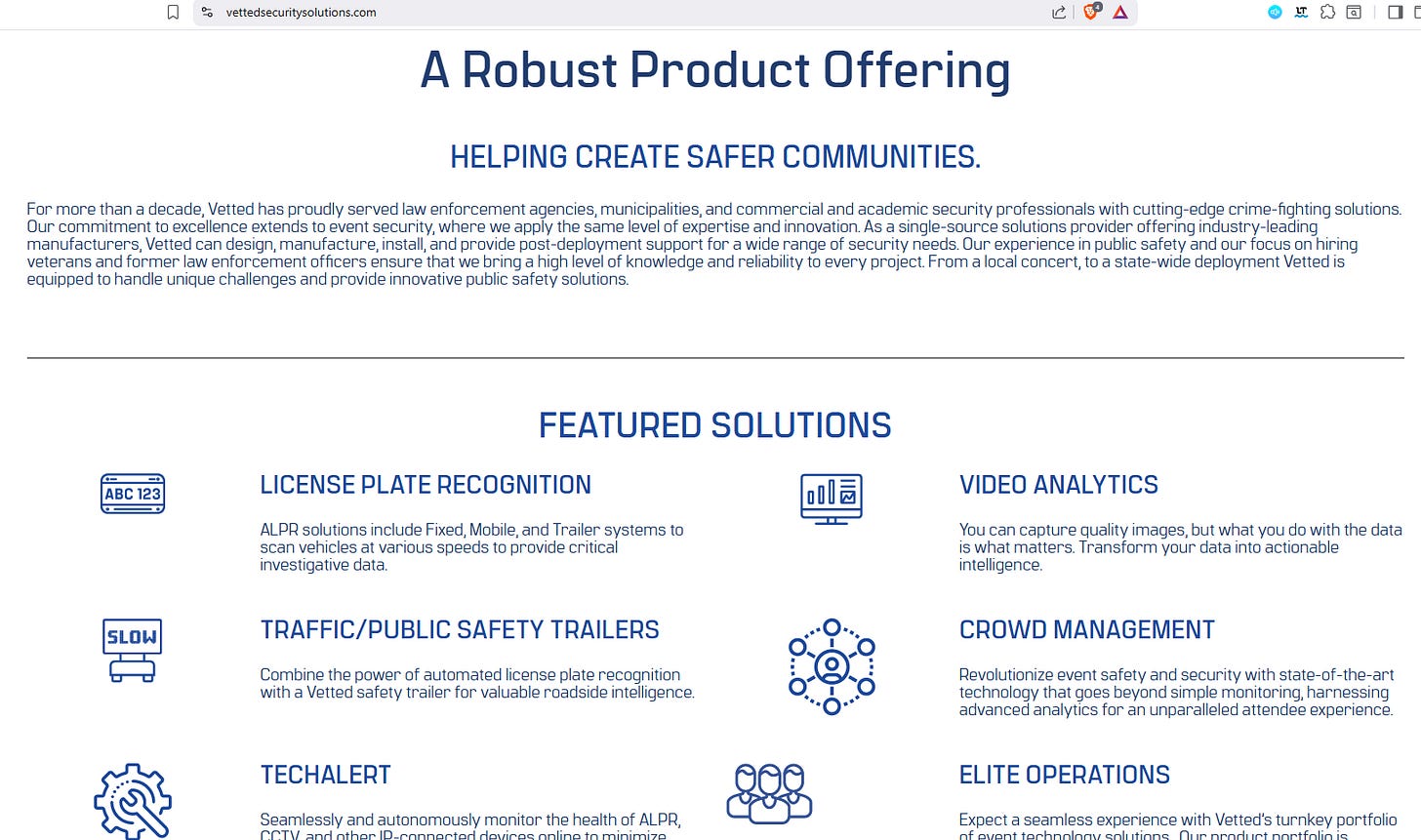
Not to harp on the site, but I don’t know who would ever select a boxy font like this for a website. Fucky really is the best word I can think of to describe it. Not only is it fucky, it’s also blue. It’s a horrific website that looks like a 5th grader made it on recess.
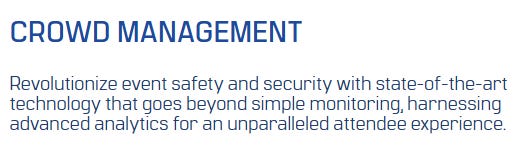
On Odin’s website, we see the same awful font. Instead of fucky and blue, Odin’s site is fucky and green.
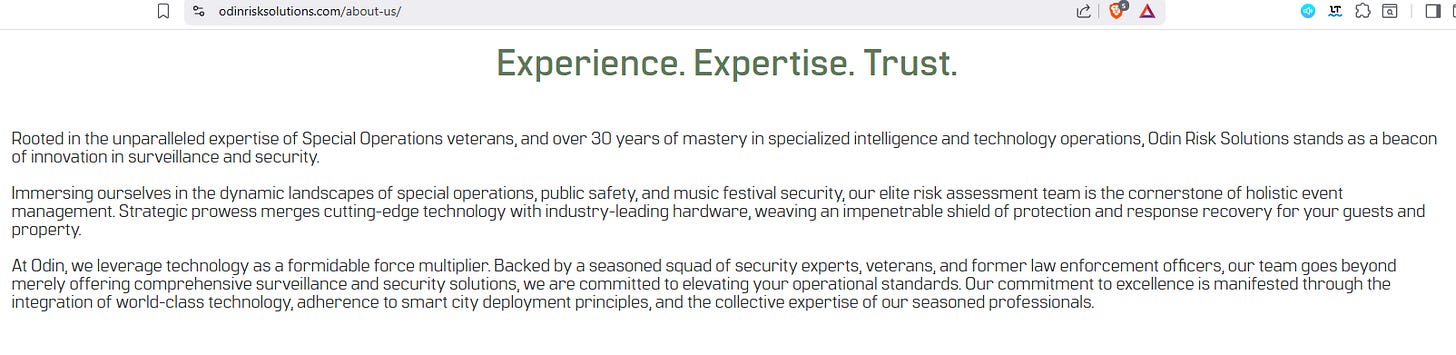
Then I came across this site, ICU Technologies, which should be completely unrelated to the aforementioned companies, but…
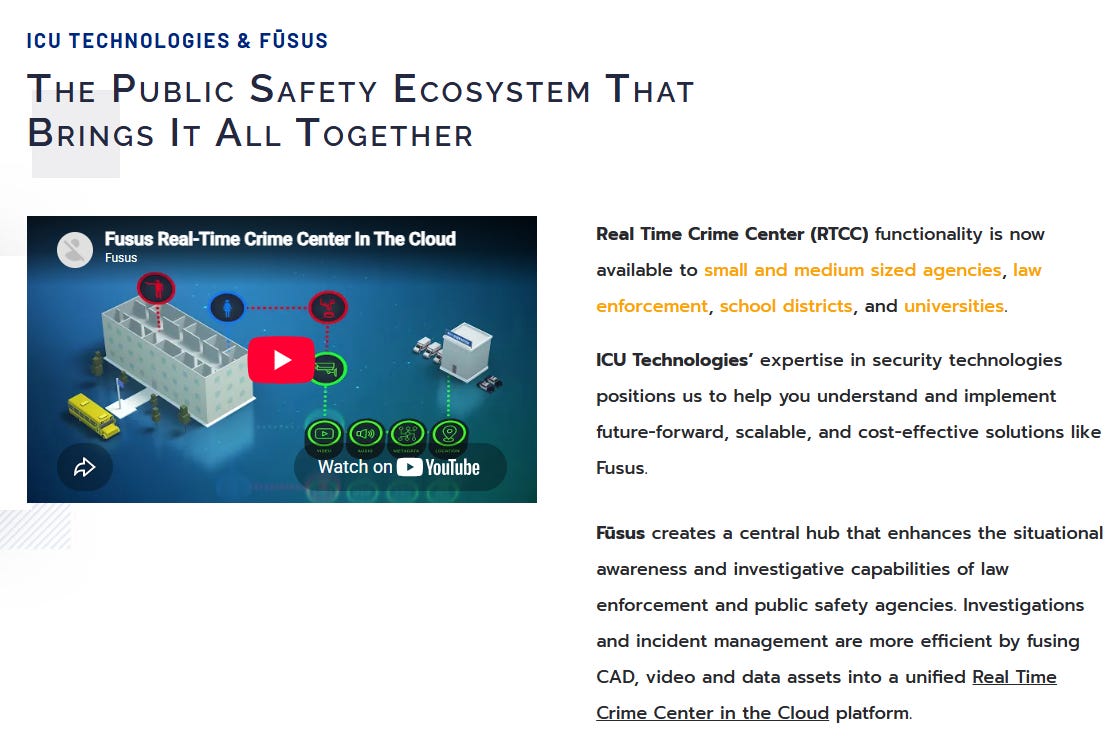
Not only is this site using the same, or a very similar, fucky font and blue text, it is selling the same technology.
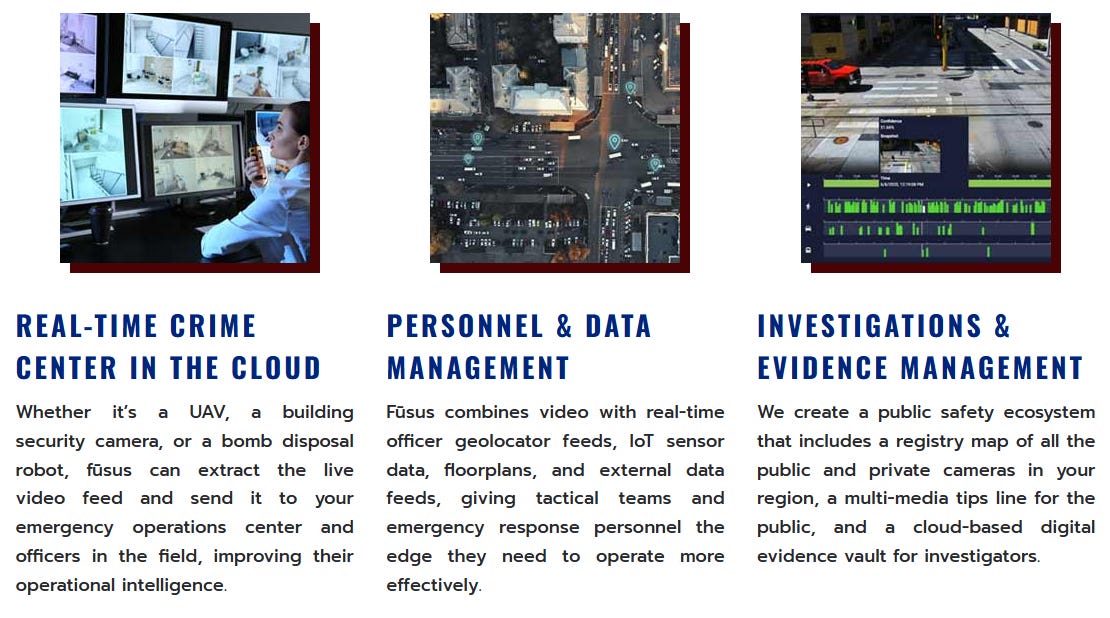

So it seems as if there are a plethora of small companies that appear to all be operated by the same bigger entity, but they give an illusion of a bunch of independent small businesses selling this tech. This really bothered me.
Ok, so, while we were all screaming about the Flock cameras, which we could see going up all over without our knowledge, let alone our permission, Leonardo, through its Florida-based entities, Odin and Vetted Security Solutions (both operating under Vetted Holdings), discreetly pushed its less obvious tech into our towns.
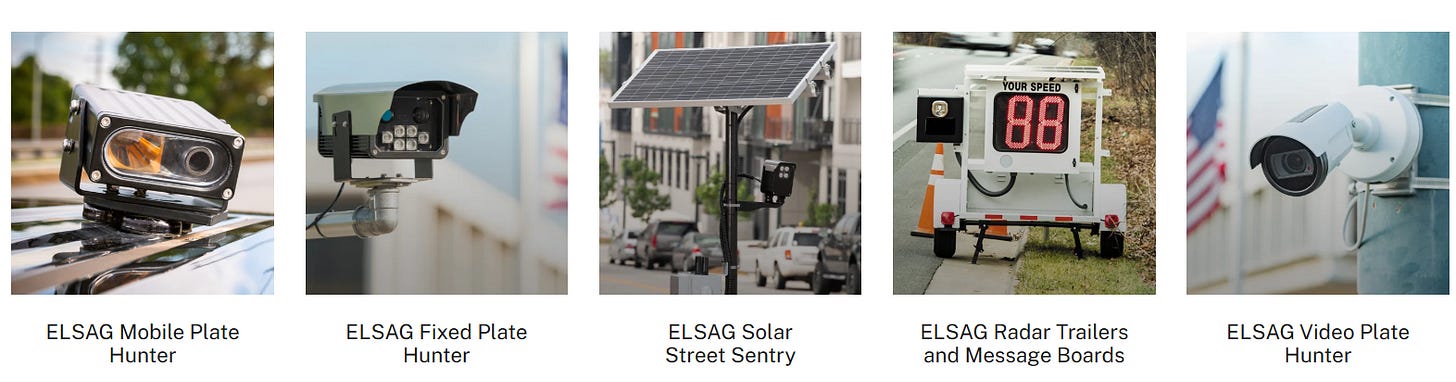
Then, once the tech was installed, something happened. It was kind of a bait-and-switch, per se. It was around a year ago that Leonardo applied for a new US patent. This patent is a software upgrade for their existing technology. This means what has been installed all over America doesn’t need to be replaced; it just needs the newest update, which can be done remotely. And by the way, the patent for the upgrade was expedited and granted in record time. Most inventors wait around two years for patent approval, but not Leonardo. Their patent was given the green light in about five months.
When the wireless system upgrade is (or was) performed on the already installed Leonardo poles with devices, the Bluetooth tracking system is live.
In addition to everything we have already discussed, in 2022, Leonardo acquired Israel’s radar maker, RADA.
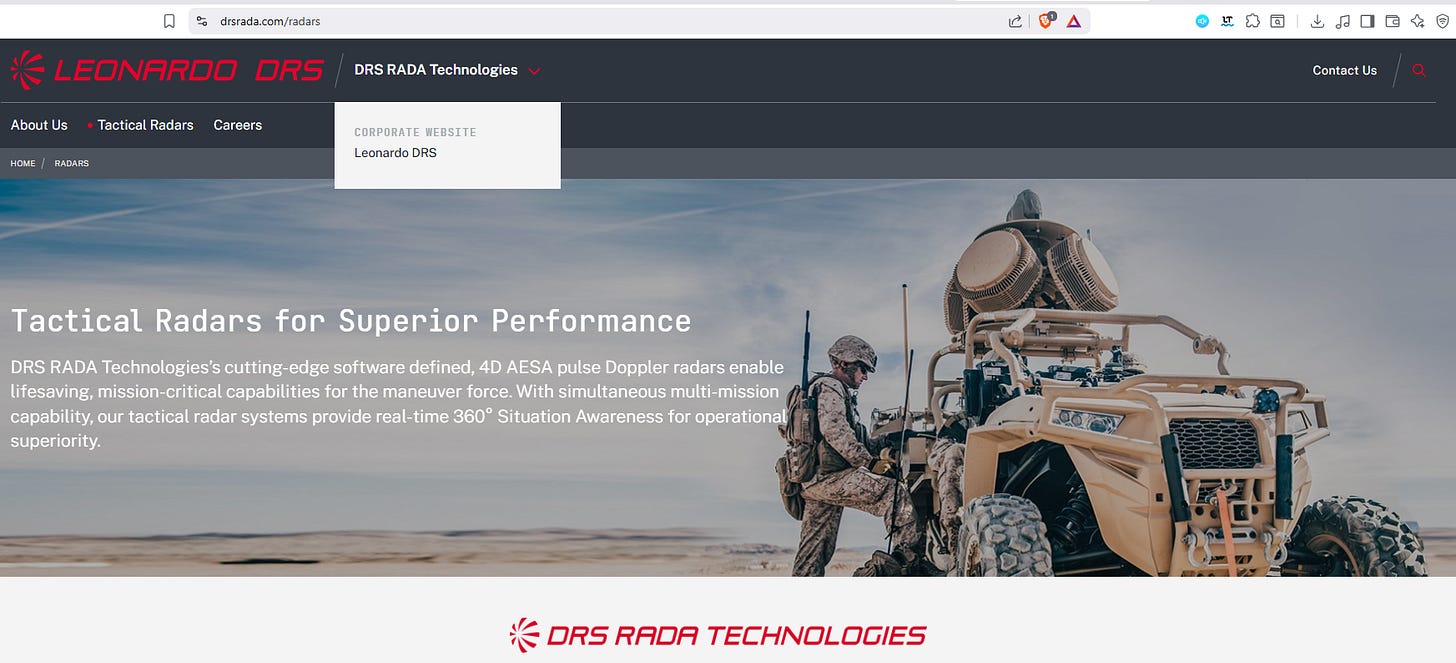
Rada makes “hemispheric 3D perimeter surveillance” technology.
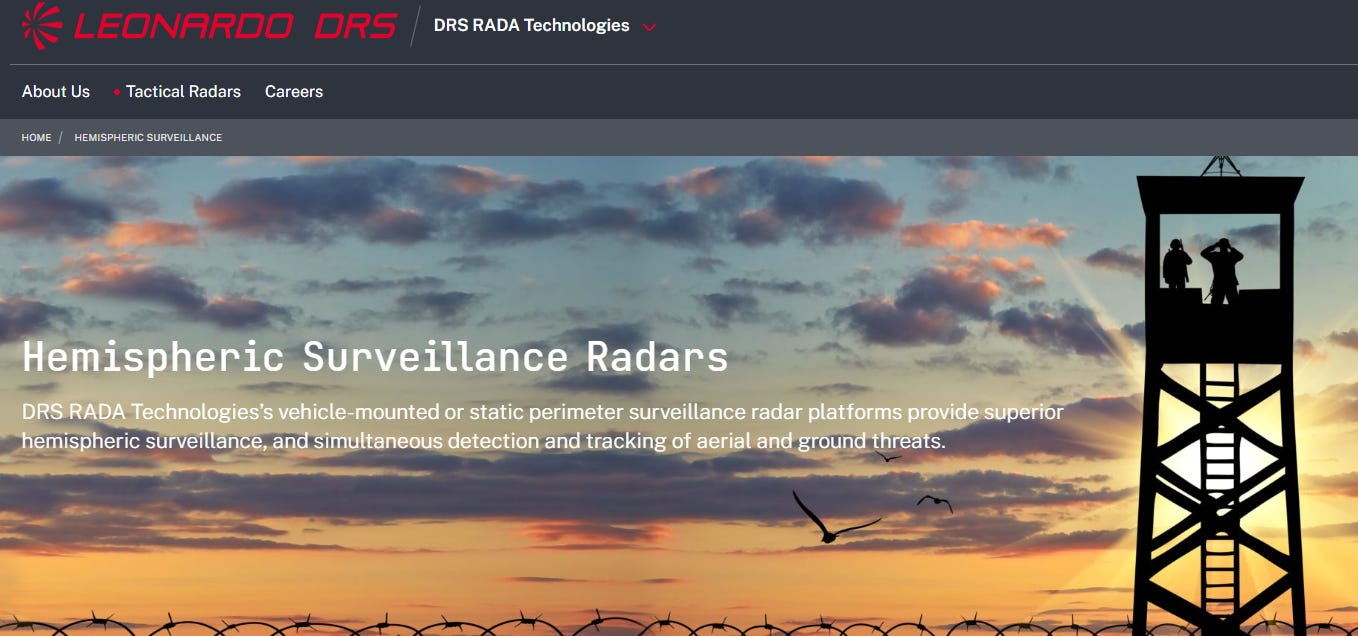
Their tech can track everything from small and slow aircraft to drones to vehicles, vessels, pedestrians, and more.
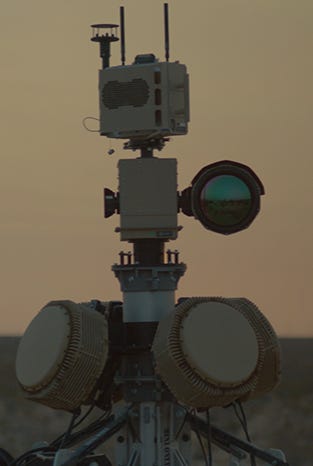
Under the terms of the acquisition, RADA became a wholly owned Israeli subsidiary of Leonardo and continued to operate its business unit within the company. So, once again, we have another Israeli company that oversees the mass surveillance of America. Now let’s put all of this on ice for a moment.
If you think what you have read thus far is scary, wait until you hear this…
Original Article: https://chemtrails.substack.com/p/who-the-fck-is-leonardo-flock-part
Part 5 | What is Cobwebs? The Shadow Entity You Need to Know About
What you do on Telegram might not be so secretive after all...
Agent131711 | chemtrails.substack.com
While people are horrified of what Flock is doing because a Flock camera is a physical object that can be seen, what we can’t see is just as bad, perhaps worse.
For all of the people who keep saying they don’t care if strangers are harvesting their data because they have done nothing wrong, let me tell you what this next company does, and you tell me if anything on this list crosses your line…
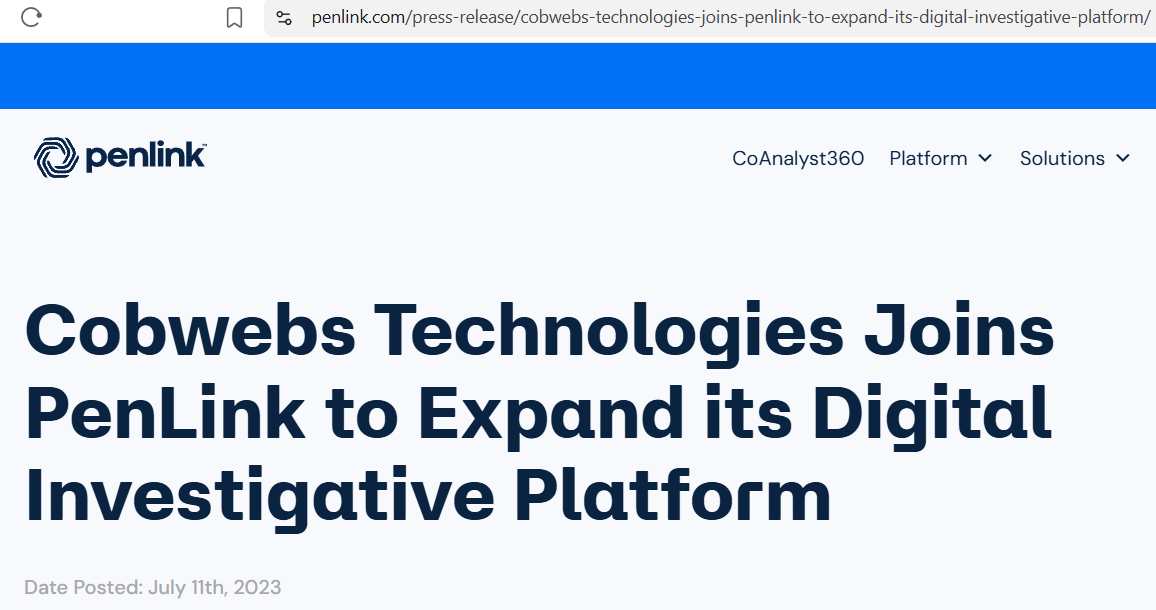
PenLink is a software company that develops high-end commercial communications, surveillance, data collection, and analysis products for law enforcement. “Tell me more,” you say. In July 2023, PenLink merged with Israeli surveillance contractor Cobwebs Technologies. Cobwebs was founded in 2015 by former members of Israeli special forces and intelligence units. Do you guys remember the Pegasus spyware scandal? In the scandal, the NSO Group, an Israeli cyber-arms company, sold its cutting-edge surveillance software to governments. While the plan was supposed to be to use this tech to catch bad guys, that is not what happened. Governments instead used it to target journalists, human rights activists, politicians, and dissidents. Fellow journalists claim the same company that developed Pegasus is the same company that developed Cobwebs, so we are talking about some major technology here.
The three founders of Cobwebs Technologies have since taken over key executive roles at Penlink, so Penlink is a mashup of the two entities.
Through their technology, Cobwebs provides “web intelligence solutions,” which allow users of the tech to, quote, “pinpoint web relations, criminal activities, and terrorist threats with a click of a button.” According to Cobwebs, they work with clients from all over the world.
There is no better way to learn about a company than by looking at their products, and thanks to Citizen Lab’s outstanding research, we can do just that. Penlink / Cobwebs developed the following products:
Tangles, a web platform that scrapes data from the open web, deep web, and dark web. This allows for the tracking of mobile devices within a user-designated area (geofencing.) According to leaked training manuals, government and commercial customers can search for keywords and personal identifiers, which include name, email address, phone number, and usernames. Once the search is run, the government or commercial customer can then identify online accounts and analyze what they post, view their interactions, relationships, activities, likes, dislikes, and event attendances. Yes, these bastards know what events you attended in your leisure time. Additionally, users can monitor and profile individuals, create “target cards” and receive alerts when a target does something; analyze geolocation information extracted from posts and photos; and perform network analyses.
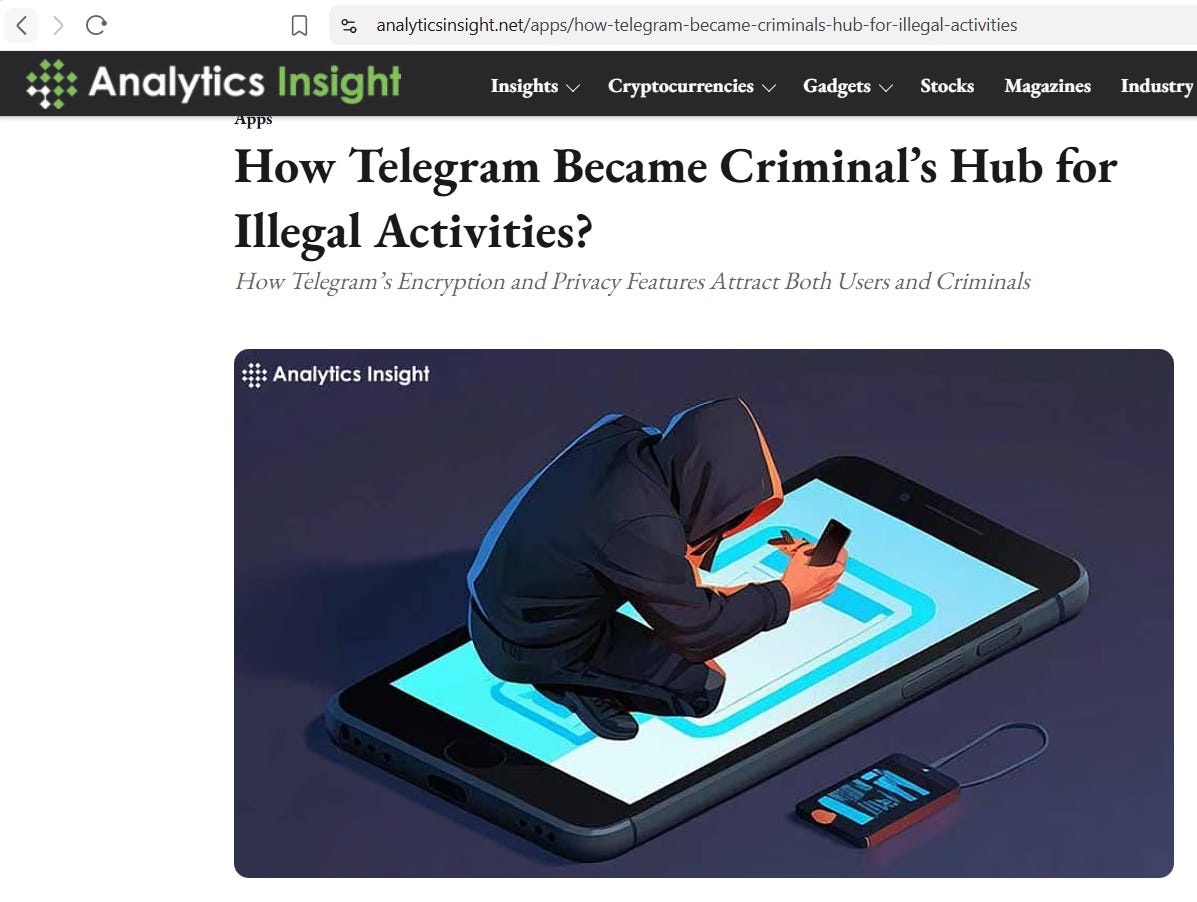
Now here’s why this is so important: Some of the data sources that we know Tangles is pulling data from include web forums, blogs, text storage sites (aka “pastebins”), Facebook, Facebook Marketplace, Instagram, Twitter/X, YouTube, LinkedIn, SnapChat, TikTok, Reddit, VK, Parler, Gab, and even the dating platform Tinder—but that’s not all. They also get your conversations from Telegram! Yes, they get your Telegram communications! Which is quite interesting because the government claims they can’t stop the crime running amok on the site because it’s encrypted. Clearly that’s not true.
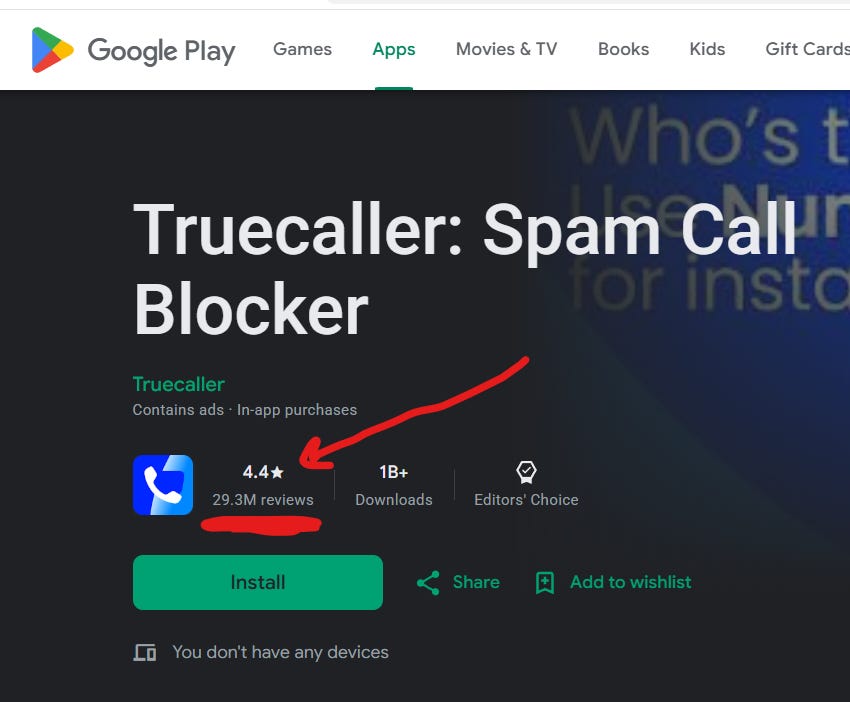
Additional data is pulled from Truecaller, which is a caller ID smartphone app! This cell phone app has almost 30 million reviews, just in the Google Play Store. That means no less than 30 million people are having their call information harvested for Tangles, and I guarantee not a single person knows this.
We will circle back to cell phone apps later in this publication.
Those are just a few of the apps Citizen Labs was able to confirm Tangles is using for data gathering. I guarantee there are dozens, if not hundreds, more. So, anyone using Tangles can type nothing more than your phone number or email address into the database, and it will spit out a biography of your life, including your Telegram conversations, your caller ID records, what you are buying and selling on Facebook, and Lord only knows what else.
Who are Tangle’s clients? Who truly knows the extent of it, but we do know the US Department of Homeland Security (DHS) enjoys the software because it allows them to “compile dossiers” on protesters and other citizens that they don’t approve of. Although all of this is done under the guise of keeping you and me safe, DHS was caught red-handed engaging in social engineering, meaning the psychological manipulation of people to get them to perform actions or divulge confidential information. Obviously, DHS denies such claims.
Additional US-based clients include ICE, the U.S. military, Texas Department of Public Safety, DHS West Virginia, NYC district attorneys, and several police departments in Los Angeles, Dallas, Baltimore, Tucson, and Durham, as well as those in smaller cities and counties like the City of Elk Grove and Pinal County.
I should mention Tangles offers its users a convenient mobile app because you never know when you will need to spy on someone while on the go, and it too was developed by Israel.
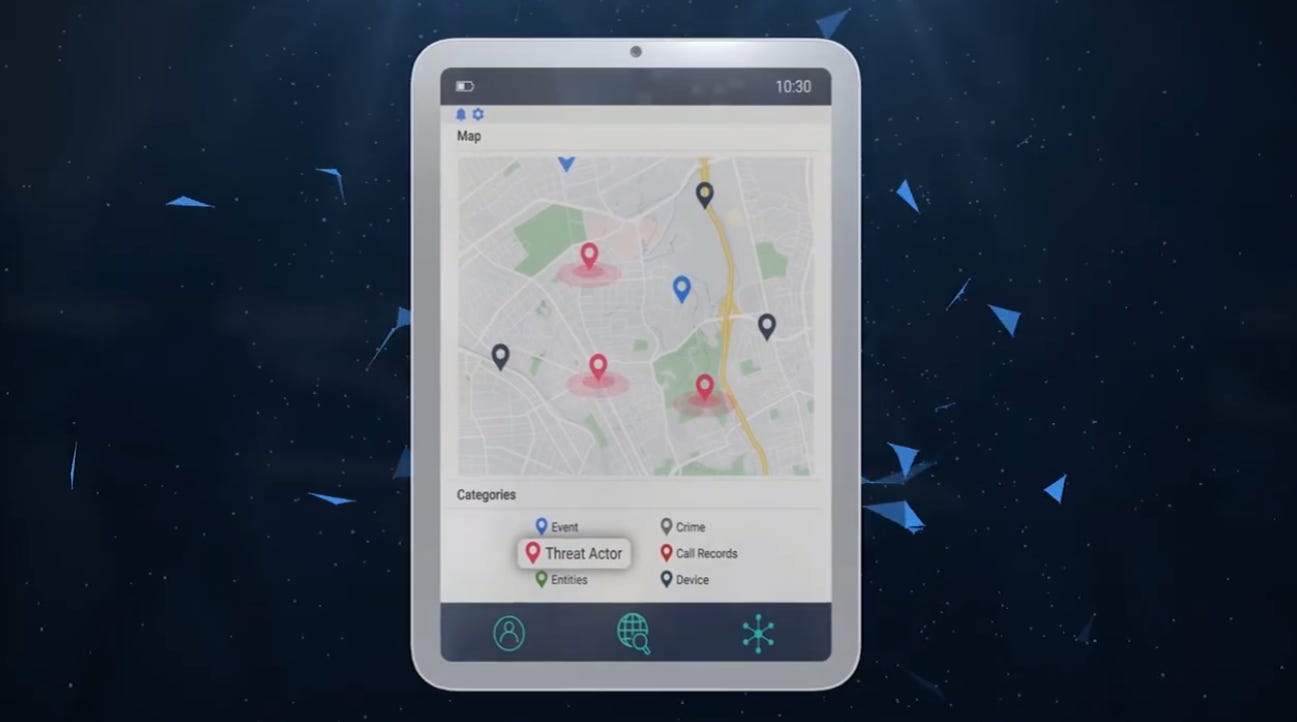
The next piece of technology that Cobwebs developed is called Webloc, which is described by journalists as an “ad-based geolocation surveillance system reported to have processed data associated with up to 500 million mobile devices.” Webloc relies on data purchased from mobile apps and digital advertising. This includes GPS, Wi-Fi location data, IP addresses, and more. (We will cover this thoroughly in the next part of this publication).
Webloc’s technology (also developed by Israel) focuses on “large-scale tracking of location patterns, movement analysis, and inference of behavioral profiles.” This program is Google Maps on steroids. Check out these screenshots from it.
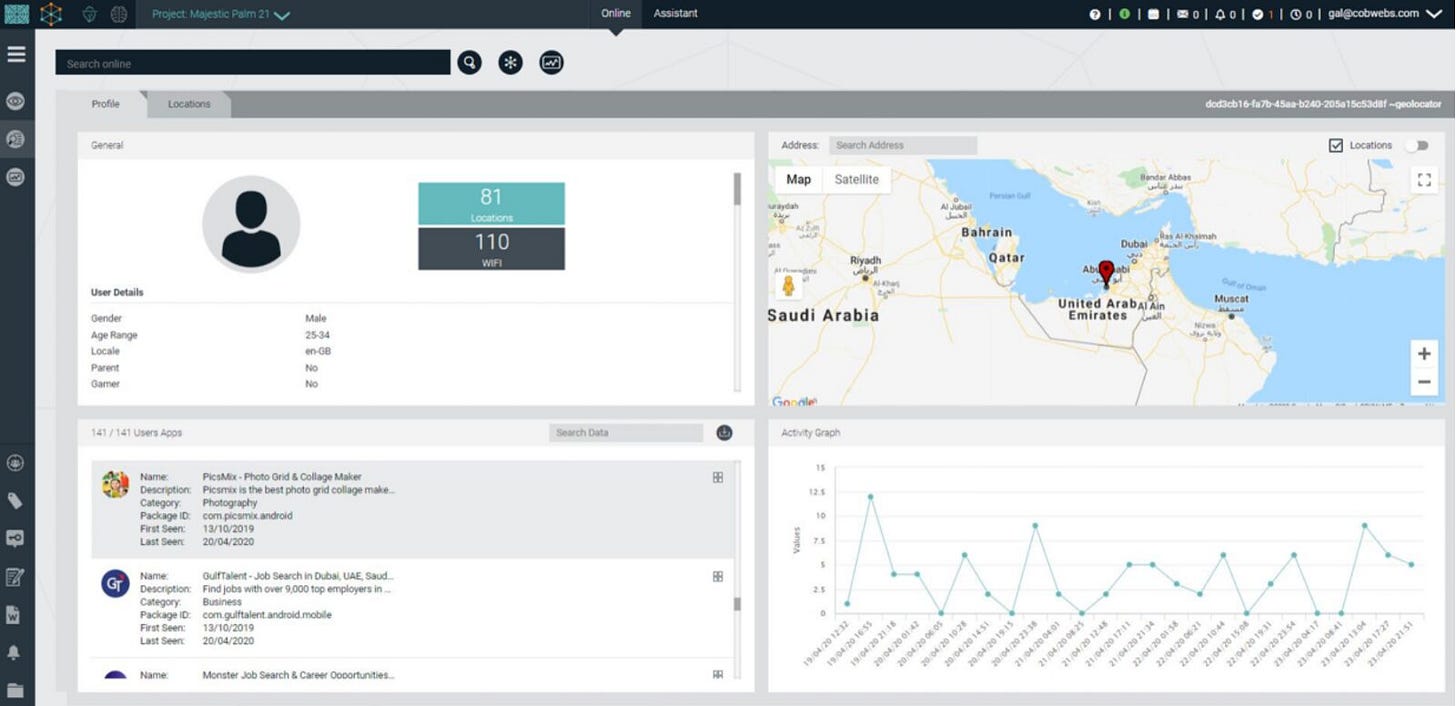
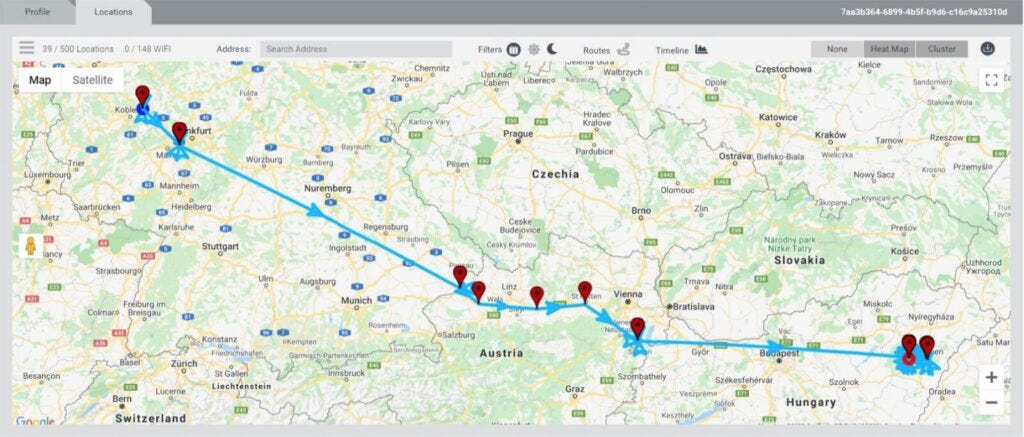
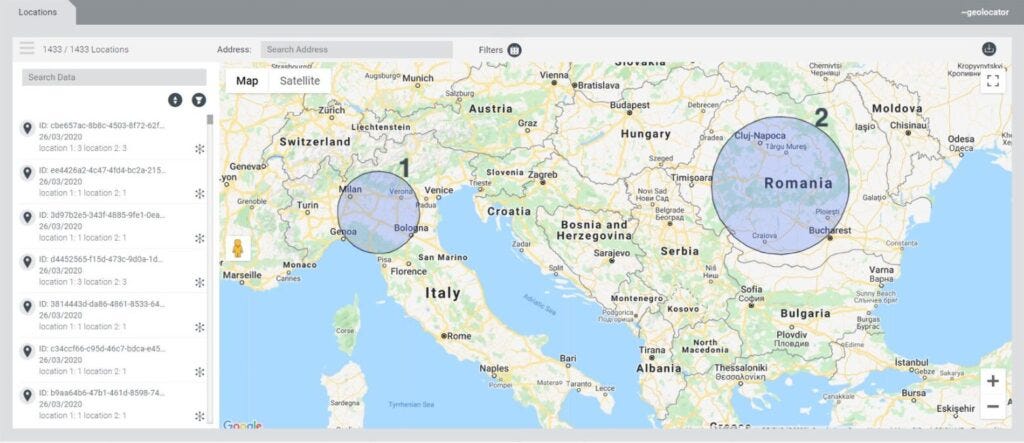
Tangles and Webloc are not the only programs being solicited by Cobwebs and Penlink. Lynx is another program that provides investigators with the capability to use social media platforms with fake identities and fake accounts. These fake accounts not only work on social media, but they also work in forums and even via email. All of this is run through a global proxy server infrastructure to mask the identity and location of the user.
Lynx does a lot more than offer users the opportunity to catfish and spy on people anonymously; the program itself also manages avatars and offers virtual agents, so it appears the fake accounts run themselves.
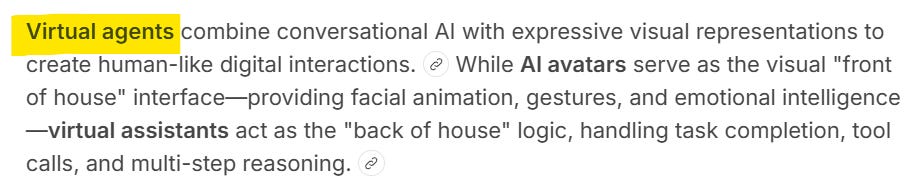
Clients include the Los Angeles Police Department as well as US federal agencies, including DHS and the Internal Revenue Service (IRS). Yeah, folks, the IRS purchased deception software that makes and runs fake accounts.
Another one of Cobwebs’ programs is Trapdoor, which Cobwebs promoted as an “active web intelligence” solution, but because it is so secretive, little is known about it or reported on it. Citizen Labs was able to obtain a technical specifications document that flat out refers to the program as a “social engineering platform.” While Lynx focuses on tricking people on social media as well as other methods of communication, Trapdoor is designed to create fake websites in a matter of seconds or minutes. These sites that Trapdoor creates are untraceable, professional-looking bogus websites, complete with a URL. It can then generate links, which, if clicked, will infect the victim’s device. Yeah, this program can throw together websites. This got me thinking about those fucky sites with the fucky font and fucky colors previously discussed. Were these instantly generated by a computer program? If so, that would explain a lot.
Additionally, Trapdoor sends targets phishing links. Phishing links are links that look like they are to one thing but are actually to something else. For example, you receive an email claiming it is from your bank that says you overdrafted your account. Although the link looks like it is from your bank, it is not. Unless you look closely, you won’t notice the name of the bank is spelled wrong in the URL because the link is fake. But, unlike traditional phishing links, Trapdoor has the ability to disguise a link as any website, so in this case, it will say the actual URL of your bank, and there will be no way to distinguish that it is a fake link.
Through the Trapdoor program, when the victim clicks on the link, malware will be installed onto their device. By definition, malware is “any software intentionally designed to cause disruption or destruction to a computer, server, client, or computer network; leak private information; gain unauthorized access to information or systems; deprive access to information; or interfere with the user’s computer security and privacy without their knowledge.”
Once the link is clicked, Trapdoor allows its customers to access a device’s camera and microphone, remotely open hidden tabs in the victim’s web browser, and deliver “payloads” to them. Additionally, information about the phone itself can be viewed, such as battery level, IP address, browser type, language, version and plugins, operating system and version, device type, CPU and GPU information, screen resolution, ISP information, estimated geolocation, user inputs, timezone, and even charging status. If available, it also provides “social media details” and “location network details.” Worse, the malware installs a keylogger, which means every key you type is logged—every text message, every email, every password to every website; it is all recorded as you type it.
Once the malware is installed, it begins to run, which includes performing actions on the target’s browser. It can close browser windows and open hidden tabs, all the while extracting media stored on your phone or computer.
Penlink claims they no longer sell Trapdoor, yet Citizen Labs was able to identify potential Trapdoor servers located in Kenya, Indonesia, Singapore, Hong Kong, the UAE, and Japan.
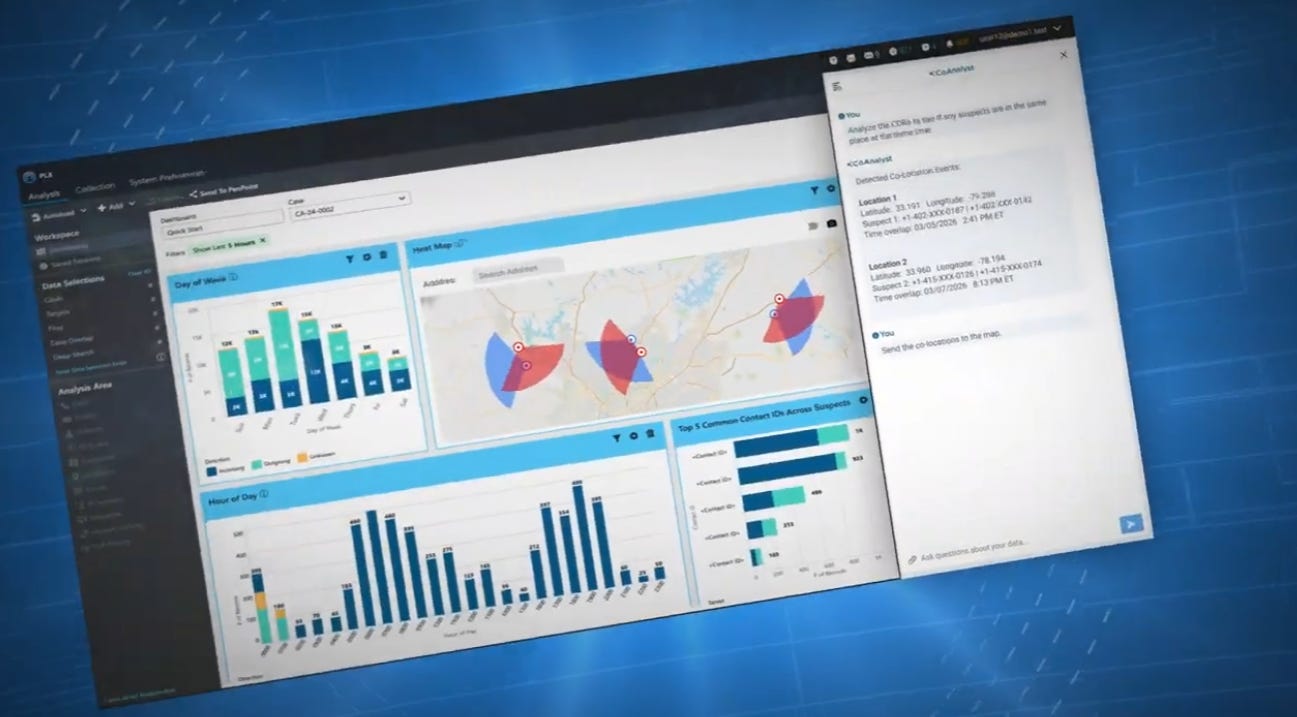
Next up is PLX, which, according to a commercial shown on Penlink’s YouTube channel, allows “investigators to uncover hidden connections, relationships, and patterns of activity between points of interest” (which means you and I). PLX helps to retrieve, organize, and analyze call records, search histories, login data, and other information from AT&T, Verizon, T-Mobile, Comcast, Google, Facebook, and other companies.
In 2022, Penlink had contracts worth $20 million a year with US federal agencies, including ICE, the FBI, and the DEA, and many more with local and state police.
Then there’s WebEye. A leaked document described WebEye as a system for “investigations of web pages and browser session extraction.” This program is also secretive, so there isn’t much to learn about it without booking a consultation through Penlink.
Pen-Link 8 and LINCOLN2 are two more comprehensive electronic surveillance systems for intercepting and monitoring various forms of communication, including wireline, wireless, satellite, VoIP, and 3G networks. Yes, wiretapping. It’s literally wiretapping. They also own PenProxy and Xnet. I have not been able to dig up anything on these two programs.
QUADREAM, I-OTT & FALKOR
Cobwebs is linked to Quadream, an Israeli surveillance technology company that was founded in 2014 by a group including two former NSO Group employees (the Pegasus spyware people). Quadream is known for its spyware marketed under the name “Reign,” which, like Pegasus, reportedly utilizes zero-click exploits to hack into target devices. A zero-click exploit is a sophisticated cyberattack that compromises a device or system without requiring any interaction from the user.
Once this spyware is installed, the individual running it has full control of the device.
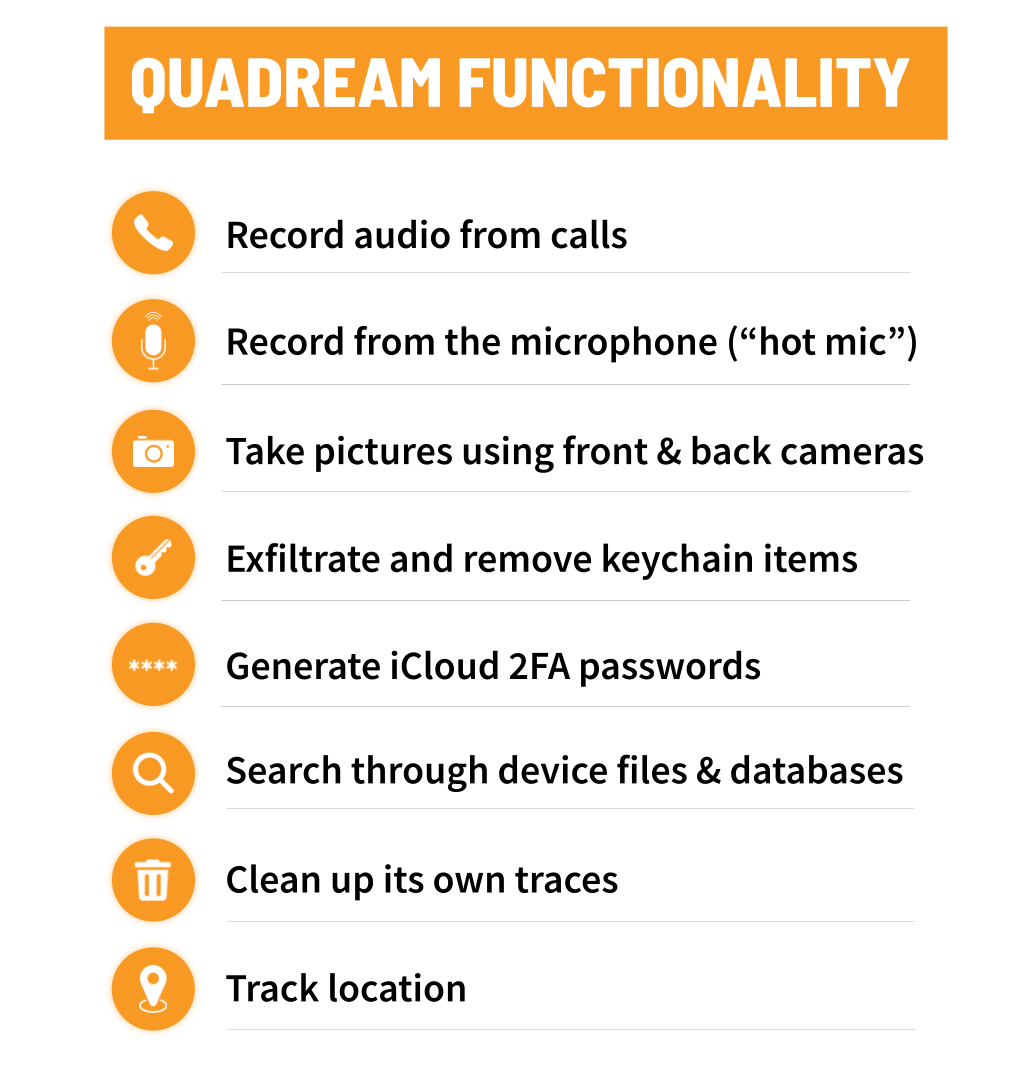
The Citizen Lab discovered that Quadream’s spyware was used to target civil society, journalists, and political opposition figures in North America, Central Asia, Southeast Asia, Europe, and the Middle East.
I-OTT
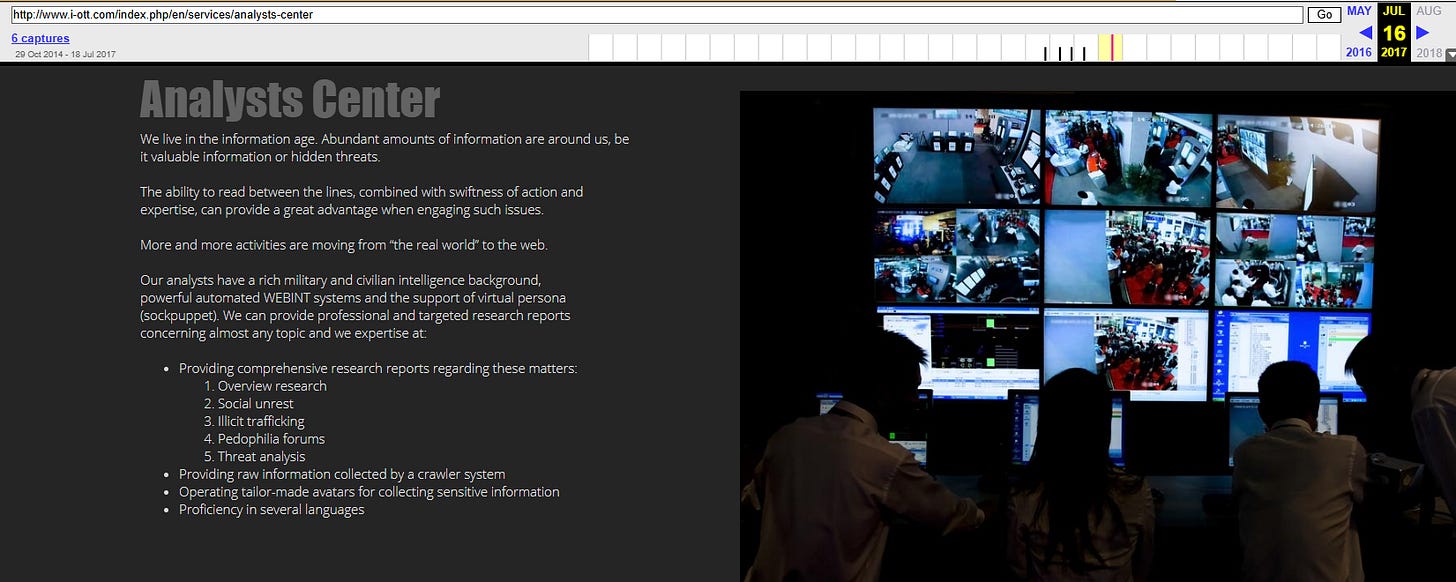
According to company registration documents from Israel, the investors in Cobwebs and Quadream also invest in a company called I-OTT. I-OTT advertises itself as providing “combat training” for “guerrilla warfare” and consultations on “covert operations.” Its website states that I-OTT offers “customized intelligence solutions for governmental and private agencies” and claims to have offices in Israel, Mexico, and Brazil.
The 2017 version of its website stated they provide users with the basic effective “toolbox” for anti-terror and guerrilla warfare along with “training and consulting about covert operations and units.” Their software’s capabilities included generating “targeted research reports concerning almost any topic,” including “social unrest.” They also claimed to be operating “tailor-made avatars for collecting sensitive information.”
FALKOR
Quadream is connected to a company called Falkor, which specializes in mass data analysis. Falkor’s program combines open-source intelligence (OSINT) with social media intelligence (SOCMINT).
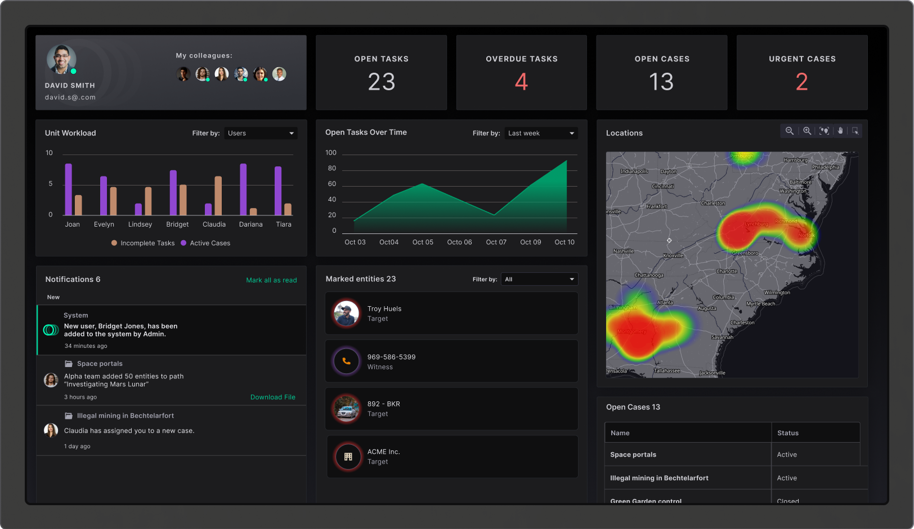
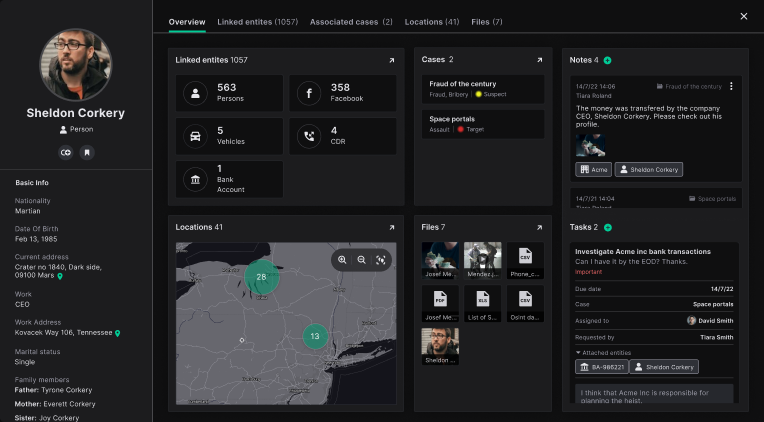
Amongst a plethora of things the programs do, they can create detailed connection charts. These charts display everyone in your life, including your boss, your second cousin, or anyone else you communicate with or have ever communicated with, including their contact information and heat maps showing where you or your associates travel. They also display bank accounts with bank account numbers.
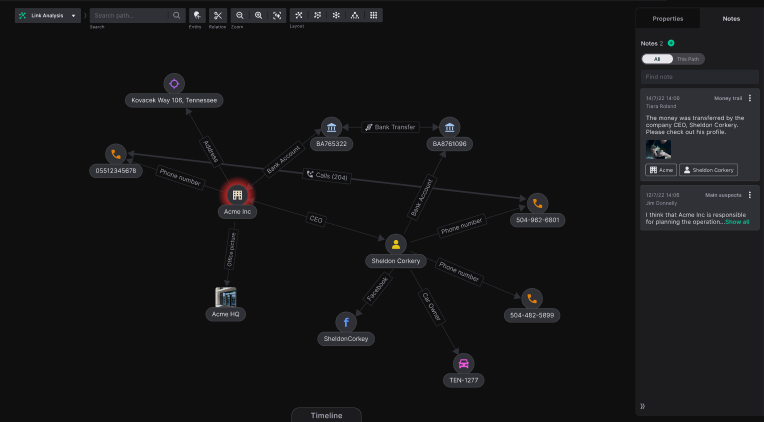
There are so many companies involved in this spy tech that I can’t possibly cover them all.
Uri Ashkenazi is an Israeli investor who not only has all of the aforementioned companies in his investment portfolio, but he is also the senior vice president of finance at Cobwebs. He is also the managing partner of Titan Ventures, a VC firm focused on Israeli cyber-intelligence investments, and a director of both I-OTT and Falkor Vision. Once again, everything is intertwined.
If what you have heard thus far doesn’t scare the absolute shit out of you, wait until you hear the next part….
Original Article: https://chemtrails.substack.com/p/what-is-cobwebs-the-shadow-entity
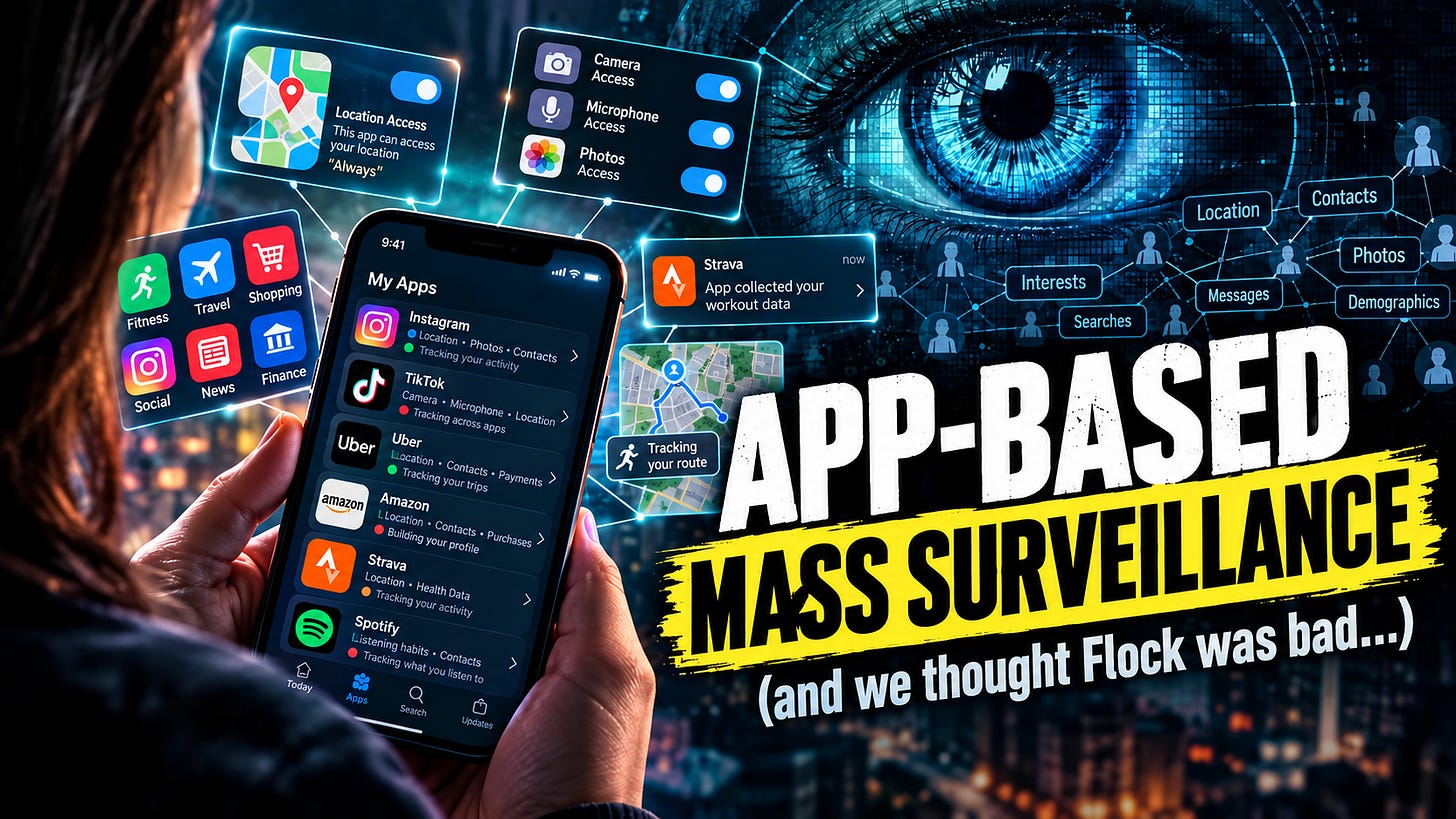
Part 6 | APP-BASED MASS SURVEILLANCE (and we thought Flock was bad…)
How Apps and Advertisements are SPYING
Agent131711 | chemtrails.substack.com
Although this series was originally intended to be a deep dive into Flock, the road took me elsewhere, and this road that few other researchers are traveling is incredibly important because it all ties together in the end. This may sound confusing for a moment, but trust me, it won’t be, so stick with it.
The advertising industry is collecting data on us. Data collected contains “Mobile Advertising IDs” (MAIDs), which identify a phone or other mobile device and the person using it. The 32-character hyphen-separated MAID assigned to your device is a special code that only your device has (e.g., 919F1D1F-F195-4C8B-AF47-58683FE11DB9).These codes enable us to be targeted with advertisements. This is why someone who loves to travel will see a lot of ads for places to travel no matter what website they are on, whereas someone who is a gamer will get lots of game-centered ads.
The advertising industry has ongoingly insisted that while people are being tracked, the MAID anonymizes them; therefore, their identity is wholly unknown to the advertiser. They further insist that, due to the anonymity, what they are doing is not actually surveillance. However, the US Federal Trade Commission (FTC) recently clarified that advertising IDs “offer no anonymity in the marketplace” because advertising businesses commonly link consumers’ MAIDs to other information about them, such as names, addresses, IP addresses, and phone numbers. Therefore, once a MAID has been assigned to your device, that device has been assigned to you as a person. It might as well be listed on your driver’s license because it is no secret.
SDKs
Recall how I said previously that Cobwebs Webloc technology “relies on data purchased from mobile apps and digital advertising.” This means Cobwebs is actively involved in the purchase of this data that is being harvested from us without our knowledge and typically without our understanding. Meaning, even if we do give an app consent to know our location, we assume this is for functionality and do not understand that they are then tracking and surveilling us.
The software used to capture this data is called “software development kits,” known as SDKs for short. These are programs / scripts that are embedded into the code of the application. So these aren’t something we can see unless we access the entire code for the application and then go through it, line by line, looking for an inserted SDK.
To recap, the MAID is the unique identifier assigned to our device. An SDK is embedded into the app to transmit data. It tells the data harvesting company what action we took and assigns that action to us via the MAID. Although the MAID is indeed a randomized set of numbers or letters, because businesses layer our MAID with other details, such as our name, address, or email address, it is no longer anonymous; therefore, these data harvesting entities know precisely who we are and what we are doing, which, despite their denial, is surveillance.
So what exactly is this scraped data being used for? An investigation by EFF uncovered that, amongst other things, it has been used for ICE investigations, global spy tools, outing a gay priest, tracking union organizers, and tracking US military personnel. Would you like to know where specifically this data is coming from? Meaning, what specifically has a data harvesting SDK in it? The answer is ordinary consumer apps, such as games or weather apps. In fact, the advertising (data harvesting) company Huawei claimed its Petal Ads SDK software is embedded in more than 85,000 apps worldwide—and this is just one company. Another company that sold the US military data collected through its SDK embeds, was pulling data from 400 apps, including Muslim prayer and family safety apps.
WHAT WE ARE ACTUALLY CONSENTING TO
When you install an app, you will likely grant it permissions. We assume the purpose of these permissions is so that the app can function properly, but it is a double-edged sword. Let’s look at what different permissions allow for.
- The “Location” Permission — Location data isn’t limited to the application learning you are from Boise, Idaho, or that you live on First Street. Location permissions include the transmission of GPS coordinates, Wi-Fi networks, and even Bluetooth beacons. Now you’re thinking, “That doesn’t happen to me because I don’t ever grant these things permissions!” I hate to inform you, but an EFF investigation identified numerous advertising SDKs that collect and share users’ location by default. Further, they found that even if you declined to give the app permission to know your exact location, they bypassed location permission and tracked their precise locations through WiFi network data. Additionally, when Apple released its App Tracking Transparency initiative and Google made improvements in Android permissions, access to geolocation data was much more limited. To get around those restrictions, data harvesters created apps that require access to location data such as weather, navigation, fitness, and dating apps.
- “Access Contacts” — As you can assume, this means the application is able to access names, phone numbers, email addresses, and whatever else is stored in your phone as contacts. Even if you do not allow apps to access your contacts, everyone else in the world does on every app, so your family tree and little circle of life is known by thousands of assorted companies all over the world—companies which you never opted in to.
- “Access Photos”—This may sound self-explanatory, but it is deeper than the advertiser just looking at all the pics you took of your cat. Should the purpose of the app secretly be data harvesting, they can also analyze metadata associated with those files and potentially obtain GPS/location information. Worse, they can copy or upload the actual image or video to a remote server if the SDK is programmed to do so, potentially perform facial recognition on your images, or even use them to build out a new biometrics program. Once you give them permission to access your gallery, they have free rein to use every last image to build user profiles or, who really knows what, because the SDK has no obligation to tell us how specifically it uses our images. Now if you’re like me, you always photograph important documents because you know you will lose the paper within 48 hours. Should you grant an application permission to access photos and files, and should the purpose of the app be to scrape information, they will soon know that you just refinanced your home and you were invited to a wedding on January 8th. Equally, if the permission granted is for photos and files, the “and files” part is the kicker. This means every single file on your device, whether that be a document you downloaded from the IRS or a digital book you’ve been reading.
- “Access Microphone/Camera”—Arguably, the microphone / camera permission is more valuable than photos / files. Camera permission can allow for biometric scans, and I assume you already know what a microphone does.
- Read Device information — allows the SDK to obtain phone model, operating system, language, carrier, IP address, advertising ID and other technical identifiers. While this information may seem very insignificant, it can be used to build user profiles. As you can see, this is no longer a 32-digit randomized code assigned to a device because they now have your IP address and so much other info.
- Usage behavior (which may instead be called “Usage Data,“ “Product Interaction,” or something along the lines of “collect component usage statistics.”) This permission grants the app the ability to monitor what you click, search for, watch, and buy; how long you stay on a screen; and what features you use. Even if you don’t grant specific permission for the application to monitor your full device, just by installing the app, you are agreeing to have it monitor what you do within the app itself.
- Browsing/activity information—this permission allows everything you do online to be indexed. This is incredibly valuable data. Take a moment and view your browsing history by opening a web browser page and clicking the three dots menu icon in the upper right. Scroll down to “History” and start skimming. As you skim, know that companies, at this very moment, could have access to every single search you performed. As a researcher of the hidden hand, you would not believe how fucked up my web history is. I cringe at the thought of it being associated with me as a person.
- Transaction information — Here, your purchases, subscriptions, and interactions with the app are recorded.
Even at this point in the story, there will be people who say, “I don’t give a hoot if some company knows I go to church on Sundays,” so let me explain what is going on in more detail:
According to the FTC, a company called X-Mode installed its SDK into over 300 apps to collect precise location data, which included latitude/longitude, timestamps, and a mobile advertising identifier. These apps included games, fitness trackers, and even religious apps. After harvesting the data, X-Mode sold it to third parties, including advertisers, analytics companies, consulting firms, research organizations, and private government contractors. Because the location pinpoints were tied to MAIDS, all anonymity was lost, and everyone who downloaded the apps could be identified by name or email addresses obtained from other sources. You see, that is what they are doing, my friends. They obtain data from one source that tells them the exact routes someone takes, such as:
Device #847293Monday: medical facilityTuesday: pharmacyWednesday: homeThursday: specialty clinicFriday: pharmacySunday: Lutheran church
Device #769569Monday: office complexTuesday: office complexWednesday: office complex, elementary schoolThursday: office complexFriday: office complex, elementary schoolSaturday: Home improvements storeSunday: Home improvements store
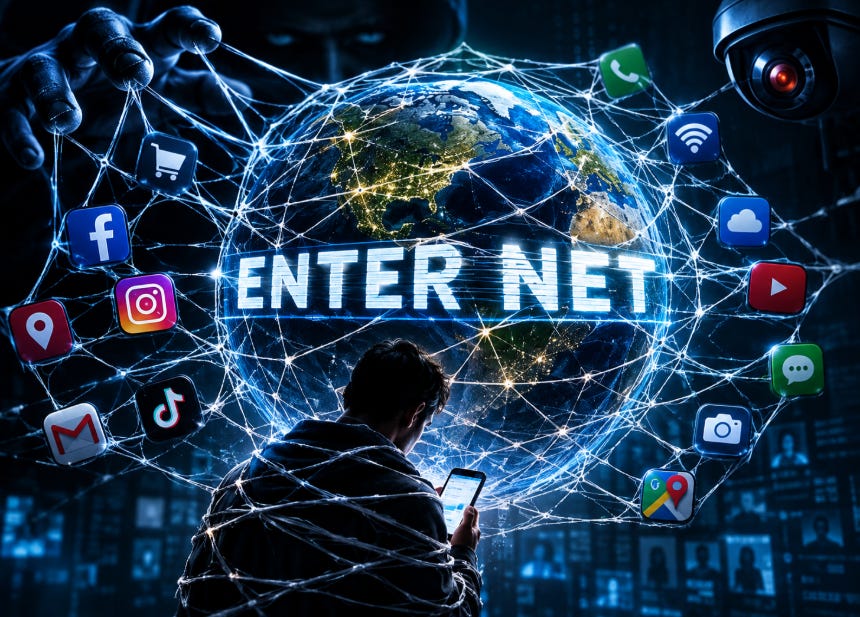
Then they combine the information with other datasets, and they learn who people are, what medical conditions they have, where they work, what faith they practice, if they have children, where those kids go to school, and who their relatives are, and so much more. Perhaps that is why it is called the “World Wide Web”—it is a web around the world; we are caught in it. It’s not “internet,” it’s “enter net”; enter the World Wide Web.
This information isn’t only sold to advertisers; it is also sold to government contractors, police, private detectives—anyone who wants to purchase it. This includes people engaged in black market activity like identity theft, mortgage theft, credit card fraud, and more. Even human traffickers could buy it. It’s mind-blowing.
THE DATA HARVESTING INDUSTRY
“Once I started asking what happens to the information collected by surveillance systems, I discovered something much larger: an entire industry exists to collect, aggregate, match, analyze and monetize information about individuals.”
InMobi and BidMachine are companies that provide advertising SDKs (software development kits) that developers can embed inside an app. Once embedded, these scripts will begin scraping data. So let’s say I make an app for Shadowbanned Library. I then secretly incorporate their SDK into it. I offer the app for download; you download it. You grant it location permission under the belief that this will allow the app to appear in your language, meaning if you are in America, it will be in English, whereas if you are in Germany, it will be in German, and so on. All along you are none the wiser that the SDK could be pulling your precise location and sending it off to be sold in an advertising system where it will be layered with so much other scraped data that your entire existence is for sale to anyone who wants to purchase it. (FYI: No, Shadowbanned Library does not have an app, and no, we would never embed this scraping bullshit or sell your data because the practice is disgusting.)
BUSTING APPS
I wanted to find out the names of apps that have been busted harvesting and selling data. Remember that this is no simple task because, in order to find out if an SDK is actively transmitting data, someone has to access all of the code and really examine what specifically it is doing, and there are not many researchers who have the know-how or desire. That said, I was able to track down several, and many of these might surprise you.
A 2026 investigation by the Electronic Frontier Foundation examined advertising SDKs embedded in Android apps and found two specific apps that were transmitting precise location coordinates to an advertising SDK. The first is QR Scanner, which advertises itself as a “fast and easy QR code scanner, QR code reader, or barcode scanner for Android.” This app has over 50 million downloads.
Who the hell would have ever thought a barcode scanning app is a data harvesting app?
The next is GPS Speedometer, which targets bikers, runners, boaters, and drivers. It has more than 10 million downloads.
Family GPS Locator & Tracker, which has over 50,000 downloads. We cannot prove this is transmitting harvested data, but it says right here that it is linked to both InMobi and BidMachine networks, so you be the judge.
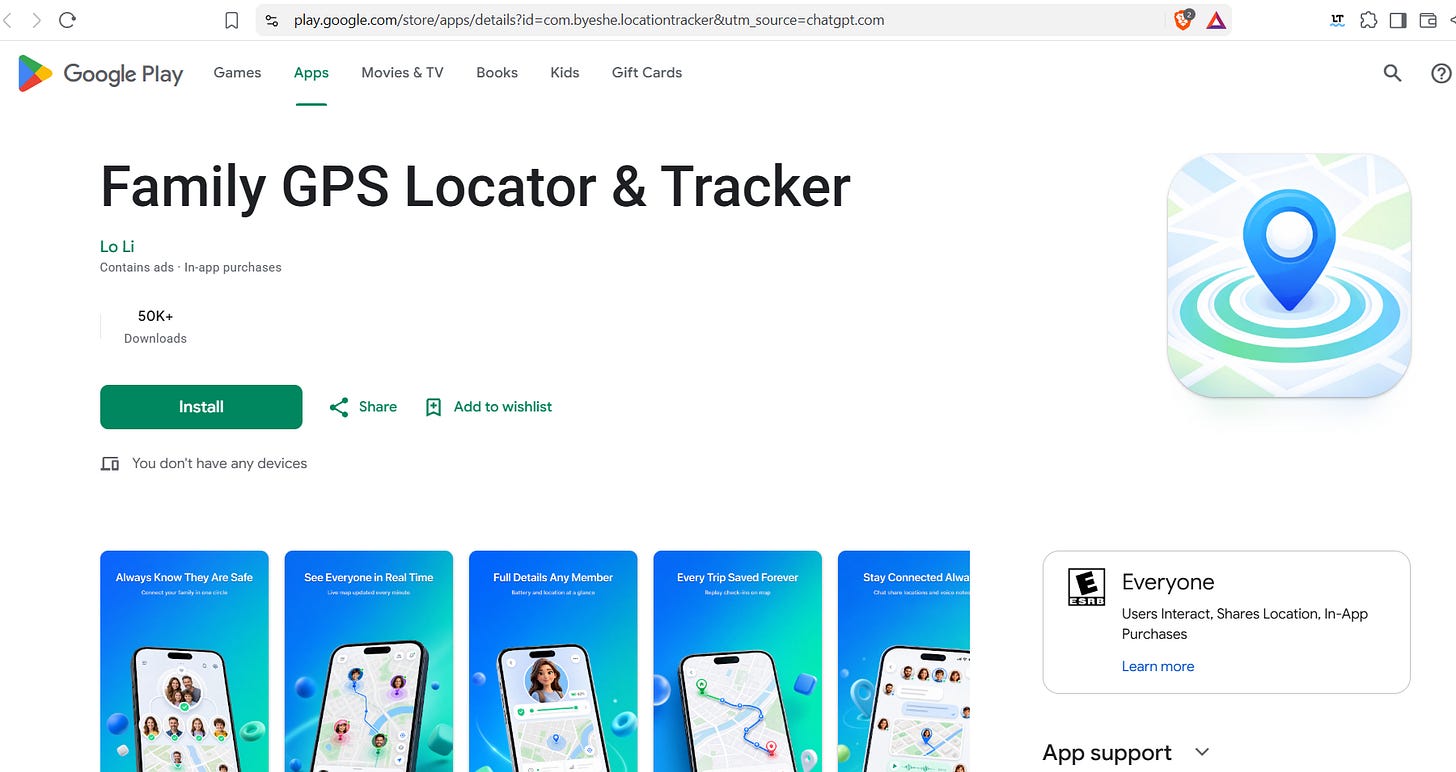
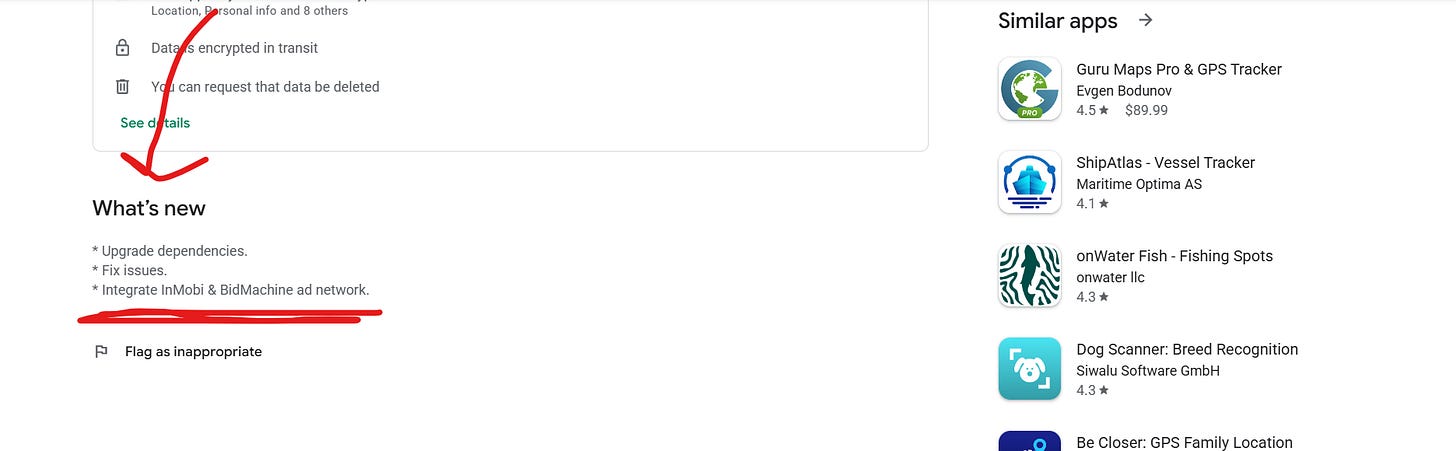
Next is Document Scanner - OCR & Smart, which has over 100,000 downloads.
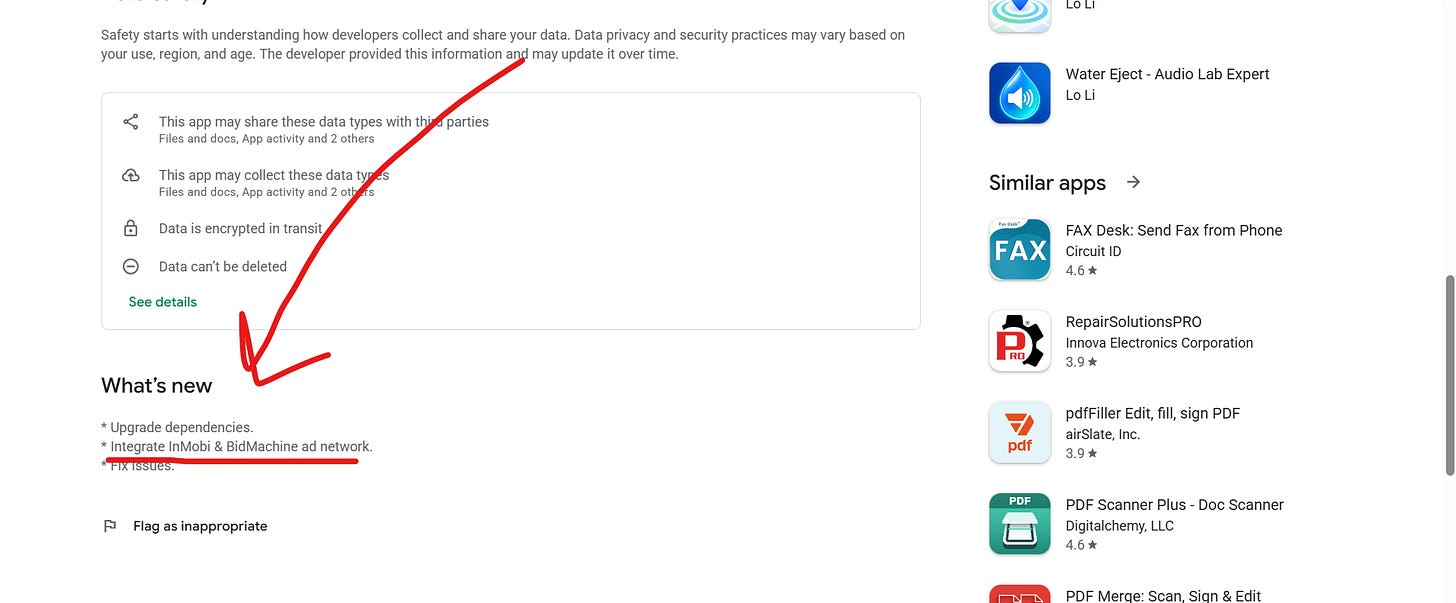
Water Eject - Audio Lab Expert, which claims to instantly remove water from your cell phone, has 50,000 downloads.

As ChatGPT pointed out to me, this app also requests CAMERA and RECORD_AUDIO, according to the permission listing for the current version.
Prank Sound, Voice & Fake Call has over 100,000 downloads, and it too features SDKs for InMobi and BidMachine, and, unlike the others, it is confirmed that this app is indeed sharing harvested data.
Metal Detector, Ruler, Decibel is a very popular app, with over one million downloads. I bet exactly zero of the people who have this on their phone know what it is being used for.
Live Wallpapers & Screensavers also has over one million downloads, but unlike the others, if you read the fine print, it admits what it is doing.
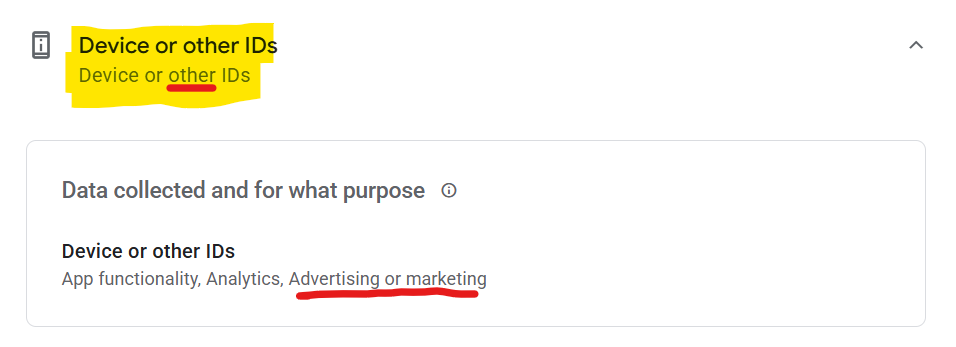
Those are just a few of an ocean of apps that are engaged in data scraping. A company called Verve says its HyBid SDK reaches more than 1.5 billion users across 10,000+ apps worldwide. Another company, Huawei Petal Ads, has its SDK installed in more than 85,000 apps. And don’t think that an app you are downloading has only InMobi or only BidMachine SDKs on it.
WalkEarn: Make Money advertises itself as a way to earn money while getting healthy by walking. In fact, my spouse downloaded it for a friendly competition at work, but my sweetheart wasn’t the only one. WalkEarn has over five million downloads.
Shockingly, an investigation performed by Exodus revealed that this application featured 28 trackers, including InMobi, BidMachine, AppsFlyer, AppLovin, Facebook Ads, and more. [You will need to translate the site to read the investigation].
Exodus also found that the app Text Free, which has a whopping 50 million downloads, was loaded with 30 trackers!
Want your socks blown off? Remember how we discussed Truecaller earlier? This caller ID app has over one billion downloads.
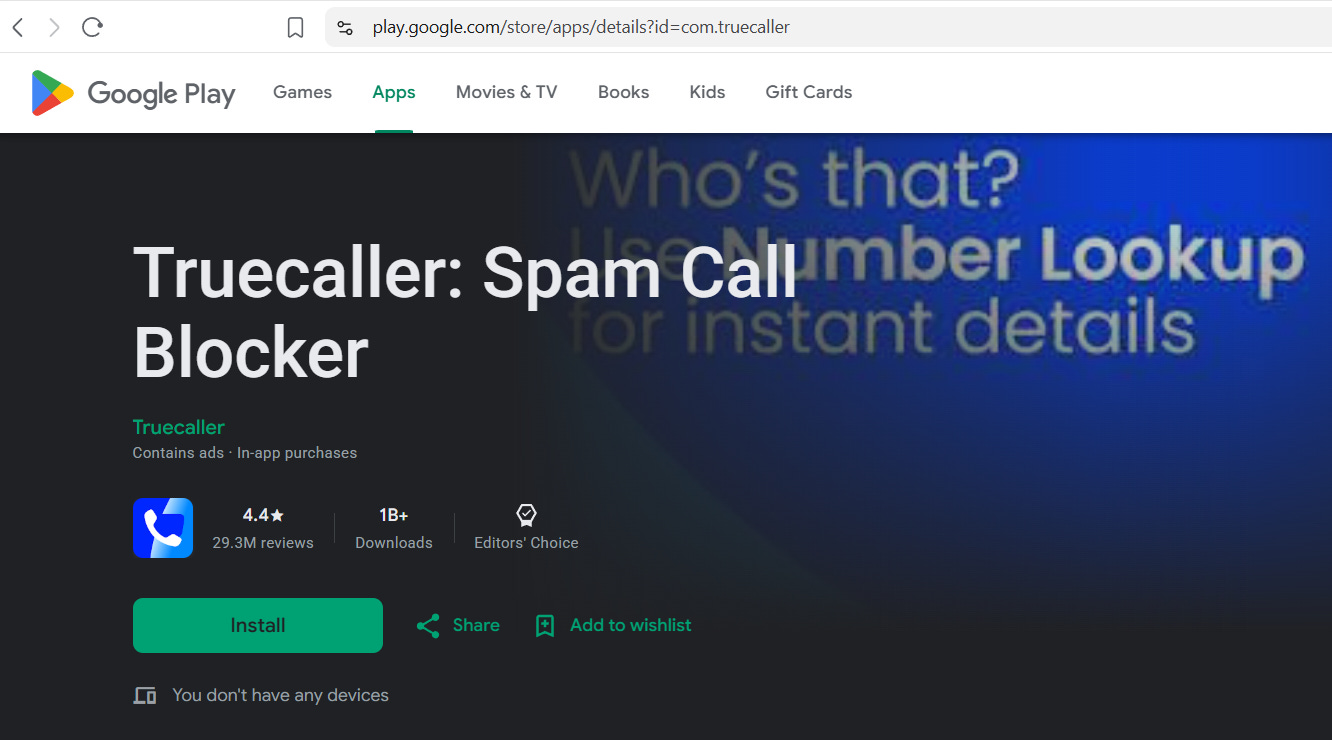
Exodus discovered it has 31 trackers in version 26.2.5, including:
- BidMachine
- InMobi
- Criteo
- AppLovin
- AppsFlyer
- Facebook Ads
- Google AdMob
- Firebase Analytics
- CleverTap
- Huawei Mobile Services
- And dozens more!
Do you remember how I said previously that Penlink-Cobweb’s Tangles program was pulling information from Telegram, Facebook, Truecaller, and more? I am willing to bet that this is because all of these programs, including Telegram, have SDKs, and Penlink-Cobwebs has access to all of them. For all we know, these companies (meaning the government contractors) are the ones making these free cell phone apps just for the purpose of surveilling us. This got me wondering about a bigger company like…
Original Article: https://chemtrails.substack.com/p/app-based-mass-surveillance-and-we
Part 7 | Facebook: The Surveillance Machine You Voluntarily Installed
From DARPA to Meta: The World’s Biggest Data-Harvesting Experiment?
Agent131711 | chemtrails.substack.com
What is really going on behind the like button? Are “encrypted” messages actually secure? Learn the mind-blowing truth about the free social media platform…
Now remember what I told you previously in this publication: Facebook happened to be founded by nerd Mark Zuckerberg the exact day the Defense Advanced Research Projects Agency (DARPA) of the US Department of Defense (DOD) (allegedly) closed down its project in which it aimed to catalog every activity and relationship a person engages in in its massive electronic database. Clearly, this is just a coincidence (LOL.) With that in mind, let’s take a peek at what specifically Facebook is doing when we use the platform and, shockingly, when we aren’t using the platform.
WHAT FACEBOOK LOGS WHEN WE USE THE SITE
- Contact information: This is important because, while this data may seem to be of little value, it becomes gold when it is overlaid with all of the following information.
- Profile information: This is also important for the aforementioned reason.
- Posts: Obviously, what we post is paramount for profiling us, and every last post is very valuable data, even the posts you made after too many margaritas.
- Photos: Not only can these be used to build out connection databases (you, your father, and your brother together), but they can also be used to create biometric databases. Photos also compile data on locations, likes/dislikes, voting tendencies, income level, and so much more. Metadata from photos can also be harvested.
- Videos: If a picture is worth a thousand words, how many words is a video worth? Videos contain faces, audio (including voice that can be used for analysis), logos and brands, buildings, license plates, children, food, music, even the text appearing on the screen; all of this is harvestable data. But that’s not where the data gathering ends. When you watched the video, did you stop after four seconds? Or did you continue until the end? Did you replay it? Did you share it?
- Stories and Reels: Allow for all the same harvesting as photos and videos, but with stories and reels there’s even more data. And, of course, who watched it, liked it, shared it, etc.—that is all great data to rake in.
- Comments: You may be shocked to discover how valuable comments are. Above and beyond linking together connections, each word has value. If someone responds, “I just bought these for my daughter,” the word “bought” triggers purchase data harvesting, while “daughter” triggers relationship data harvesting. If you take this a step further, the photo combined with the comments is used to create groups. For example, a photo of a wounded Army veteran and the outpouring of support in the comments section. The people in the comments section can be added to data sets for supporting military veterans.
- Messages: Facebook claims messages are end-to-end encrypted, but, upon investigating this further, “end-to-end encryption” does not mean the company can never see or read any of the information associated with the conversation. It specifically means the message content, while in transit, is not readable by the service provider. The keywords are “in transit.” This means that during the split second the message is in the delivery stage, nobody can see or listen to what’s sent or said. So the text leaving your phone and arriving at the recipient’s phone will be protected, but there is no protection for the text you type before it leaves your phone or after it arrives on the recipient’s phone. In fact, earlier this year Facebook announced it will be using AI to scan messages for spam. So, because there is no encryption until the message is sent, and then there is no encryption after it arrives, there really isn’t any privacy at all, and throughout the process, AI and SDKs can scrape every last detail. With that in mind, messages are a goldmine of information, even if the conversation seems dull. Something as simple as “Uncle Joe was diagnosed with cancer” not only signals a relationship but also a medical condition. Now imagine if the content is salacious, such as a politician flirting with a young social media influencer or a Ford Motor Company executive making a racist joke privately to his buddy.
- Likes and Reactions: Whether you click the like button on a Nike ad, a baby chinchilla, or a clean eating recipe, this information is being added to your secret user profile; Brenda Jones likes Nike sneakers and cute animals. She tends to avoid processed foods but has a serious sweet tooth—all very valuable information.
- Searches: As you can imagine, what or who you search for is even more valuable than the heart you clicked on the bowl of spaghetti. Think about it; you search for “Divorce lawyers in Minnesota”—not only are you currently married, considering a divorce, and living in Minnesota, but you are also looking for a mouthpiece to represent you in court. My goodness, those four words turned into a lot of data.
- Friends and Followers: This may seem obvious, but it’s deeper than that. If ten of your friends like the Denver Broncos, eight follow NFL players, and six of them belong to football groups, you don’t have to tell anyone that you like football because the people around you are a strong enough indicator. Through friends and followers, your profile can be built to include politics, religion, and so much more.
- Groups: This data is incredibly valuable too, especially from an advertising point of view. If you join a group for money-saving ideas, you can be spammed with ads about saving money, or you may be suffering financial hardship and be in need of a loan, refinancing, or debt consolidation. Equally, if you join a group for a very specific person, place, or thing (e.g., University of Michigan Alumni), you don’t need to log that you went to school there for Facebook to know.
- Marketplace Activity: Whether you are hunting for a one-time purchase, such as an affordable used chandelier, or an ongoing restock, like wood for your woodworking side hustle, what you buy, sell, and even what you view are all usable data.
- Purchases: I have covered this one previously in this publication.
Not only is Facebook (Meta) recording all of that information, but it is also scraping metadata surrounding all of that activity, including the time of day you post or like something, the frequency and duration of your activities, what device you were using, what links you followed afterward, and so much more. Meta’s privacy policy says it collects information from computers, phones, connected TVs, and other web-connected devices that integrate with its products. For fuck’s sake, the company’s name is Meta, which means “high-level analysis of something.” That high-level analysis is being performed on us.
After collection, Facebook layers that data with other data it has collected. Not only does this include location-related information, but it can also harvest information about nearby devices and networks, so it is basically creating a geofence.
“THAT’S WHY I DON’T USE FACEBOOK!”
I hate to inform you that even if you don’t use Facebook—perhaps you have never even made a Facebook account—you are still having your data harvested by Meta. This is because Meta has an expansive assortment of data scraping tools that businesses and individuals can install on their own websites and put into their apps. A few of Meta’s tools include Meta Pixel, Meta SDKs, Meta APIs, social plugins, and Conversions API. There is also server-to-server communication, and this one is important because there doesn’t have to be a tracking script running in your browser for a business to send Meta information about you or your actions.
For example, you visit an online store that sells sneakers. You browse the site for a while to compare products. You then purchase a pair that fits your needs. If the entity is connected to Facebook, the business’s server can send Meta details about the purchase, including when it happened, what you bought, how much you spent, where you are from, and more.
Now let me add in here, not all trackers are “bad.” Whether it is good or bad depends on who is obtaining the data and what their goal is. As an example, at Shadowbanned Library, my partner Medicine Girl and I have decided to collect as little information as possible while still being able to have a fully functional website. This choice has had repercussions. One of them being that without tracking, I have no idea how many people read the articles I post. This isn’t good because I have no way to judge growth. Our site also is not connected to Facebook or any other platform. But it’s a double-edged sword because we have no metrics aside from the very basics. That said, we generate enough money to pay the bills each month, so until that changes, we can keep flying blind. But as I said, whether trackers are good or bad depends on the end goal, and when that end goal becomes building databases for evil purposes, this is when we enter scary territory.
REAL-TIME BIDDING & DATA PACKETS
Without getting into the weeds, you know how there are ads all over the internet? Ads change every time a page is viewed, and the ads that you see will be different from the ads that I see. Businesses bid on their ads being shown (and hopefully clicked). These auctions take place in a fraction of a second because the ad, tailored to you, has to be in place when the page loads. This process is called Real-Time Bidding (RTB).
So basically, how it works is the business, say a clothing store, wants their ad for sweaters to appear on your browser screen, and because so much of your data has been scraped from you, the ad companies know you always buy a new sweater this time of year. The clothing store tells the advertiser, “We are willing to pay $2 if you get the sweater-lover to click our ad.” Then another clothing store says, “We will pay $2.50 because we know that lady is bound to buy one.” A third offers a whopping $3. Imagine this on a worldwide scale: all of these businesses competing for space on our screen, and it all takes place within a fraction of a second.
The data that is associated with real-time bidding has so much value that it too is bought and sold. A single data broker who obtained RTB data and sold that data to US federal government customers through defense contractors claimed to have data on more than one billion mobile devices. I said one billion mobile devices! Another collected real-time bidding data from thousands of apps.
So, as you can see, we now have two different methods that are being deployed to scrape every last piece of data about us: SDKs (Software Development Kits) and RTB (Real-Time Bidding). Now that we know how our data is being scraped, let’s move on to what is happening with it once it is obtained because this is what begins to bring the two worlds together (what we do online and what we do in real life)…
Original Article: https://chemtrails.substack.com/p/facebook-the-surveillance-machine
Part 8 | Your Credit Card is Spying: We are Being Tracked Like Deer
How your credit card is selling you out to the highest bidder. What exactly are they doing with all of this information? The secret world of data harvesting explored.
Agent131711 | chemtrails.substack.com
And right about now you’re thinking, “This is supposed to be about Flock cameras. This has literally nothing to do with the topic,” but here is where it all begins linking together—pay attention to this one because this is the intersection between what we do online and what we do in real life. Once we cross over the intersection, you will see how it is all connected…
WHERE THE DATA GOES AFTER IT IS COLLECTED
Assuming you have read the prior chapters in this series, once the data has been harvested, it goes to a company like LiveRamp. LiveRamp says it works with mobile app developers to obtain mobile device advertising IDs—Apple IDFAs and Android Advertising IDs. Those IDs are then added to its lists available in its Data Marketplace, which allows companies to buy and sell marketing data.
As you can see below, LiveRamp’s Data Marketplace sells data to a huge variety of industries. These industries can purchase location data, survey data, TV viewership records, demographic data, life-stage data, and data involving attitudes, values, interests, opinions, and lifestyle choices). But that’s not all, they can also buy records related to our purchases, friends and family, online registration information, and even offline data. Did you hear that? I just said “offline data.” More on this momentarily.
LiveRamp claims its marketplace currently has 200+ data sellers and 650+ partners, with audiences capable of being activated across hundreds of destinations.
When going through the LiveRamp partners page on their site, I found some of the partners to be of interest. For example, Edmunds.
Chances are, if you are in America and you have hunted for a new vehicle in the past decade, you have ended up on Edmunds’ site.
Who knew they were partnered with a company harvesting every last speck of information we provide in hopes of finding a new vehicle that fits our needs?
What about Fetch?
Fetch is a site that gives you points for every receipt you scan. You then convert those points into gift cards.
According to LiveRamp, Fetch currently has over 11 million receipts captured daily from over 12 million monthly active users, representing 179 billion dollars in annual sales data. And anyone can buy all of these records.
Our purchase data is so incredibly valuable that businesses, from the corner gas station to Amazon to a clothing retailer, all offer cash back or assorted loyalty programs if we just grant them access to track everything we purchase. It all becomes even more valuable when we give the retailer our phone number and email address to tie it to. Once they layer that information, they have a giant database on everything about us, including if we prefer T-bones or New York strips.
Ibotta, another app that does the same thing as Fetch, is also a LiveRamp partner.
And you can purchase all of their data too.
What about Duns & Bradstreet? Duns tries to push every business into claiming a free “D & B” number, which will act like a social security number for the business. In return, the business can build credit and apply for loans. Without a D & B number, the business cannot bid on government contracts and will be restricted from other opportunities.
In turn, all of the data harvested is being sold on LiveRamp. Just how much data is D & B producing? According to the listing, the Dun & Bradstreet Data Cloud is comprised of 455 million business records and 350 million cookies [installed trackers] and mobile device IDs.
Here’s a partner you might be familiar with: MasterCard.
The listing for MasterCard is tight-lipped about what data they are selling, but according to a quick internet search, there are 1.12 billion active MasterCard credit cards and 1.83 billion debit cards in circulation worldwide, totaling approximately 2.95 billion cards. Did you know your credit card records were being prostituted?
There are so many publicly named partners that I can’t possibly cover them all.
And right about now you’re thinking, “This is supposed to be about Flock cameras. This has literally nothing to do with the topic,” but very soon you will see how this all links together…
OFFLINE DATA
Even if you throw away every electronic in your possession, you still cannot dodge this mass harvesting of human activity. Aside from credit card purchases, offline data harvesting includes:
- Warranty registrations.
- Magazine subscriptions.
- Addresses and household information.
- Property ownership.
- Vehicle registrations.
- Public records.
- Our physical movements.
- Places we visit.
- Whether we live near a particular business.
- Demographic and household information.
- Sometimes information about health-related purchases or interests.
And let me point out, you don’t ever have to tell one of these entities you are pregnant. In fact, you and your spouse can believe you are keeping it a secret for the time being, but it’s only a secret to the people in your circle of life because your devices already know, and they are already selling that data on you. This is why these companies sell lists titled “Pregnancy” or “George Floyd Protests.” Yes, people who attended protests were turned into sellable audiences despite never checking a box agreeing to have their information whored out. Along those lines, the company, Gravy Analytics, was selling location data that pinned people to specific churches. This means the advertiser not only knows you are Protestant but also knows you worship at Willow Creek Community Church at 67 Algonquin Rd, South Barrington, Illinois. Gravy Analytics then sold this information to the US government (which means we, the taxpayer, purchased location data on our fellow man for our government to use however they pleased.)
Recall how I said earlier that the stores themselves were pimping us out. The major retailers also own advertising companies. Let me tell you about a few of them so you can try to grasp how expansive this truly is.
- Walmart owns Walmart Connect, which uses Walmart customer/transaction data to sell advertising and then measure the success of the advertising against purchases. The Walmart Connect partner directory is huge. Sam’s Club benefits from Walmart Connect.
- Target operates Roundel, which, like Walmart Connect, uses Target shopper data for advertising and measurements. Target’s pregnancy-prediction program analyzed customers’ purchasing behavior and developed a pregnancy prediction score based on combinations of seemingly ordinary purchases. I don’t know what the accuracy of this program is, but the fact that it exists is enough on its own to raise an eyebrow.
- Kroger owns Kroger Precision Marketing, built around Kroger’s shopper and transaction data.
- Albertsons has Albertsons Media Collective, which does the same.
- CVS operates CVS Media Exchange, also known as the CMX Network.
- Walgreens has Walgreens Advertising Group, which it describes as, “real people, real purchases.”
- Amazon combines enormous amounts of purchase, browsing, and behavioral data through Amazon Ads.
- Home Depot operates a retail-media business using customer/shopping data, Orange Apron Media.
- Lowe’s operates Lowe’s Media Network.
- Best Buy has Best Buy Ads.
- Dollar General operates DG Media Network.
- Instacart announced that its first-party retail-media data could be used directly within TikTok Ads Manager, including audience targeting based on purchase behavior and closed-loop measurement. But that’s not all. Pinterest advertisers can target Instacart audiences based on actual purchase behavior, and Instacart said in 2026 that retailers can use its off-platform advertising capabilities through partnerships with Meta and others to reach consumers beyond Instacart. What a web they have woven.
THE MIDDLEMAN
Not every big store owns its own media group. For those that need a middleman, companies like Catalina are available. Catalina is a data harvesting and advertising company that sits between retailers, brands, and advertisers.
Catalina says it has purchase data covering 130 million households, $600 billion in annual spending, 11 billion annual shopping trips, and more than 400 million shopper IDs.
This data is then aggregated with loyalty club card data, marketing data, and sales data to create audiences and target individual shoppers. Companies like Catalina have so much data that they can know what a customer needs to buy and can deliver personalized messages by text message or email before people enter a store.
Another major middleman is NielsenIQ. Neilson is networked with more than 8,900 retailers in 88 countries. Neilson combines purchase data, loyalty card data, offline activities, demographics, and media consumption and uses this data to create sellable consumer profiles. It also says it receives nearly four billion receipts annually from Fetch Rewards, which we already discussed. And guess who is a customer? The US government.
OFFLINE IDENTITY RESOLUTION
I guarantee that’s a three-word phrase you’ve never heard before; neither had I. So what exactly is “offline identity resolution”? It’s what turns a heap of seemingly unrelated records into a profile associated with one person or household. It’s taking all of the data we have discussed—both online and offline—and combining it into one file. This is what companies like Experian do. Experian owns what they call an “Offline Graph,” which is a massive database that pulls its data from public and state records, including
- property and tax records
- census data
- transactions
- online/mobile data
- location data
- consumer surveys
- published directories
- public and state records
- property and tax records
- census data
- transactions
- online/mobile data
- location data
- consumer surveys
- published directories
- and more
Experian’s Offline Graph contains data from more than 3,500 original public and proprietary sources. As unbelievable as this may sound, businesses send all of their records to Experian, and Experian matches those records against Experian’s existing Offline Graph.
Considering that Experian is already a provider of “credit scores,” which take our payment history, amounts owed, length of credit history, new credit, and more and combine them into a score that determines if we can buy a house, car, and so on, you can see how we are only a flip of a switch away from a full-blown social credit system. Quite horrifying.
Speaking of offline data harvesting, there is another thing we must discuss…
AMAZON ECHO, GOOGLE HOME, AND SIMILAR DEVICES
Unless you have been living under a rock, by this point you are very familiar with Amazon Echo devices, which use AI assistant technology called Alexa (now Alexa+).
These devices allow you to say voice commands for actions, such as booking a flight or an Uber, reordering your favorite olive oil, even getting the score of last night’s ballgame. All of this is indeed convenient, but it comes at a high price surveillance-wise.
When Alexa responds to a request, Amazon receives the voice interaction and creates a transcript, but we didn’t really know the full extent of what was going on with that data until an Federal Trade Commission case back in 2023. If you read this case, you will see that the FTC discovered that Alexa AI technology was (and is) collecting “vast amounts of data about consumers ranging from their geolocation data via the company’s Alexa app to their voice recordings collected by Amazon’s Alexa voice assistant service.” And, we also learn that Amazon gave 30,000 employees access to Alexa users’ voice recordings—even though many, if not most, of those staffers had no business need for the files because those files are allegedly not a part of Amazon’s business.
However, if we rewind a few more years, we learn that these voice files really were a part of Amazon’s business.
To quote from a Bloomberg article titled Silicon Valley is Listening to Your Most Intimate Moments, “Ruthy Hope Slatis couldn’t believe what she was hearing. She’d been hired by a temp agency outside Boston for a vague job: transcribing audio files for Amazon.com Inc. For $12 an hour, she and her fellow contractors, or “data associates,” listened to snippets of random conversations and jotted down every word on their laptops. Amazon would only say the work was critical to a top-secret speech-recognition product. The clips included recordings of intimate moments inside people’s homes…
The recordings she and her co-workers were listening to were often intense, awkward, or intensely awkward. Lonely sounding people confessing intimate secrets and fears: a boy expressing a desire to rape; men hitting on Alexa like a crude version of Joaquin Phoenix in Her. And as the transcription program grew along with Alexa’s popularity, so did the private information revealed in the recordings. Other contractors recall hearing kids share their home address and phone number, a man trying to order sex toys, a dinner party guest wondering aloud whether Amazon was snooping on them at that very instant. “There’s no frickin’ way they knew they were being listened to,” Slatis says. “These people didn’t agree to this.”
The whole issue has become so bad that there was a lawsuit filed in 2024 over Alexa illegally recording conversations without consent. The plaintiffs have pointed out that Amazon is collecting billions of conversations without the knowledge of the consumer. But let me tell you, this isn’t limited to Amazon products. Let me share with you the intel Bloomberg dug up on Apple:
“…At a GlobeTech office near an airport in Cork, Ireland, some say, they sat in silence at MacBooks wearing headphones, tasked with transcribing 1,300 clips a day, each of which could be a single sentence or an entire conversation… When a contractor clicked play on a voice recording, the computer filled a text box with the words it thought Siri “heard,” then prompted the worker to approve or correct the translation and move on. GlobeTech didn’t respond to requests for comment.
A program the workers used, called CrowdCollect, included buttons to skip recordings for a variety of reasons—accidental trigger, missing audio, wrong language—but contractors say there was no specific mechanism to report or delete offensive or inappropriate audio, such as drunk-sounding users slurring demands into the mics or people dictating sexts. Contractors who asked managers whether they could skip overly private clips were told no clips were too private. They were expected to transcribe anything that came in. Contractors often lasted only a couple of months, and training on privacy issues was minimal. One former contractor who had no qualms about the work says listening in on real-world users was “absolutely hilarious.”
Google and Facebook aren’t innocent either. Facebook has used human transcribers for its chat app Messenger—you know, the app you are supposed to believe is super duper safe.
And now that AI has officially rolled out, there is no need for human transcription because the software can do it all on its own. This brings us to the next question: being that all of these entities are desperate to obtain every trace of information about us…
HOW MUCH IS OUR DATA WORTH?
Researchers at Duke University investigated what data brokers would charge for data (“datasets”) about Americans. They found that one broker offered a dataset containing 435,780 individuals’ records for $0.06 per person. This means it would cost the company a little over $26,000 to purchase the whole load. Another broker quoted $275 per 1,000 people with a 5,000-record minimum. Pricing for mental health information varied: one data broker charged $275 for 5,000 Americans’ mental health records, while other firms work off a subscription model that rakes in $75,000 or $100,000 annually. And keep in mind, this is digital data that is not exclusive. The same dataset can be sold a dozen or more times in a single day. It could even be sold hundreds of times if needed.
NETWORK SHARING
Aside from selling data, data can be shared for free. And the kicker is that sites that say, “We don’t sell your data!” can say that with a straight face and then transfer the data out through an SDK to a company that does sell it. Again, this is all completely legal.
THE MOBILE HEALTH DATA HARVESTING INDUSTRY
Mobile health, known as “mHealth,” is a new industry that eliminates a trip to the doctor by allowing people to connect remotely. mHealth also refers to the use of mobile devices and technologies, such as smartphones, tablets, apps, and wearable devices, that are used to collect, monitor, or deliver health-related information and services. All of these mHealth entities offer apps, and, as one can assume, these apps collect highly sensitive data. What you may be surprised to learn is what is happening with that data after collection.
You see, most mHealth apps are not covered by the Health Insurance Portability and Accountability Act (HIPAA); therefore, they are not bound by the same laws. This means they are not legally obligated to keep their clients’ data confidential. This means all of these companies that are collecting customer data, whether that be through wearables, cell phone apps, websites, or social media platforms, can legally share, license, and sell users’ health data (in addition to other data) to third parties without users’ knowledge or consent, and data brokers love it.
To quote from an investigation by Duke University, “The 10 most engaged brokers advertised highly sensitive mental health data on Americans, including data on those with depression, attention disorder, insomnia, anxiety, ADHD, and bipolar disorder as well as data on ethnicity, age, gender, zip code, religion, children in the home, marital status, net worth, credit score, date of birth, and single parent status. Pricing for mental health information varied: one data broker charged $275 for five thousand aggregated counts of Americans’ mental health records, while other firms charged upwards of $75,000 to $100,000 a year for subscription/licensing access to data that included information on individuals’ mental health conditions.”
Check out this insane list showing what some of the collected information includes:
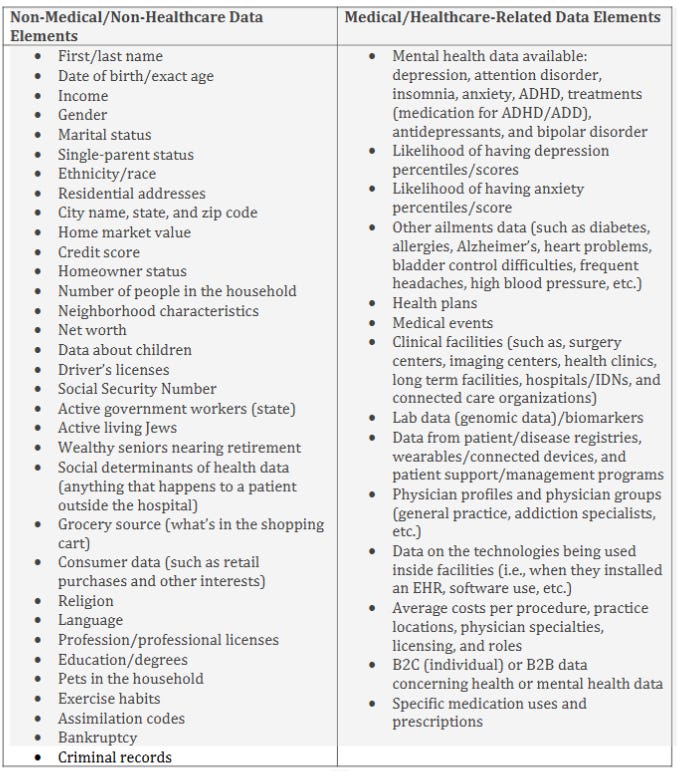
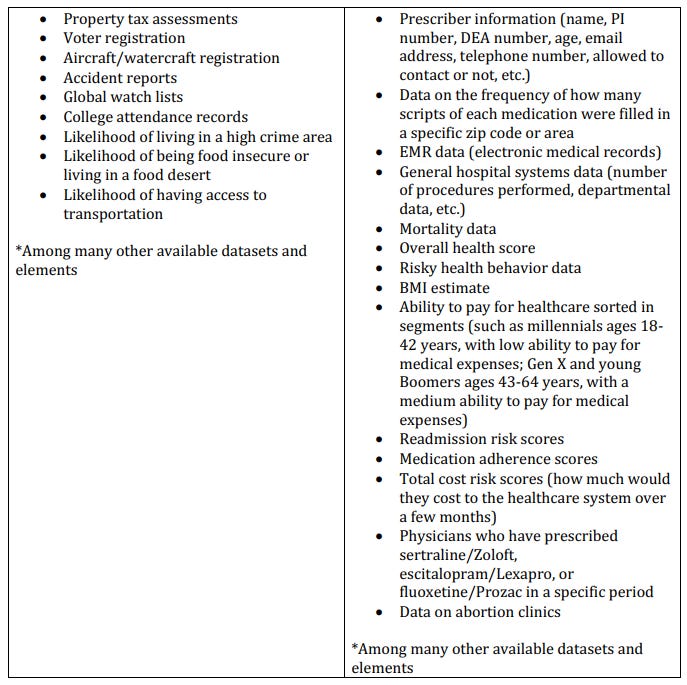
Now we must ask, “What exactly are these data buyers doing with this information?” Answer: In many cases, they are sending communications, such as letters that say things like:
“Dear [name], We are reaching out to you because someone at this residential address may have or has been formerly diagnosed with depression and/or anxiety. Please contact us if anyone in your household would be interested in being connected with community resources.”
Yes, these secretive data harvesting operations are the reason you keep receiving junk mail telling you the warranty on your car has expired or you need to contact the company ASAP about a problem with your loan, when in reality there are no problems with your loan. But it’s not just junk mail; it’s also emails, text messages (including political texts), and phone calls. If these businesses could send us smoke signals and carrier pigeons, they would. I should mention that many of these data brokers have partnerships with pharmaceutical companies or other entities, so the data brokers themselves are partners with Pfizer, Merck, Johnson & Johnson, and so on. This means a data broker can obtain your sister’s data from her loyalty club card for the local pharmacy. From this data, the broker discovers that she recently took your nephews to get a flu shot. Being that the kids got one shot, it is likely their mother can be sold another. The broker can solicit all of her information to the pharmaceutical company, and they can bombard her with fear propaganda until she returns to the pharmacy for more jabs.
WEAPONIZING HARVESTED DATA
But that’s not all. As Duke University pointed out, the collection of the data can be weaponized. Just how Flock cameras network with car insurance companies, these online data harvesters can do the same. As Duke said, “Health insurance providers—which already buy individuals’ race, education level, net worth, marital status, and other data without their knowledge or full consent to predict healthcare costs—could buy mental health data to discriminately charge individuals for care or discriminately target vulnerable populations with advertisements.” But it’s not just mental health. Equally, let’s say you throw your back out on the job and file for workers’ compensation. You have never complained about your back to your doctor, you have never had back surgery, and you have never filed for compensation before, but the insurance company, through data harvesting, discovers that you recently told someone on a dating app that you can’t meet up because your back is sore again. Now your compensation is denied on the grounds of your back being a pre-existing condition. This is just the tip of the iceberg.
Here is the point in this publication where I will begin tying all of it together; Flock, Leonardo, MAIDs, Facebook, every last bit of it…
Original Article: https://chemtrails.substack.com/p/your-credit-card-is-spying-we-are

Part 9 | COVID, 5G, Microchips & Spam Calls
Believe it or not, all of these things go together...
Agent131711 | chemtrails.substack.com
Continuing to uncover the stealthy mass surveillance system, which is rapidly being installed around us…
Rewind to Covid [scam] lockdowns. While our local parks were closed down, swings and slides were covered in caution tape, while grocery store entrances were guarded by security to check for face masks, and while we were trapped in our homes, something unexpected happened. It was so unexpected that we didn’t realize it until it was too late. But how could we have realized it when we were stuck at home, not even driving our normal route to work? What was that unexpected thing? 5G. These towers rapidly went up across the nation, exactly during the Covid hysteria and lockdown. Exactly when we were in a battle over if the so-called virus came from a bat or was made in a lab (because those were the only two options we were presented.) [In reality it was a renaming of flu symptoms]
Installation of these towers was done sneakily by men who were working overtime, around the clock, while the rest of us were financially panicking due to another week of no employment. The government had no fear that the tower installers would become ill and spread Covid. So, under the cover of lockdown and panic, 5G towers were affixed to schools, churches, and businesses and even hidden inside trees and cacti.
In the shocking images below, you will see 5G coverage before and after Covid. Here is Sprint’s 5G coverage before Covid. As you can see, Sprint only had four locations covered and had five more planned.
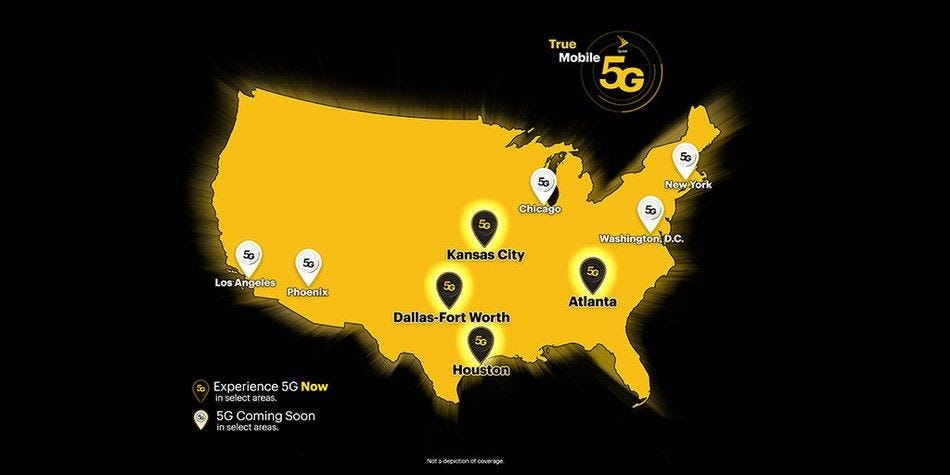
And here is Sprint after Covid (2021).
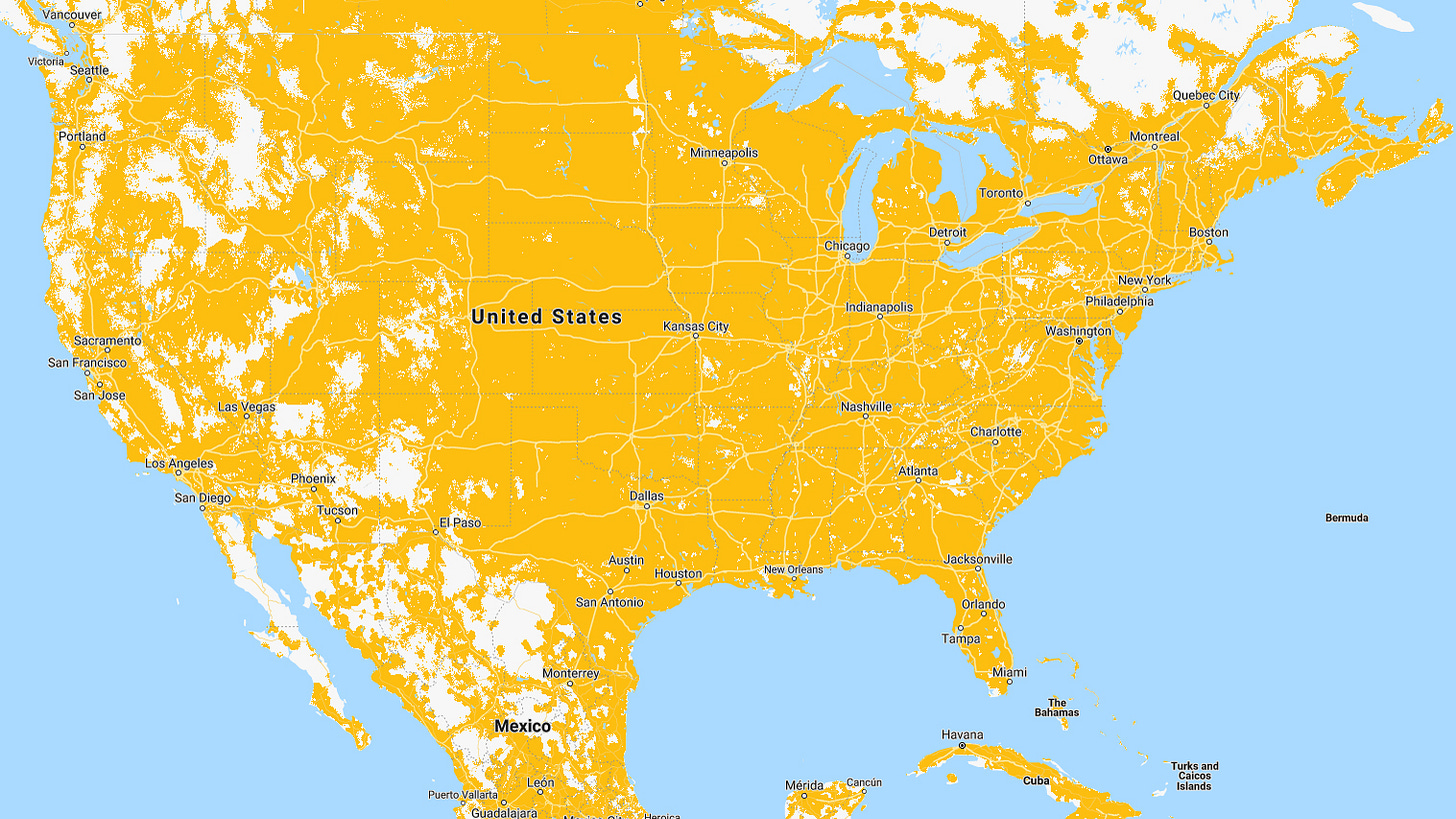
Here is Verizon before Covid.
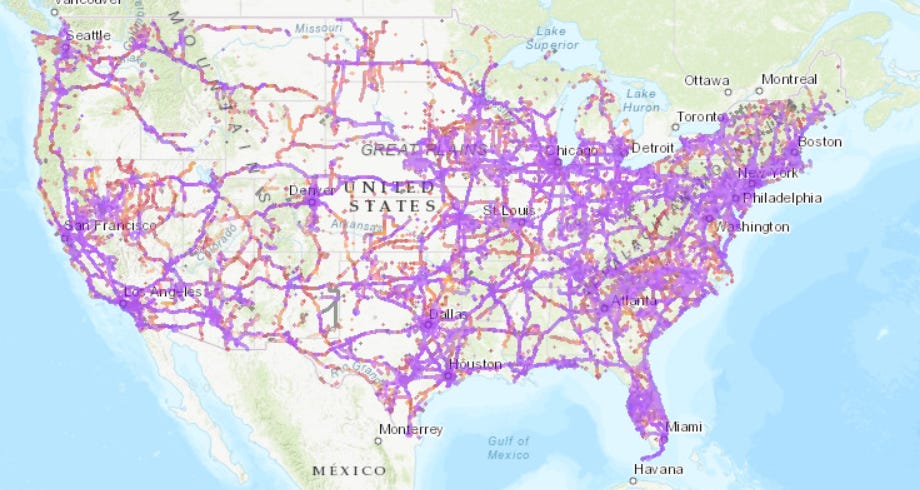
Verizon after Covid.
Interestingly, back in 2018, the SEC published a heavily redacted document that said, “Accelerated 5G Deployment Will Help the United States Continue to Lead the World.” In this document, they assure that by installing 5G across the nation, we, the taxpayers, will pay less and get more. (How’s that working out for you? Have your internet bills gone down? Mine sure haven’t.)
What you will find eyebrow-raising is that in the 2018 document, 2021 was a key date in which all the major carriers will have greatly expanded 5G capacity, meaning the project will have been completed. 2021 was only 31 months after the publication of the redacted document. That’s a pretty tight schedule, isn’t it? Think about covering the entire nation with 5G towers in such a short timeframe. Seems unlikely, doesn’t it?

Not to mention that doing such a thing would lead to pushback and temporary injunctions in court, which would stop the process, but it just so happens that lockdowns occurred 21 months later, which was ten months before the expansion deadline. And it just so happens that during lockdowns the courts were mostly closed.
To make sure this happened as quickly as possible, weeks before the nationwide lockdowns hit (2020), the US government agreed to give $20.4 billion in grants (tax dollars) for 5G to be installed via the Rural Digital Opportunity Fund (RDOF). And packed into the Coronavirus Relief Fund was even more money to expand broadband infrastructure.
The CARES Act allocated another $150 billion to state and local governments, which many jurisdictions used to expand internet infrastructure. In fact, a deadline was set, which was December 20th of 2020, which just so happened to be right before the master deadline, 2021, which was decided upon back in 2018.
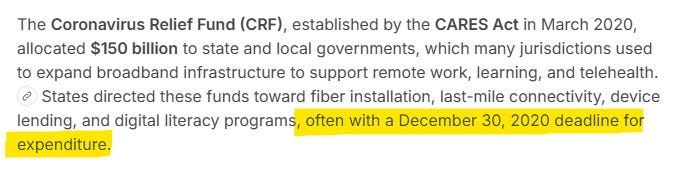
Why does this matter? Because, if not for this mass expansion of 5G, the police state that is scheduled to go into effect by or in 2030 could not remain on schedule. The wireless internet upgrade, with more towers and no home left connectionless, is required for the AI mass surveillance system. And one of the many surveillance tools on this network is something you probably never even considered…
WI-FI MOTION DETECTION
Yes, this is a real thing.
To quote from the Forbes article, “Comcast is turning compatible Xfinity Gateways into motion sensors with a new feature called WiFi Motion, which uses changes in the Wi-Fi signals around your home to detect movement… the Xfinity Gateway monitors changes in the radio-frequency signals between the router itself and any Wi-Fi-connected devices around the home. When you move through the rooms, your body interferes with the signals.” This is in addition to all of the information your humble little router box is already collecting, which includes a precise household activity timeline:
- Phone X appeared at 7:32 AM.
- Phone X disappeared at 7:59 AM.
- TV connected at 8:40 AM.
- Phone Z appeared at 9:05 AM.
- TV disconnected at 12:00 PM.
- Laptop appeared at 1:18 PM.
- Phone X returned at 2:46 PM.
- A new device connected at 3:13 PM, the same time Phone X connected.
And so on.
This technology cannot operate on the majority of current routers. Everyone must be upgraded to the new routers, which are 5G routers.
As CyberHoot points out, once installed, all of your motions can be monitored by your internet provider. As I will add, your habits can then be monetized by selling them to the highest bidder. The router can work in tandem with our smart door locks because they know when people are coming and going. And if each person has their own unique PIN code or fingerprint to open the door, it’s even better for the overseers of society.
Speaking of being monitored by internet providers, have you heard of Starlink? Of course you have, but just in case you haven’t, Starlink is a worldwide “satellite” broadband internet service developed by SpaceX, designed to provide high-speed, low-latency connectivity to underserved, rural, and remote areas where traditional infrastructure is limited or unavailable, because it is exceptionally important that everyone can be surveilled. So you want to know what data Starlink collects? Obviously it collects all the basic stuff like name, address, phone number, browser type, and so on, but it also collects cookies, pixels, tags, device identifiers, and more. Do you know what it does with the collected data? Starlink’s privacy policy describes advertising and analytics partners that can track activity on its website and applications. It says this tracking can occur even when a visitor is not logged into a Starlink account. Additionally, Starlink says personal information may be shared with third-party partners to help develop and train AI.
Meanwhile, our smart thermostats log temperature, schedules, and whether we crank up the heat on chilly winter nights. Soon these will self-regulate, meaning to save the planet, your home will stay at 65 degrees during the winter and 79 during the summer. This has already rolled out in other countries. Eventually, paying for heat and AC will be a privilege, and it will only allow you to use these utilities if you have been a good citizen.
What you may not know is that they also have motion sensors and occupancy detection. Yeah, your thermostat knows if you are home alone or with a friend. Google says Nest sensor information is regularly sent to Google, where it can be shared with third parties. So, let’s say police want to bug your residence. Your thermostat, through third-party data sharing, could tell them when your house is empty.
Did I mention that robot vacuums are mapping your home? Did you know the fine print also involves image collection and human detection data?
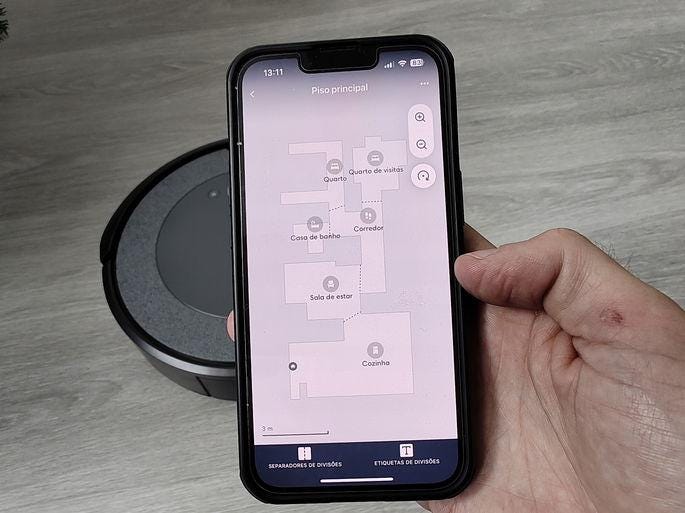
Do you now wonder what happens with that data?
Just wait—it gets even more frightening—Automatic Content Recognition (ACR) is the technology new televisions use. The TV itself can analyze and interpret what is on the screen as well as the audio associated with it, and, like Leonardo, it too uses this information to create a “digital fingerprint.” The cartoons your kids watch on Sunday morning, Hollywood movies, documentaries, podcasts, a conspiracy video, games running on the PS4 that is connected to your TV, screencasts, even some late-night pornography—it will all be your fingerprint.
As of five years ago, this technology was used by 24 leading television makers, which includes Amazon Firestick and Roku, and I’d bet my bottom dollar this same tech is in our phones, tablets, computers, and anything with a screen.
But to get back to the topic we were discussing, 5G was an imperative step in creating the cage around us, so let’s discuss this more.
COVID
I wrote back in 2024 that being forced to wear face masks in public was not simply to humiliate us, nor was it to see if we would comply, nor was it to promote the virus hoax. Those were just bonuses. What I told you back then sounded so crazy that it was difficult to believe, but it makes perfect sense now, doesn’t it? Perhaps you didn’t read that article, so let me tell you what I wrote.
The original plan was for us to be monitored through digital ID, which would be tied to our fingerprints, which cell phone manufacturers have been testing for quite a while now by offering “password-free unlock” / fingerprint unlock.

The other idea was facial recognition. Then the overlords had a revelation, and it was a massive revelation. That revelation was that while facial scans and fingerprint scans were really great, there is something even better: retina scans. They claim that fingerprint scans and even facial recognition aren’t foolproof, but retina scans are, because retinas never change and can be scanned with a quick glance at a camera.
Despite being called “retina scans,” they’re not exactly scanning your retina, per se. What they’re scanning is blood vessel patterns in each eye, and, according to their documents, no two people have the same patterns. There are additional benefits, such as the ability to scan in low light and being able to scan even if someone is wearing glasses. But this presented a problem. The problem was that the AI cameras had been built for facial scans, not eye scans, but artificial intelligence is called “intelligence” because it can learn, so if there was a way the cameras could be trained to scan retinas, this would solve the problem. But how do you get existing cameras to learn to read eyes and ignore the rest of the face? Answer:

…you cover the rest of the face….

Now all that’s left is the eyes, so the cameras are forced to zero in on them. It’s diabolically brilliant, isn’t it? And now that you know, isn’t the reason for face masks so painfully obvious? Yet we all overlooked what was, quite literally, right in front of our noses this whole time…

Perhaps this explains why they didn’t care what kind of mask you wore; it could be cloth, a knit scarf, a surgeon’s mask, or anything you want, as long as the only thing showing is your eyes, therefore forcing the camera to scan only those.

MICRO-CHIPPING
So, the p[l]andemic happened, and a huge portion of the world rushed to get injected with vaccines [bioweapon injections]. Some people got numerous injections. It didn’t take long for the most bizarre thing we have ever witnessed to begin happening. That thing was that many people began emitting MAC addresses. By definition, a MAC address is “a unique 48-bit hardware identifier permanently assigned to a network interface controller by its manufacturer, serving as a device’s physical ‘name tag’ on a local network.” So it’s basically a MAID, and exactly like a MAID, a MAC address remains constant throughout the device’s life. (For more on this topic, watch the documentary Blue Truth:


Of course the media says this is just a hoax; nobody ever emitted a MAC address, all of the journalists and scientists are fools, and the vaccines are not causing this odd phenomenon, but what’s interesting is that all the way back before 9/11, Rockefeller wanted to RFID microchip everyone [see video: https://videos.sb-library.com/w/v8jpcFwiAGXJA3XovzVqCb or read The Secret History of Microchipping].
If you are finding this too hard to believe, please read Cell Towers & the NIH Contract You’ve Never Heard Of. Even if you believe it, you should still read that piece. It’s the true story of David Larson, who, in the early 1990s, discovered he was being experimented on by the NIH and that the technology was connecting to communication towers that surrounded his home. Through research, David came to learn that those towers happened to be controlled by individuals affiliated with the NIH. It sounded so crazy back in the 1990s that, for the most part, Mr. Larson was chalked up to being a rambling nutjob.
By or in 1995, which was right after Larson discovered the NIH was tracking people using communication towers, the Stingray surveillance device was being used by law enforcement in America. If you’re not familiar, the Stingray is a cell site simulator. In plain English, it’s a gadget that mimics a cell tower. Once a phone connects to it, the Stingray can track the user’s precise location (often within a few feet), collect metadata such as call logs and text messages, and intercept the content of calls and data transmissions.
The Stingray was originally developed for military and intelligence, but, like everything else, it was deployed against the American people. Of course, law enforcement says it’s just for catching bad guys, so it’s ok. But the thing is, it’s not just for catching the bad guys because, unlike traditional warrants that require carriers to hand over records, Stingrays allow officers to bypass the warrant process and bypass the carrier entirely. Not only is there no approval process for the collection of this data, but there is also no specific individual from whom data will be collected because the Stingray, just like Flock, Axon, and Leonardo, is a dragnet that collects data from all devices in the vicinity, including those of innocent bystanders. This has sparked Fourth Amendment legal challenges regarding privacy and the requirement for warrants, but the Constitution doesn’t matter when it comes to data collection.
Although law enforcement claims Stingrays are a great thing because they protect the populace, the FBI went to great lengths to prevent the public from having knowledge of cell site simulators. They went to such lengths that they even required state and local law enforcement agencies to sign nondisclosure agreements before purchasing the technology, which is probably why you have never heard of Stingrays. Yet this tech is so old that I was in high school when they began rolling it out! I’m now in my mid-40s with adult children!
In 1997, Google was founded and would soon offer a “free” search engine.
Then, in 1999, the Auto ID Center was established “as a not-for-profit consortium to develop a system for using the Internet to identify goods anywhere in the world.” They already knew exactly what was required to give humans an Electronic Product Code (EPC), a code that would link us to the internet. Let that sink in for a moment: human beings getting a product code…

This concept of chipping us is not some screwball idea that some 45-year-old tinfoil-hat idiot came up with while eating ramen noodles in his bedroom in his parents’ basement. This is instead a very real idea that some evil elites came up with while implementing their agenda to control the world and further enslave us.
On the 4th of February, 2004, Facebook came to be, but what I didn’t tell you is that two months later, Gmail was launched. Of course, Gmail provides us with free email for a reason, and that reason isn’t kindness.
The following year, on Valentines Day, YouTube, the company that lets us watch free videos, was founded. How sweet of them!
Then, at some point between 1990 and 2005, another thing came to light, literally. This thing was streetlights. More specifically, that the streetlights were spying. As I wrote many years ago, these streetlights (and parking lot lights too) are able to see, hear, and record, then transmit all of that data.


And nobody in the public would ever have any clue because they are cleverly designed to look like normal lights.


As I said back then, these streetlights are part of the smart cities technology collection.


Do you recall how I mentioned the 2018 redacted document that said 5G must be deployed across America and 2021 was the deadline? Well, these streetlights are more than just lights. They are also 5G stations.

So, while it looks like your city is installing new lights, what they are actually installing are 5G hotspots and continuous-record surveillance technology, and this system will be tied to digital ID, which will require retina scans (biometrics). Through a single event, a so-called pandemic, the hard part was accomplished, and the cameras were trained to scan eyes; meanwhile, the motion detector Wi-Fi routers are already going in homes to complement the occupancy monitoring thermostats and floor plan mapping vacuums. All of that has been checked off their list.
SPAM CALLS
Now let’s take it a step further. Governments worldwide are currently on a mission to stop spam calls, or so they claim, in unison. While you may hear this and think, “Praise God!” because we are all tired of these calls, what you might not realize is that all of these governments are claiming the solution is a phone registry, meaning just how you register your vehicle, you will register your phone’s SIM card.
And don’t think you can dodge this by taking the SIM out and popping in a new one because now all SIMs are turning into digital eSIMs, so there will be no physical SIM. The SIM will be a part of the phone itself. That said, the idea that this will stop spam calls makes no sense. If you have ever looked into the spammers, they operate out of call centers primarily located in India (check out Jim Browning’s YouTube channel. He hacks into their computer systems and exposes them). So forcing people in America, Mexico, Britain, Australia, and so on, to register phone numbers will have no impact on international call centers operating entirely, or almost entirely, out of India. Additionally, these call centers do not use cell phones. They use Voice over Internet Protocol (VoIP) computer calls, so there is no SIM card.
And it isn’t even India behind this scam. India is only being hired because it is cost-effective and there are few legal repercussions. So who is behind the scams? Well, when Trilogy Media investigated Indian scammers targeting Americans, they ended up at the lowest levels of the Chinese mafia. See, I told you the mafia runs everything, and all nationalities of the mafia work together (read Pizzagate.)
But to get back to spam calls: this phone registry is only the first part of the plan. To ensure terrorists are not getting phones, just like when you purchase a gun from an authorized dealer, the phone company will perform a background check by checking each applicant versus the database of so-called terrorists. Not only does this mean you can be rejected from owning a phone, but it also means once your phone is tied to your identity, you can be arrested for a text, a Twitter post, an article you wrote, or a meme. When all of this goes into effect, everything from our phones to our own eyes will be on file with the government and a variety of shadow entities, and it will all be tied to our ability to use the internet or a bank account. It will be tied to our ability to cash a paycheck or buy groceries. Tragically, this is only a part of what is coming down the pipe.
Original Article: https://chemtrails.substack.com/p/covid-5g-microchips-and-spam-calls
Part 10 | The KILL SWITCHES Have Arrived
Just when you think things can’t possibly get any worse...
Agent131711 | chemtrails.substack.com
Only one article in this series left to go, so it’s time to start showing everyone what is on deck. All of this technology will be unleashed upon us very, very soon…
Most of us have come to realize that our vehicles transmit data. Our cars, trucks, and SUVs collect speed, braking patterns, GPS, and more through “telematics,” and this data can be harvested remotely. For example, both General Motors and OnStar collected “driving behavior data,” which included all the aforementioned in addition to late-night driving and acceleration speed. But what nobody realizes is what is about to be unleashed upon us in the form of new vehicles. You see, the new Investment and Jobs Act secretly harbors a vehicle kill switch law within Section 24220, which is to go into effect by or on Nov 5th, 2027. This secret kill switch is disguised as “advanced impaired driving prevention systems,” and it must go into all new vehicles. This means all new vehicles will have the obligation to refuse to start if the vehicle, meaning computer AI, feels the driver is too impaired to drive. Now here’s what’s interesting: while you are thinking “impaired driving” means drunk driving and because you don’t drink, this won’t impact you; you are dead wrong. Many auto manufacturers are using the broadest definition of the word impaired which means “diminished, damaged, or weakened” and “functioning poorly or incompetently.”
How this will work is the computer in your vehicle uses AI, and that AI deems you impaired from a puff of pot, lack of sleep, or maybe you just found out your beloved grandfather was just rushed to the hospital and your adrenaline is pumping. Unfortunately for you, you are emotionally impaired, and you will not be driving today.
Ford has filed many patents involving biometric scans, facial recognition, emotional state reading, heart rate analysis, and even lip-reading systems. Yes, your F-150 will be able to read your lips. Did you just mouth, “Screw the IRS”? I hate to inform you that you will now have to catch an Uber to get to work.
This tech will be combined with cabin surveillance, and it will all be used to determine whether your vehicle will be allowed to start or not.
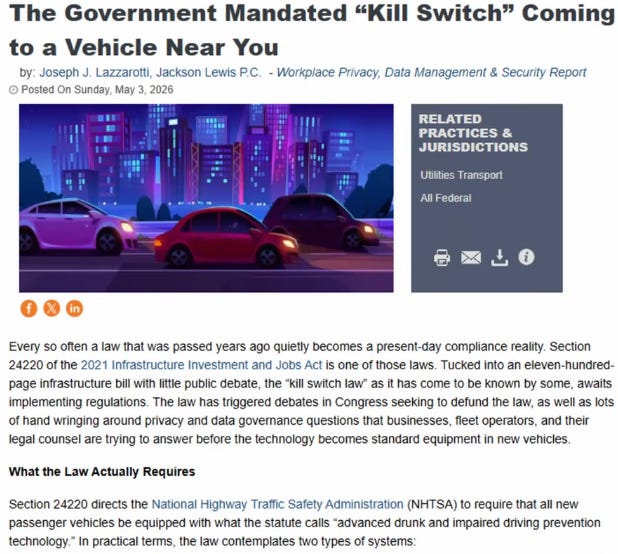
And this isn’t just a Ford thing. Every vehicle maker is filing these crazy patents because they have to install the kill switch, and it is probably easier to put in a multi-faceted kill switch up front than to file a patent for drunk driving, go through all the work of producing the tech, and then, in five years, have the government expand the law to include emotional instability. And let’s face it, these automakers are all government controlled because when someone pays you, they own you. These automotive producers are on bended knees for Uncle Sam because Uncle Sam holds the bailout purse strings and tax incentives.
I misplaced the link to it, but another new automotive patent discussed biometric scans, which will be linked to criminal databases, so before your vehicle can start, the AI program will check to see if you have any unpaid tickets, missed a court date, or, God forbid, are on the top-secret terrorist watch list for what you posted on Facebook. I know I failed by losing the link, but you don’t have to take my word for it because you will see this firsthand within the next couple of years. What will begin as blocking intoxicated people from starting their cars will turn into journalists like me being banned from driving.
Additionally, this automotive tech can cross-reference insurance company databases to make sure your policy is up-to-date before you hit the road. While we are in the patent stage here in America, this tech has already rolled out internationally.
And it’s trickling into the US. In Illinois, a new law just passed to prevent speeding. If you get two tickets in a year for excessive speeding, you will have to pay for a monitoring device. If your vehicle is too old to use the monitoring device, your license will be suspended for two years.
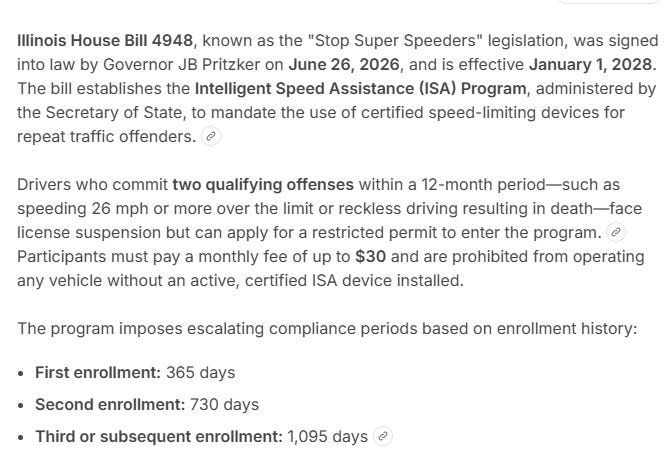
FYI: “too old” is 1996 and older because these do not have the port required to monitor you.
OUR SECRET SPY CARS
I came across this really interesting video, which I have transcribed for you with a few minor edits to make it easier to understand without the visuals of the video.
Transcription: “2024, Brian was driving his 2023 Toyota Corolla GR on the highway. He then noticed that something was wrong. Smoke started pouring into the interior.
Brian pulled over to take a look and see what was going on. And before he knew it, the front end of the car was completely in flames. Some of the damage was covered by insurance, but the remaining cost was to be covered in a warranty claim by Toyota.
After all, the car was only one year old and just caught fire for no apparent reason. But to his horror, Toyota denies his claim. Why? According to their reply, his car had sent data packets to headquarters indicating that he’d driven in excess of 85 miles per hour at some point during his ownership.
Among other excuses, they concluded that they couldn’t provide any assistance due to his irresponsible driving. This was despite the fire having nothing to do with how fast he’d driven the car at a completely separate time. For context, the GR Corolla is a rally car which can do zero to 60 miles an hour in under five seconds.
This scenario sounds like a comedic B-plot in a dystopian sci-fi movie, but this is very real and is happening today. In 2023, there was a review of the privacy standards of 25 major car brands by the Mozilla Foundation. The results were a complete disaster.
All 25 of the brands failed to meet consumer privacy standards. According to ABC Australia, the report revealed that murky and vague privacy policies allowed brands like BMW, Ford, Toyota, Tesla, Kia, and Subaru to collect highly sensitive and personal data. Shockingly, this includes information on activity, immigration status, race, facial expressions, weight, health, genetic information, and driving locations.
And unfortunately, these companies can potentially sell this data to third parties. The data is being collected by sensors, microphones, cameras, car apps, the phones and devices that drivers connect to their cars, and company websites. The report named Nissan as the worst offender, as they collected data on, quote, activity, health diagnosis data, and genetic data. But strangely, no one knows exactly how they got this information. Nissan (terms and conditions) say that they can share and sell consumers “preferences, characteristics, psychological trends, predispositions, behavior, attitudes, intelligence abilities, and aptitudes.” Nissan can give this information to data brokers, law enforcement, and other third parties.
The report also called out Toyota’s privacy policies as “a near incomprehensible galaxy.”
Mozilla asked the companies about encryption of the data, and only one of the brands, Mercedes, even responded. Jen Caltrider, a writer of Mozilla was stunned by the findings and would conclude, quote, “All new cars today are privacy nightmares on wheels that collect huge amounts of personal information,” end quote.
It’s pretty insane already, but it goes deeper. In March of 2024, the New York Times released a bombshell investigation of how car companies are selling driver data to insurance companies. Data such as where they’re driving, how fast they’re going, how hard they accelerate and step on the brakes—pretty much everything. The companies involved include General Motors/GM, Honda, Mitsubishi, Kia, Ford, Hyundai, and Subaru, all to varying degrees, as you’ll soon see. Car manufacturers will always try to hammer this point home. And at a stretch, if you squint your eyes, perhaps you could see it that way. But if we’re being real, it turns out that these car companies are making millions off selling your driver data to brokers and onto insurance companies. Your insurance premium could start skyrocketing, and you have no idea why. The last thing you’d expect is that your humble car was snitching on you to a large corporation.
The New York Times gave an example of Ken Dahl, a 65-year-old careful driver who had never been responsible for an accident. Suddenly, in 2022, he got a rude shock when his car insurance costs jumped by 21%. After shopping around, he realized something strange; other car insurance packages were suddenly unusually high for him too. Wondering what was going on, he asked an insurance agent, and he told him the real answer. He’d gotten a bad report from LexisNexis. Now who the heck is that? Well, they’re one of those third-party data brokers. And where did LexisNexis get the data from? From General Motors, who made Mr. Dahl’s Chevy Bolt. He dug a bit deeper and got his hands on the actual report from LexisNexis. It was over 130 pages long, detailing every move that he and his wife had made. 640 trips. It included when he was speeding, braking sharply, or accelerating sharply; the time they set off for a trip; and the time the trip concluded.
Mr. Dahl would tell the New York Times, quote, “It felt like a betrayal. They’re taking information that I didn’t realize was going to be shared and screwing with our insurance. The raw data from your car is collected, sold to data brokers who analyze it and then send it to your insurance company, all without you having a clue.”
Some car companies do sell the information directly, and some do have opt-in clauses, but many don’t and are on by default without the drivers knowing. Furthermore, these drivers aren’t aware that their data is being shared with third parties. Even for those drivers who opt in on data collection to improve their driving, they innocently think it’s going to help them become a better driver.
There’s still no obvious indication that this data is going to third parties. A lot of the time it’s hidden behind the fine print of legal jargon. For sports car enthusiasts, it’s a nightmare.
The same New York Times report shines a light on one Corvette owner. He took his car out for a spin on a professional racetrack. His car’s data was then filled with rapid acceleration events, potentially ruining his car insurance score.
Another Cadillac owner had had enough after he was denied car insurance by seven companies. And of course, his LexisNexis report was to blame. He finally did get car insurance, but for twice the price.
Kia, Subaru, and Mitsubishi also share data with LexisNexis, who has now collected data from over 10 million cars. Ford, Honda, and Hyundai are also selling driver data, but to another data broker called Verisk. Subaru states that it only shares odometer data, according to the New York Times, and Ford denies the claims, saying it was only partnering with LexisNexis to, quote, “explore ways to support consumers.” They go on to state that they send driver data directly to insurance companies only with explicit consent. Kia, Mitsubishi, Hyundai, Honda, and Acura all have driving feedback apps where drivers can opt in to monitor how well they’re performing on the road. But what drivers may not know is that this data is getting passed on to, you guessed it, either LexisNexis or Verisk. So once again, insurance can potentially be affected as a result of their driving habits without them necessarily knowing.
Toyota is no angel in all of this. Rafi Alam from the Australian consumer advocacy group Choice states, “When we looked at Toyota’s privacy policy, we found that these connected service features will collect data such as fuel levels, odometer readings, vehicle location, and driving data, as well as personal information like phone numbers and email addresses,” end quote.
And all of this isn’t to mention the risks of data breaches. Unfortunately, it’s just a sign of the times. Data collecting technology is becoming ever more common in newer cars, and much of this can’t be opted out of.
Most new cars today will have some kind of location tracking technology included, but does it have to be this way? Critics argue that these data collection practices are non-transparent. Hidden clauses in massive, complicated contracts aren’t good enough. California’s privacy regulator, Senator Edward Markay, has called for investigations into these data practices. He questions whether this violates consumer protection laws.
Overall, the intersection of connected car technology and insurance rates poses important questions about transparency and consumer rights. Our cars can’t just be spying on us without our knowledge. And writing it all in the fine print, hidden within walls of legal jargon, isn’t good enough either…” (End transcription.)
When it comes to Ford Motor’s data collection, they not only track your location but also log what music you listen to, what apps you use, everything the microphone and cameras pick up, if and when you wear your seatbelt, your driving data, and more.
Why do they collect this information? This NYT article explains why. They sell your driving data to LexisNexis and insurance companies so that they can raise your rate if they see that you brake a little too abruptly or accelerate a little too harshly. They also sell it to social media companies and advertising agencies so they can sell you things. They also share it with law enforcement and other government agencies.
Pretty shocking, isn’t it? So our vehicles are and will collect this data; they then share or sell it to LexisNexis Risk Solutions and Verisk. Who exactly is LexisNexis? And more importantly, what exactly do they know, and what are they doing with the information?
LEXISNEXIS
LexisNexis is a mass data aggregate, and, quite frankly, it is terrifying. The company has as many as 145 billion records from more than 10,000 sources. They claim to add one million new records daily. Their database covers approximately 95% of the U.S. population and includes historical archives dating back decades.
Your LexisNexis credit report/file has a ton of information about you that you don’t know is out there, including your social security number, every alias you’ve ever had, every phone number and email address that you’ve ever used, whether you own your home or lease, who resides in your home with you, even the building materials of your residence, loss cost projections for your properties and vehicles (yes, they are analyzing how much our vehicles and property depreciate in value over time), every car you’ve ever owned, every VIN for those vehicles, every insurance policy you’ve had, every time you’ve been arrested for anything in your life, any license you have been issued or had revoked, marriages, divorces, and even birth records. This additionally includes your utility bills, payments, and utility usage records, LLC and business filings, workers’ compensation filing history and injury details, “fraud indicator scores and suspicious activity flags” (whatever that means), any legal demands you have ever been sent (whether justified or not), eHealth information, as well as all non-HIPAA protected medical data, social media records, and, of course, everything about your driving patterns, accident claims, traffic tickets, other details related to automotive insurance, and so much more. Lexis also pulls records from other companies, including private companies who have chosen to share or sell data, so there is no way to know all of the data they have on you. But, if you read this publication from the beginning, you already know this includes credit card companies, grocery stores, and eCommerce websites; it’s overwhelming yet all so secretive.
All of your records are then combined to a lengthy Lexus Nexus report. According to Lexis’s commercial, AI then analyzes all of this data and finds patterns, which are, quote, “invisible to the human eye.” This is all part of the LexisNexis Digital Identity Network.
As part of the digital ID network, Lexis’ AI links together associations between people, so it knows where you work, and because of this, they know who your boss is, who your friends are, your mom, your kids, your wife, her job, her boss, her friends, yada yada, and because it has profiles on all of those people too, our entire lives have been condensed into pages of data that are made available to, quite literally, anyone—and all along you and I thought the digital ID would be a virtual driver’s license, but the truth is far, far worse.
Behind the scenes, this company is influencing huge life decisions, without us even realizing it. For example, LexisNexis is feeding information to lenders and credit issuers. These entities can pull this data quietly and use it to make all kinds of decisions about you, including if you should be approved or denied financing, the rates and terms you should get, and how much money you should get approved for.
But this isn’t just related to financial decisions. The government buys data from LexisNexis, such as in the case of ICE. ICE gave Lexis over 22 million dollars’ worth of our tax money in exchange for records that would pinpoint people they could surveil, detain, and deport.
Regardless of where you stand on the topic of removing noncitizens from the nation, the point is that all of this is done without a warrant, and all of this is connected to Palantir—quite literally, it is all wired together.
I can’t get into the (Israeli) Palantir today, but despite being a massive company, their Wikipedia page is microscopic. This should be a huge red flag.
Disturbingly, LexisNexis is not only being used to stalk people, but it is also being used to select courtroom juries, and this is quite problematic because juries are supposed to be 12 randomly selected, nonbias peers.
Additionally, Lexis is used by employers to decide if you should be hired for a job. This means you could be denied a position you are plenty qualified for because of something that happened in your personal life back in 1996. Landlords can use it to make tenant decisions, government agencies can use Lexis to determine eligibility for a program or benefits or even to aid in prosecuting you. Debt collectors, utility and telecommunications companies, retailers, payment processors and buy-now-pay-later providers, and even casinos and gaming establishments all have access to this technology and essentially can wield it like a weapon, and nobody has any obligation to tell you they are thumbing through the most personal details of your entire existence, covertly.
While they claim they are only scraping public records, if this was the case, they would not have our social security numbers and such. All of this personal data is coming from the private sector businesses I mentioned previously.
A quick look at the LexisNexis website is exhausting and legitimately horrifying.
I’ll let you look at it more on your own. The point is that our vehicles are collecting all of this data without us knowing. The data is then being sold to or shared with LexisNexis, who is compiling vast amounts of public and personal data on us; then that data is being sold, which is why LexisNexis is estimated to be raking in over two billion dollars every year.
And this is where someone we already discussed pops back up…
WHERE THE RUBBER MEETS THE… CAMERAS
To understand this, we have to go back to Leonardo’s Elsag which, as we learned, is far from being a bra for floppy tits. It is instead a cutting-edge spy device that is not only reading license plates but is also capturing every last Bluetooth signal oozing out of our vehicles, our pockets, or, in some cases, our own arms. While the solution of a Faraday bag would likely stop this tech from grabbing our earbuds’ and cell phones’ Bluetooth, there is one thing we have pretty much no way to hide. That Bluetooth is in our TPMS. What is TPMS? It’s the tire-pressure monitoring system.
TPMS uses physical sensors mounted inside each tire, usually on the valve stem. These sensors each contain a small battery-powered transmitter that measures the air pressure (and often temperature) in real-time, then transmits the data wirelessly via radio frequency (RF) to the vehicle’s onboard computer.
Now here’s why this matters: like an IP address is exclusive to a computer, or like a MAID is exclusive to a device, a tire signal is exclusive to our vehicles, and it has been federally mandated on new vehicles in America since 2006. And these transmissions are unencrypted, so anyone with the means can grab them from inside or outside our vehicles.
A group of researchers got together to try to figure out just how valuable TPMS readings could be. Long story short, only a dozen readers, which cost the research team roughly $100 per piece, were linked together to form a small network. Through this tiny network, they were able to track vehicle locations 24/7 and learn drivers’ travel patterns, habits, daily routines, and more. As CyberNews.com points out, this data is a goldmine for hackers and other evil-doers. I would add that it seems like a jackpot for robbers and stalkers too. After all, if they know you’re single and leave for the gym every day at 3pm, there is nobody at your home.
Meanwhile, under the guise of safety, older vehicles are essentially being banned by making them too expensive to own. The government must abolish these vehicles so we can only drive smart cars. To keep the public from outrage, the bans are sneakily coming in the form of things like the Vehicle Modernization Act, new mandatory state inspections that dictate exactly which tires, brake pads, and so on must be on the vehicle, as well as increased insurance and making insurance unaffordable. Additionally, by-the-mile fees are rolling out, and insurance companies can increase or outright deny coverage on the grounds that your 2010 SUV is so old that it is too risky for them to cover. This financial squeeze is designed to be so pricy, annoying, and intrusive that buying a new vehicle is the only option.
Massachusetts has already banned the sales of gas-powered vehicles, which will force all new car buyers into smart electric vehicles or no vehicle at all. After this goes into effect universally, gas stations will begin to vanish, so even if you refuse to buy an EV, you will not be able to drive your gas-powered car.
To aid in the war on gas vehicles, California is leading the way with raising gas taxes.
Speaking of vehicles, have you purchased a newer vehicle lately? People are coming to the realization that new models are becoming equipped with interior cameras, such as Jeep’s “FamCAM” which is being sold as a way for parents to watch the children who are sitting, quite literally, right behind them.
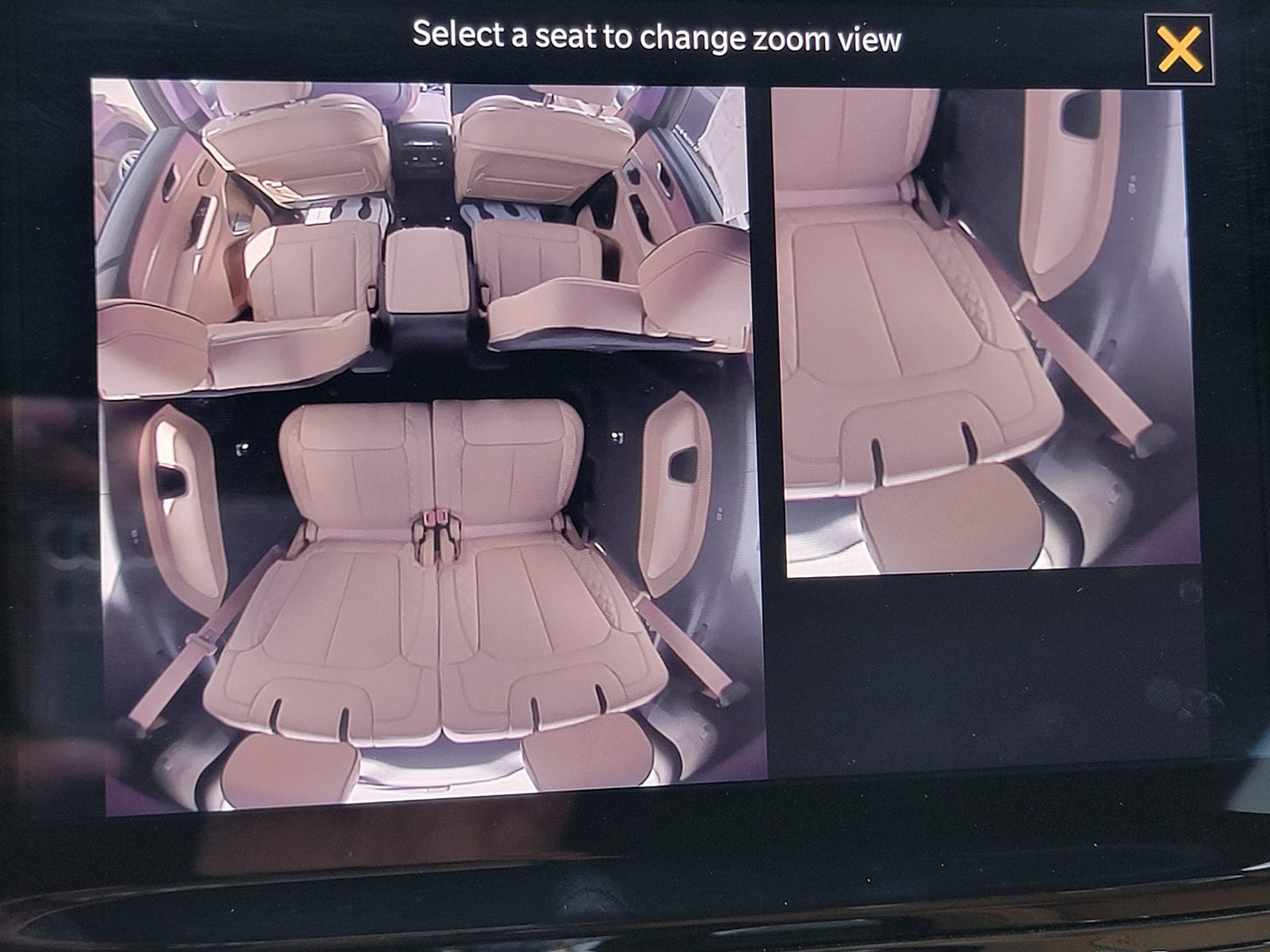
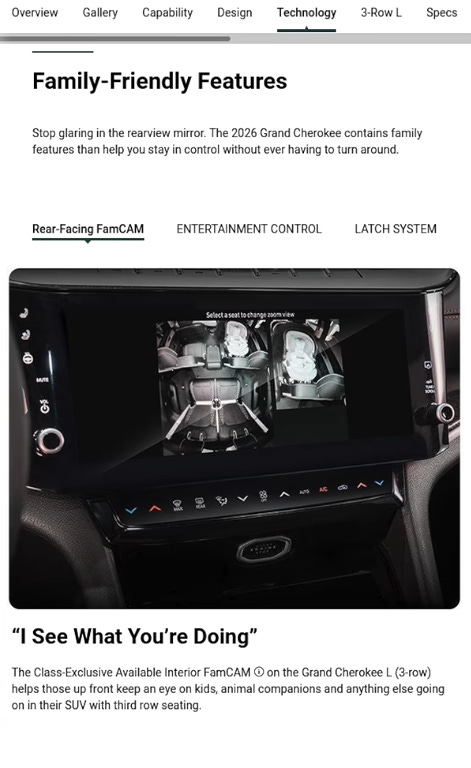
What exactly your children are doing that requires surveillance cameras to monitor them? I haven’t the slightest clue, but I can tell you that, since the first automobile was released in 1908, children have survived without a camera recording their every action, and your kids will also survive without one. And let’s not forget all of the microphones inside the vehicles. After all, you need these for hand-free calls and such. And because you could need to shout an order to your new truck at any time, the mics are always listening.
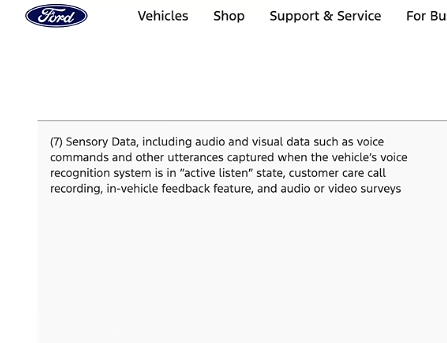
Tesla even has microphones on the outside of the vehicle, because, yeah.
Other vehicle purchasers have come to discover that their new car features a face identification system, which identifies the driver.
Aside from the discovery of interior cameras, when you purchased your new ride, did they force you to download a cell phone app that you didn’t want? Not only are people being forced to have these unwanted cell phone apps (which are harvesting their data), but they are now discovering that features that came with the car at the time of purchase are being taken away and made available only through a subscription program, which is a part of the unwanted app. For example, if you want to remote start your vehicle or use Apple Car Play, those will now cost you five to ten dollars per month. And this insanity isn’t only going on with budget vehicles. A new Mercedes-Benz buyer who spent $65,000 on the luxury vehicle is not able to unlock her vehicle using her cell phone without a subscription. Mercedes is even charging owners who want to be able to increase acceleration.

In some Mercedes SUVs, if you want to be able to turn your tires as far as possible for making sharp turns, that will now cost you.
With new Toyotas, having the ability to use navigation on your cell phone now costs $15 a month. It’s another $15 a month to stream music to the vehicle’s screen, but you can bundle the two for $25 a month. In newer Camrys, you can’t even use the built-in navigation unless you hop on a subscription plan. Another individual said they have to pay $8 a month to see their oil level and tire pressure.
While you can say nobody truly needs remote start or Apple CarPlay, think of the bigger picture. What happens when your heated seats and heated steering wheel package you paid for will only activate if you are on a monthly subscription? Oh wait, BMW already did that.
What if the radio doesn’t work unless your credit card is billed monthly? What if the gas flap won’t unlock? You see, when we bought the car, we paid for these features; now they are being taken away and put behind a paywall. And the bigger question: where does it end?
Scarier is the fact that these automakers have the kill switches already in place to remotely turn off our ability to use features on our vehicle based on whether we have a subscription for it through a cell phone app. Do you now see why all physical buttons are being removed and the push button start has been installed in everything?
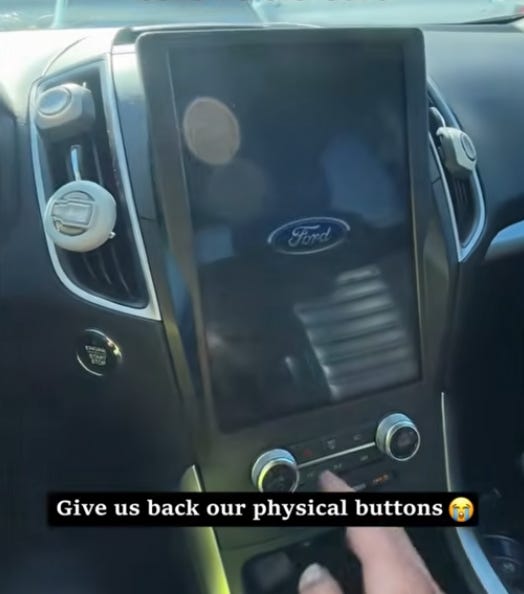
Even the door handles themselves are becoming push buttons.
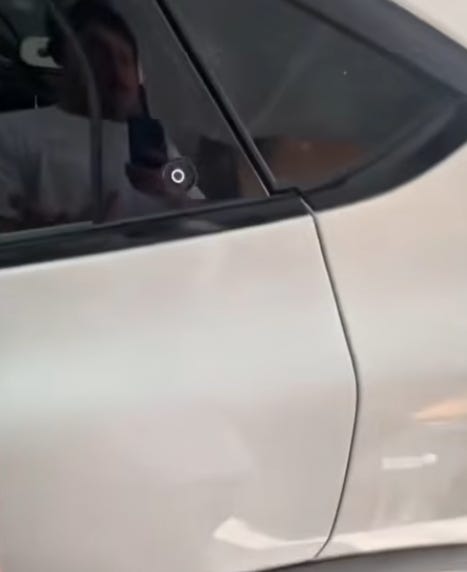
It is so it all can be taken away! Holy shit. And guess what? Every modern vehicle has a TCU, meaning Telematics Control Unit. It has its own dedicated cellular connection that is always on, and every single sensor in our vehicles is hard-coded to it. Now here’s the part that will blow your mind. This is all connected to our vehicle’s VIN number. This means if you tamper with a sensor, change a fuse, or, God forbid, try to not use one of these subscriptions by instead using completely legal open-source software, the vehicle instantly generates a report and sends it directly to the manufacturer’s cloud. In fact, a man who purchased a brand new Bronco claims he had it remotely shut down because he was running behind on one payment. Want to know where specifically the car turned off? Right in the middle of traffic.

Even that is not where the craziness ends. As you know, planned obsolescence has taken over the world. If you have never heard the term, be sure to read my fantastic publication, Planned Obsolescence, Hedonism, & The Conspiracy to Forever Alter American Society.

Vehicles are no exception to the rule. Like everything else that was intentionally downgraded so it will not last, our cars, trucks, and SUVs are designed to break.
And if your brother knows how to wrench on cars, so you’re not too worried, automakers are now pushing politicians to make it illegal to DIY fix vehicles. Now, some automakers are rolling out a $50 a year subscription for people who want access to their vehicle’s diagnostic data so they can find the problem and correct it without the need for a pricy visit to the dealership mechanic. If you don’t pay, you will not have access to error data. Chrysler, Subaru, and Nissan have already implemented this, while Ford and others have confirmed they are not far behind.
While all of this is overwhelming information, the wildest part is just how long the spying has been going on without us knowing and just how far back this whole thing was planned. Let me show you…
Original Article: https://chemtrails.substack.com/p/the-kill-switches-have-arrived-flock?triedRedirect=true
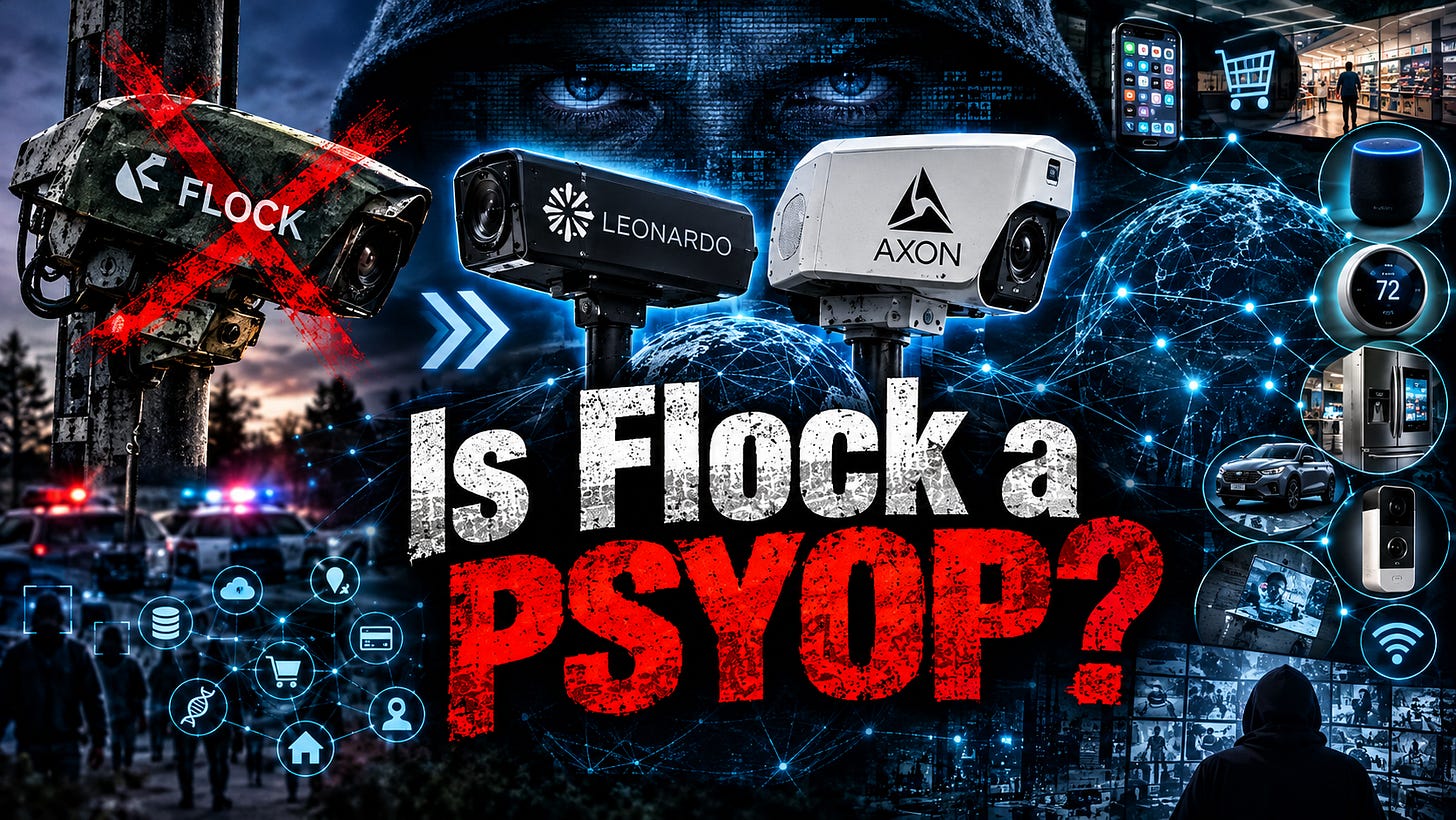
Part 11 | Is Flock a PSYOP? The Final Chapter
Asking the question few are asking: Is Flock really the endgame? Or was it all a diversion from something much, much worse?
Agent131711 | chemtrails.substack.com
What if this entire thing was a ploy to get us to attack Flock cameras? Meanwhile, an entire web of surveillance is rapidly being installed around us—a web that doesn’t need or want Flock cameras? What if?
Flock Safety was founded back in 2017, but Google Trends reveals that there was pretty much no news about this company until 2026.
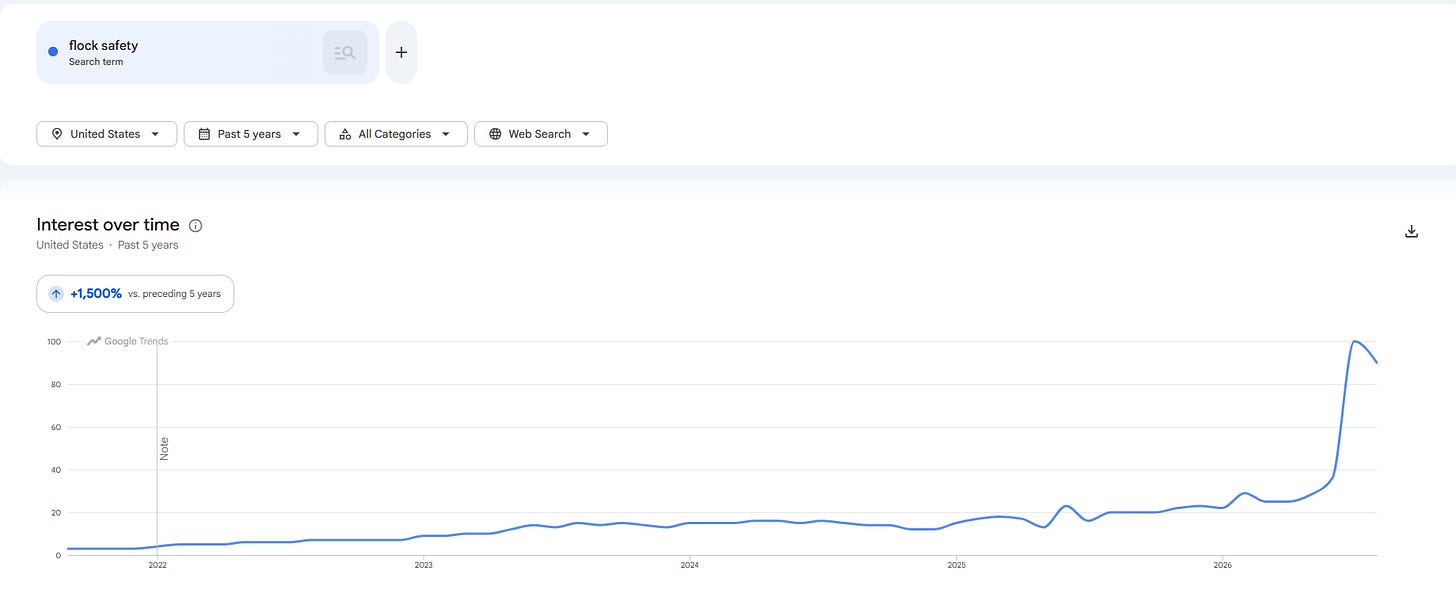
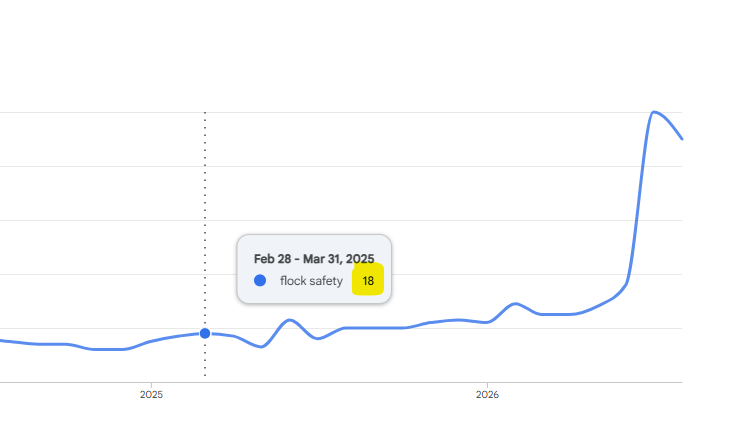
Then, all of a sudden, in 2026, Flock became mainstream.
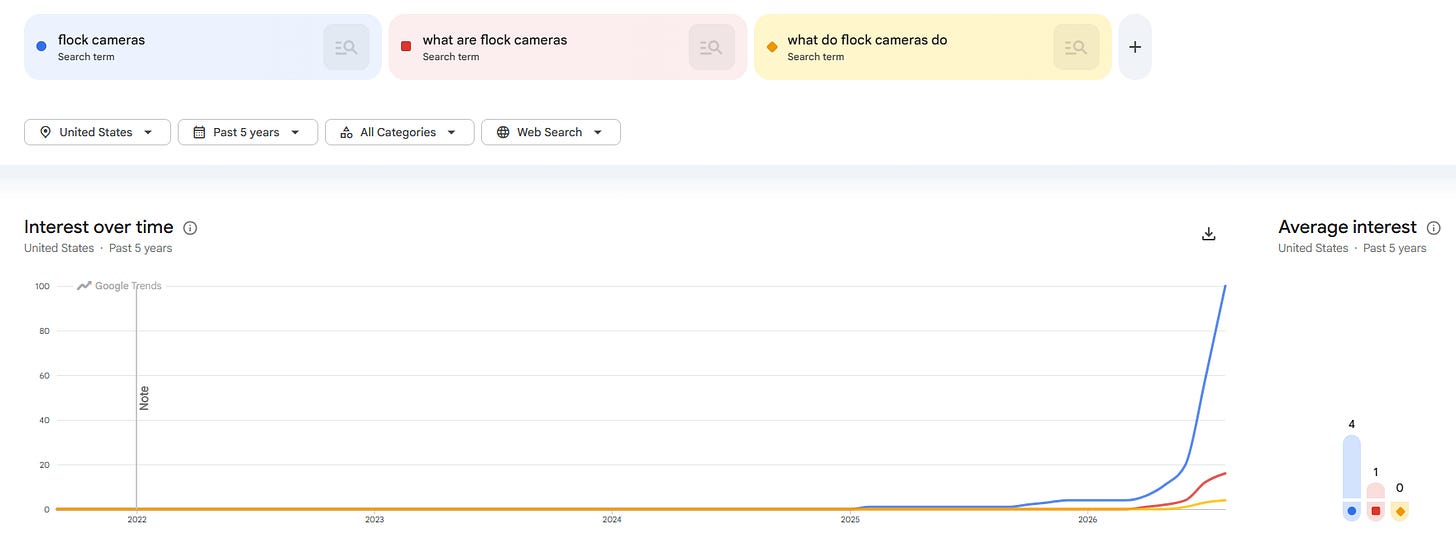
And this coincides with their giant, tacky cameras affixed with giant, tacky solar panels being put up across our nation in the most conspicuous places imaginable.
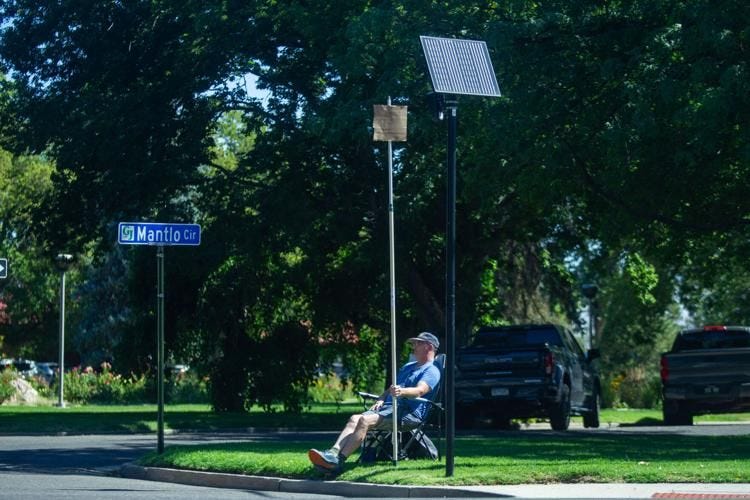
Meanwhile, they were hiding 5G towers inside of trees because they didn’t want us to see those.
Simultaneously, numerous social media influencers have come forward and admitted that they were offered pay to post videos bashing Flock cameras.
What you may not know is that the Flock cameras were installed oddly. For example, YouTuber The Guardrail Guy has traveled the country proving that Flocks are installed illegally close to guardrails.
Can we agree that’s incredibly illogical? How would so many of these cameras end up with illegal placement? Obviously the installers know about placement because they install shit for a living, so this is a massive red flag to me.
The next red flag is that Flock cameras are being placed to harass people who question them. For example, this guy began researching if Flock cameras were constitutional and questioning it on YouTube. Next thing he knew, they had installed one directly in front of his house, pointing at his house.
He is not the only one to share a story like this. The point here is, all of these giant illegally placed cameras will have to be taken down, and surely the installers knew this from jump, so what is going on here? Let me run this hypothesis by you:
As outlined in the part of this publication about Flock’s secret warehouses and front companies, by all outward appearances, this looks like a black operation. By definition, a black operation (or black op) is a covert or clandestine mission conducted by a government agency, military unit, or paramilitary organization that is not officially acknowledged by the sponsoring entity. This operation could be secretly conducted under the guise of national security. National security is the ruse that is always used to justify government overreach, such as 9/11 leading to permanent airport harassment, in which we cannot board a plane without specific forms of identification, we are fondeled, X-rayed, our property is searched, and we can’t even bring a standard water bottle through security check (but we can pay $8 to buy the exact same thing on the other side of the gates). And now, biometric scans are rolling out across the United States. All of this to take a flight, but back to Flock…
A fellow researcher pointed out something he found to be strange, but it seems he failed to grasp the bigger picture. What he said was that nobody has ever been prosecuted for Flock vandalism.

And, as unbelievable as this sounds, the news is providing maps of where Flock cameras have been destroyed.
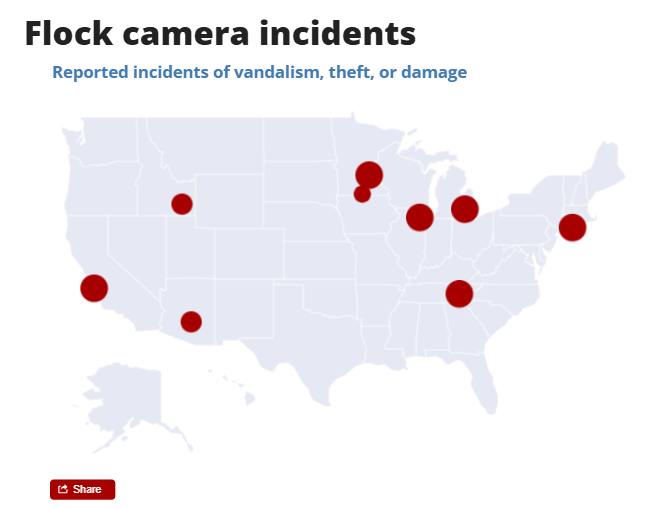
You are thinking to yourself, “But they sure didn’t provide maps of where people died after being vaccinated.” Nor are they providing maps of where Leonardo and Axon cameras are going up.
Note: I was able to locate a case in which a man was allegedly prosecuted and jailed over vandalizing a Flock camera. The story is Marcus Bee, 40, of Pismo Beach, traveled about 150 miles to Monterey County, where investigators said he vandalized at least three Flock Safety automated license plate readers.
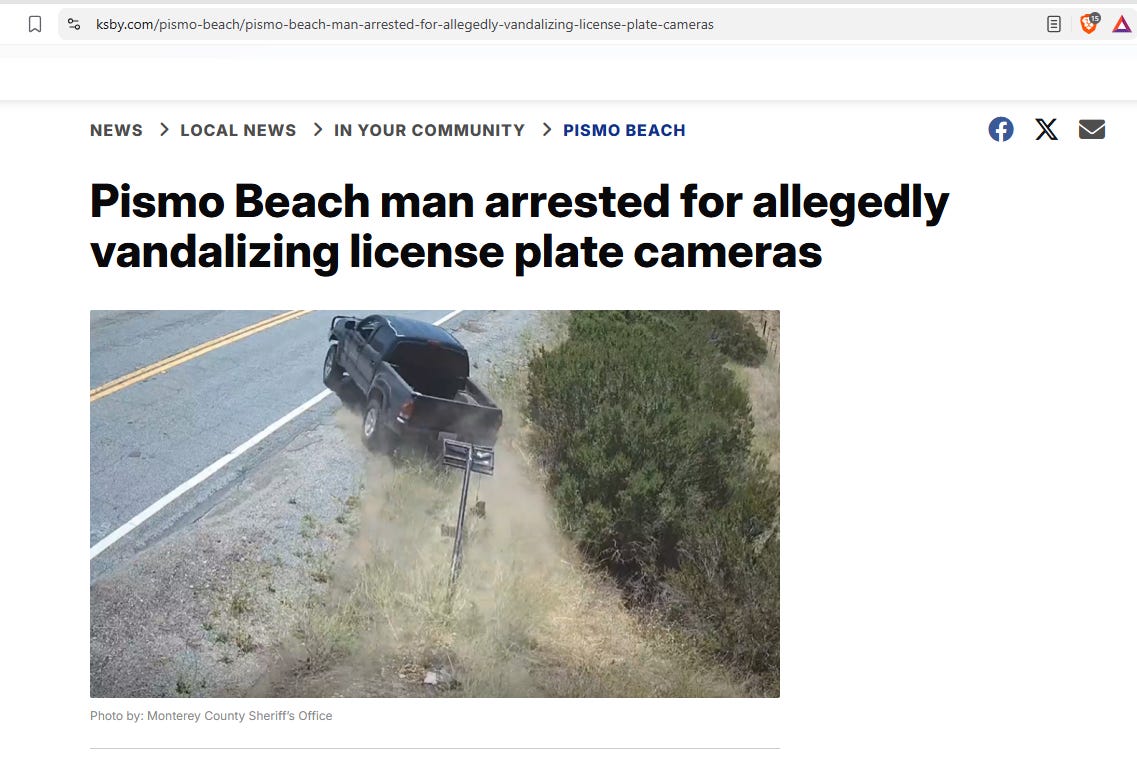
This story is kind of hard to believe, and a close look at it leads to more questions than answers, but regardless of whether a person, or a few people, has been arrested for Flock vandalism or not, the low number of arrests is atypical for people intentionally destroying government property. And you and I both know that if the government wanted to nip the vandalism in the bud, prosecuting destructors would be a top priority, but for unexplained reasons, it isn’t.
To get back to what I was saying: while we are fighting tooth and nail to have these big, noticeable cameras on thin poles taken down, whether that be through protesting to our local city councils or through vandalism (because the cameras are quite easy to break)…
Town after town began getting rid of them because the people stood their ground. Yay!
But, in true psyop fashion, the victory is an illusion because these same towns, as soon as the relationship with Flock is terminated, sign lengthy contracts with Axon, and remember, Leonardo is Axon’s partner. This switch-a-roo is precisely the case of Douglas County, which replaced Flock with a 10-year Axon contract worth 23 million dollars.
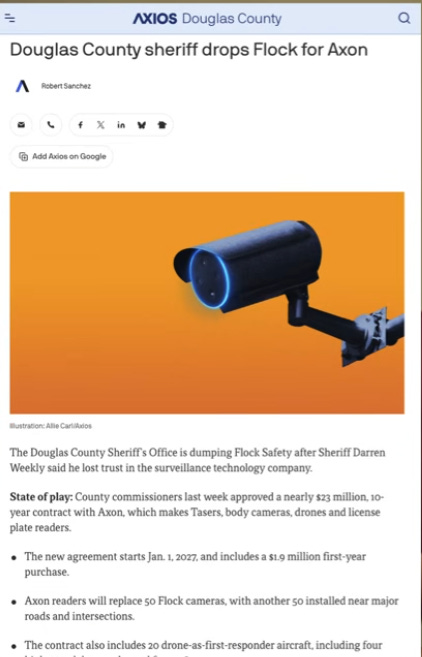
It’s as if this were the plan from the start.
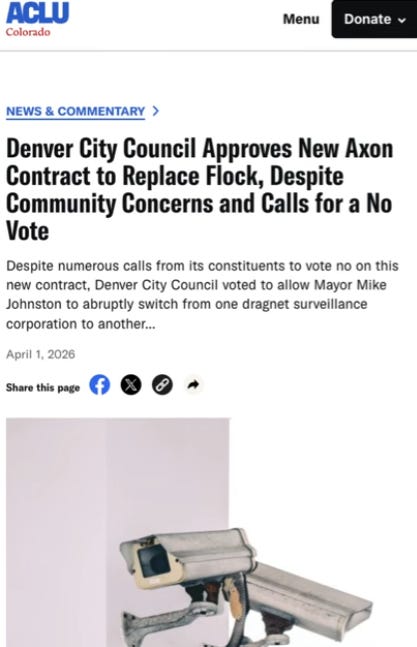
And recall that the patent for the upgraded technology with Bluetooth capturing was rushed through. This tech can be updated remotely.
And while this is going on, there isn’t a peep about it in the media. A search of Bitchute for “Leonardo Camera” turns up a single video, which isn’t even about the mass surveillance system; it is about Leonardo DiCaprio.
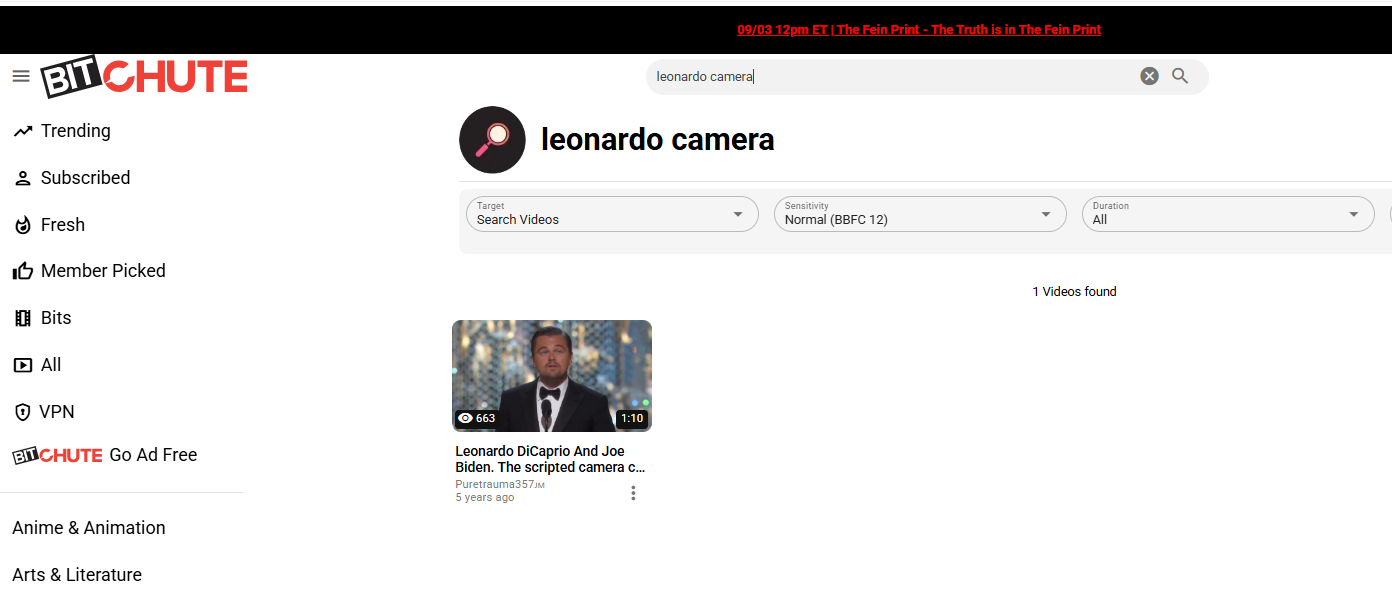
Meanwhile, a search for Flock brings up nearly 3,000 videos.

A search for Axon brings up 105 videos, most of which are the same video.

A search of Rumble for “Leonardo Camera” turns up zero videos. A search for Axon brings up roughly 90 videos, many of which are reposts of the same video. It would appear the psyop is working.
Now here’s the kicker: Do you recall the five proxies that have the same power in Leonardo as owners? Do you remember how most come from the financial investment industry and have also held high-up positions in our government, which makes no sense whatsoever because a financial guy would not be the most qualified man to oversee national security, right? So we must ask why. Why are these financial bros the proxies for this mass surveillance company that is supposed to be keeping us super duper safe? The answer can be found in a question…
“WHO CONTROLS THE DATA?”
To quote from DailyKos: “Perhaps the most underappreciated dimension of this technology is custodial. This is not a government database. The collection and storage of data is carried out by corporations, not law enforcement agencies. Leonardo US already holds contracts with U.S. Special Operations Command and the General Services Administration. Its parent company, Leonardo S.p.A., is an Italian defense conglomerate with a market capitalization exceeding $17 billion.” And that’s just one company in the sea of surveillance entities.
So you see, folks, these cameras and trackers aren’t about national security or stopping crime; they are a business venture. A business venture which, unlike police, do not need a warrant to record in public, log Bluetooth signals, or run biometric scans on us while we walk our dogs. And in this endeavor, the product isn't actually the cameras; the product is us and the data we produce is the currency. Like mining Bitcoin, we must be mined to produce this currency. Our eyes, our faces, our earbuds, our vehicles and tires, our doorbells, our computers, phones, and tablets, the article we read on lunch break, the type of milk in our refrigerator, the route we take to drive to work, if we completely stopped at the stop sign or exceeded the speed limit, the early morning phone call to the orthodontist, smart meter data, our receipt from the grocery store, every song we listen to, the text message we sent to our brother to ask if he wants to go to a football game, the AirTag on our keyring, whether we walked up the stairs briskly or slowly, what time we made coffee, what we said to our spouse during an argument, what medications we are on, what movie we watched on Friday night, if our vehicles are insured, and if our eyes lost contact with the road while we drove—it is all currency and it all must be harvested. They are the farmers, and we are their crop. And this currency has been in the works for a very long time. Recall what I told you previously: DARPA’s LifeLog database was to include credit card purchases, websites visited, the content of telephone calls and e-mails sent and received, scans of faxes and postal mail sent and received, text messages sent and received, books and magazines read, television and radio selections, physical location recorded via wearable GPS sensors, biomedical data captured through wearable sensors, and more. Our lives were to be logged; each action we take is to be accounted for, and the government, along with their contractors, are the accountants of this currency. And guess who is leading the way with facial recognition built into phones? None other than Facebook! This means as you stroll through the grocery store while on your cell phone, Facebook can log every person who walks by.
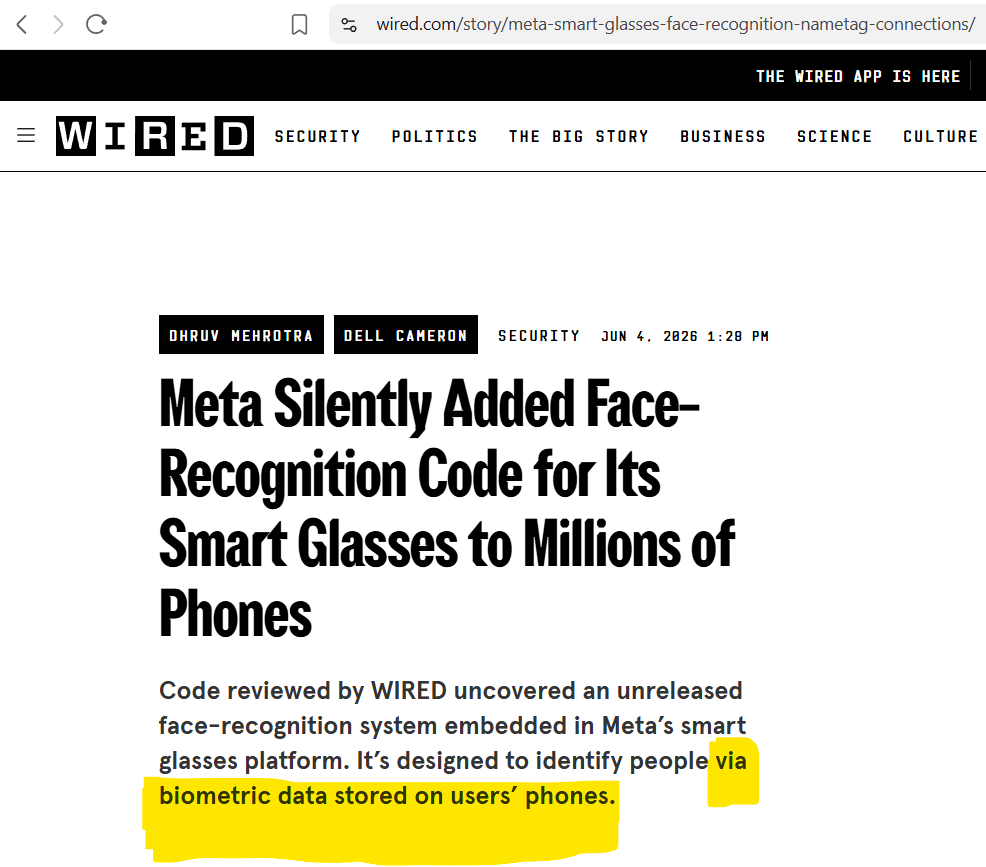
And here’s the huge thing that nobody has put together yet: the American court system just ruled that our vehicles are legally allowed to intercept and store our text messages and call logs if they are sent through the connected system. Simultaneously, the government has outlawed being able to use our phones when we are in our vehicles unless connected to a smart system. When a crew of researchers investigated where vehicle data was going after it was harvested from our autos, they found that the top recipients of the driver data were some of the country’s largest tech companies, including Amazon, Google, Microsoft, Pinterest, Snap, Yahoo, and, of course, Facebook (Meta). These are the same entities harvesting our online actions, purchases, etc.
HOW IT ALL TIES TOGETHER
Our vehicles are spying on us. Numerous data breaches revealed that all anyone had to do was look up a license plate, and not only would they instantly receive everything about the owner of the car, but also the precise GPS location of the vehicle at that very second. This information can include records of interior and exterior cameras and microphone recordings, as well as text message and call logs. Mind you, this is before the roll out of the terrifying new technology discussed previously.
Automakers of new vehicles can now turn off and activate features remotely. We can be blocked from driving for non-compliance, and each action taken against us is recorded. Our cars can read our text messages and share and sell data.
This information, along with every record related to our existence (licenses, emails, phone numbers, addresses, marriage records, social media accounts, etc.), is obtained by companies like LexisNexis. Additional information is being pulled from SDKs embedded in cell phone apps. This includes precise GPS, contacts stored in our phone, photos, microphone, browser activity, even purchase history and transaction information. The data brokers then compile everything into dossiers. This information can then be shared and sold, used to build AI, or warrantlessly passed along to law enforcement or any other government entity. While they might not share our text messages with businesses who want to buy them, who knows what they are actually doing with this info?
Then, there are the surveillance cameras, such as Leonardo, Flock, and Axon, and the video doorbells that we use to surveil ourselves and each other that log our whereabouts. Ring Neighborhood Portal is bad enough…

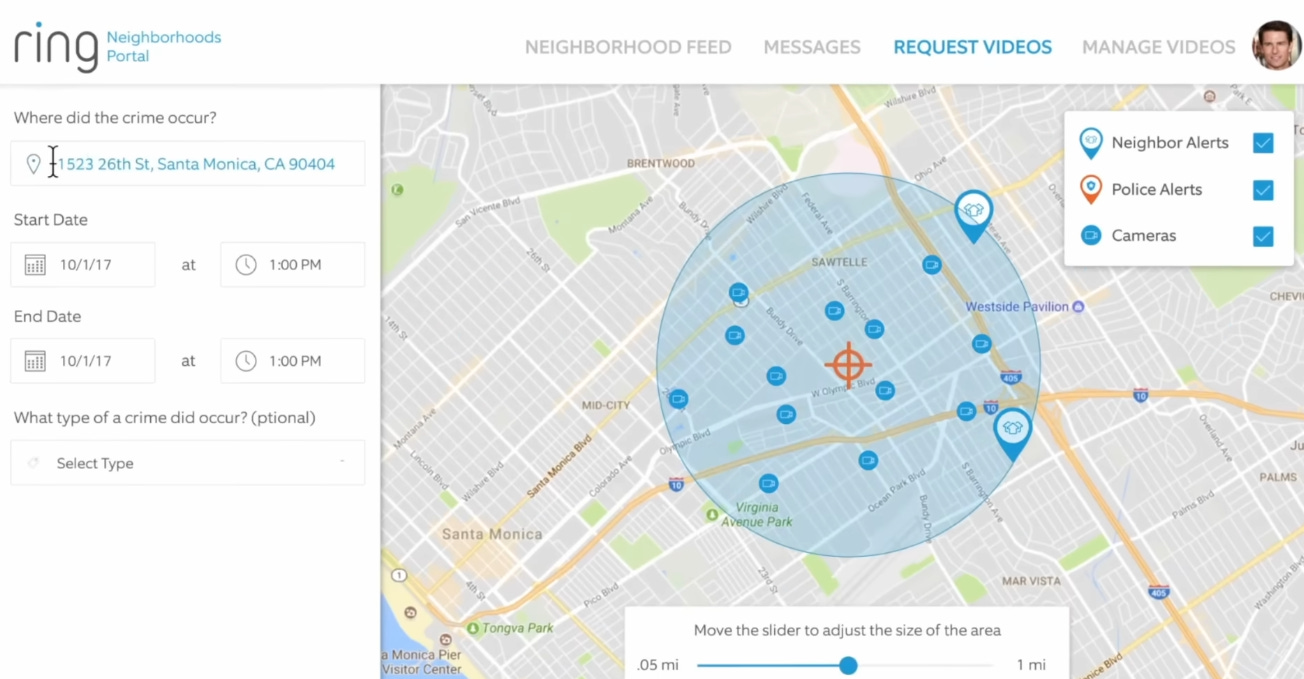
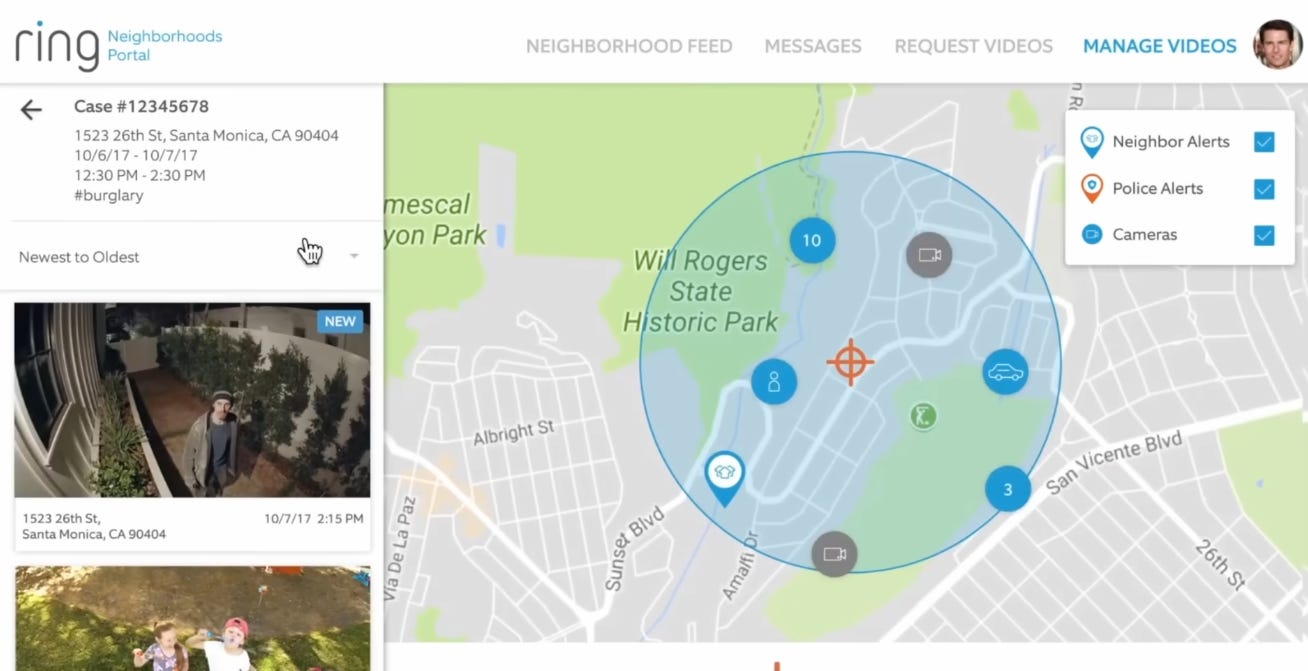
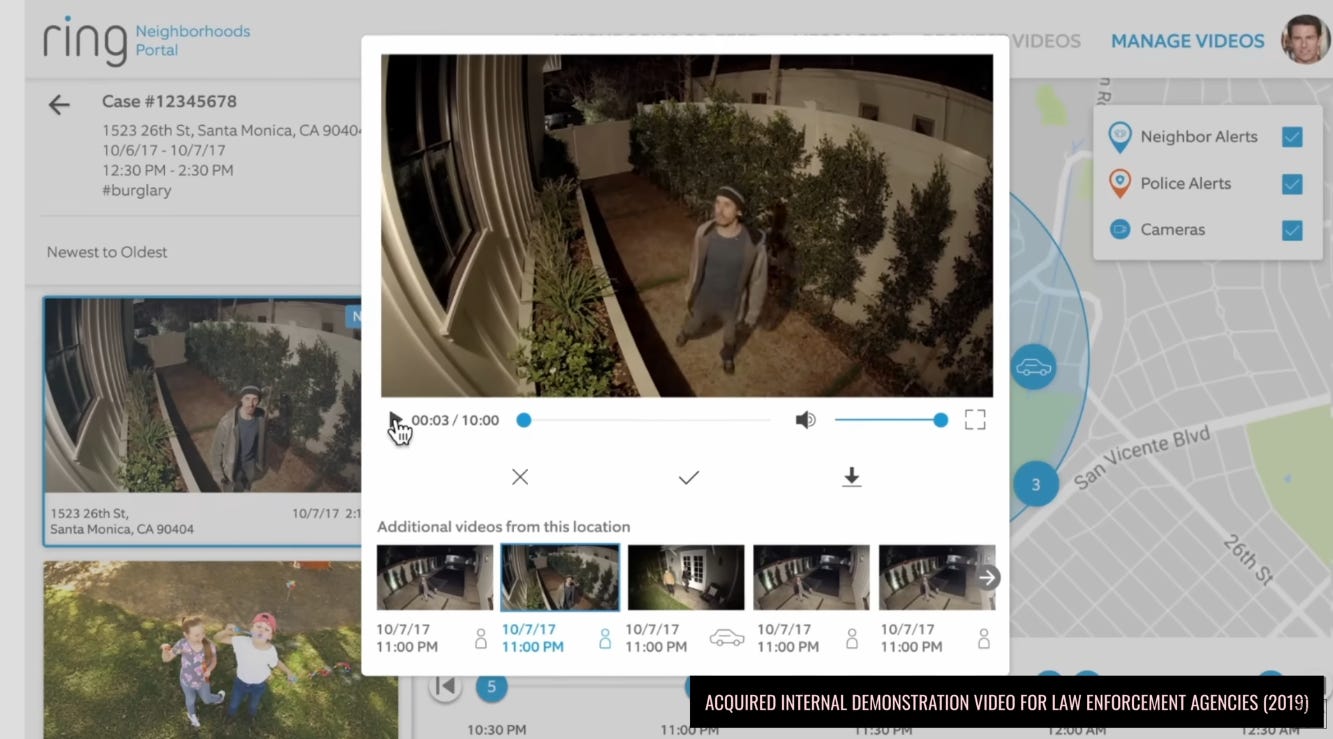
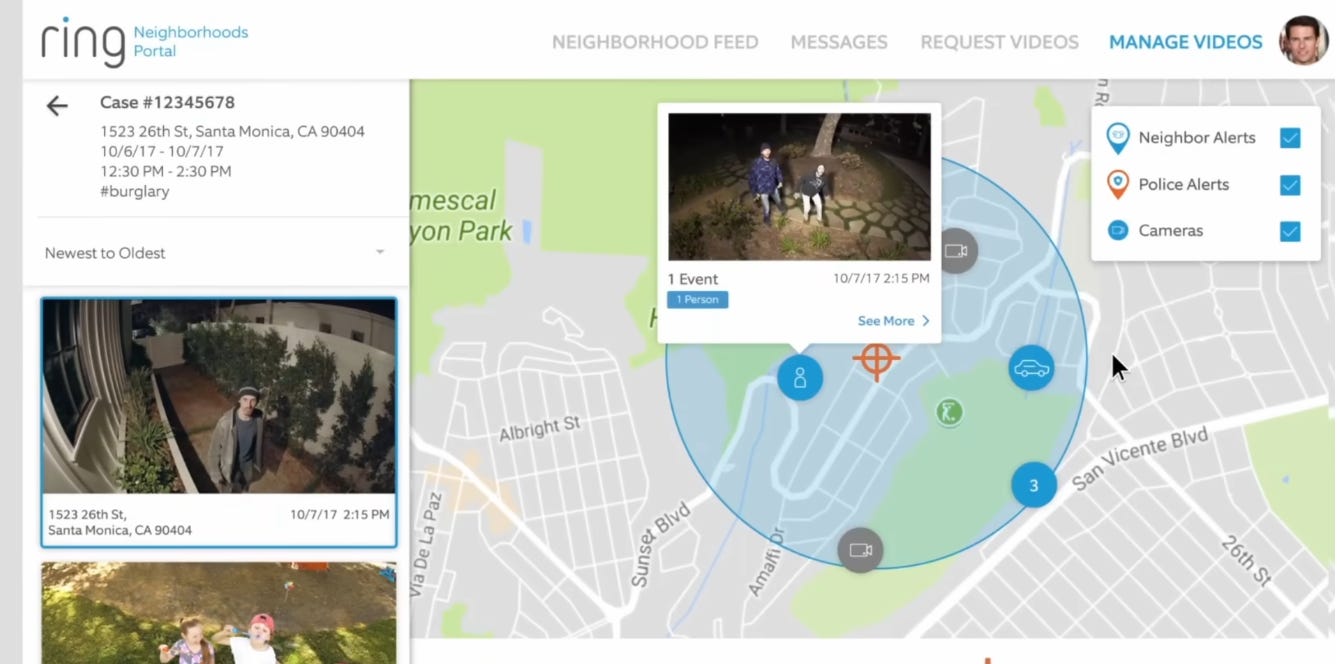
But if you want a glimpse of the dystopian future ahead of us, all you have to do is watch Rings commercial for their Search Party technology.
Meanwhile, license-plate readers, including those now affixed to delivery vehicles and garbage trucks, establish our vehicle’s movements. If we are in our car, they grab every last signal that is emitting from us and our vehicles and assign them a fingerprint. They then identify who we are with. With the use of AI databases, a connections chart is instantly generated showing our friends, family, employer, bank, likes and dislikes, how we voted, our income bracket, and the last event we attended. All of this information comes from companies like LexisNexis.
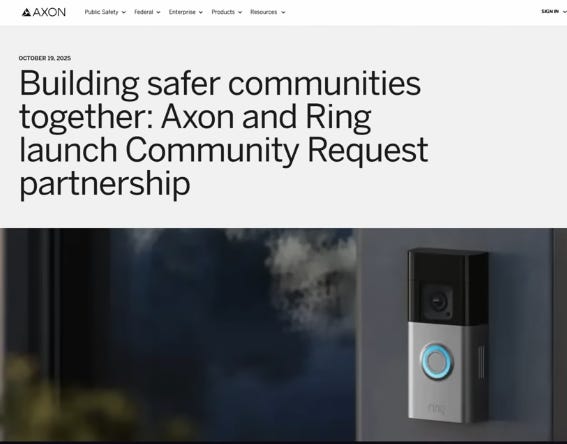
Meanwhile, our cell phones provide a precise GPS log of where we have been, what direction we are headed, if we drove, biked, walked, or took a subway, and they record the designation’s address and duration of stay.
When we drive, our vehicles will soon record everything we say and do during the trip, including what music or podcast we listened to, if we waited out the commercials or changed the channel, and if we slouched in our seat or glanced at a lost dog on the side of the road, because this too is valuable data.
If we spend money while at the designation address, the store itself is also likely harvesting and selling its customer data so that it can be layered with the other already collected information.
The end result is, every breath we take, every move we make, every bond we break, every step we take, they’ll be logging us. Every single day, every word we say, every game we play, every night we stay—they’ll be logging us. I’m sure it’s coincidence that this song was originally by a band called, of all things, The Police. But defunding the police has been a top priority. Why? Because the new police are on deck: the AI police. And remember, Covid face masks, biometrics, and 5G infrastructure—it was all needed to get to this stage.
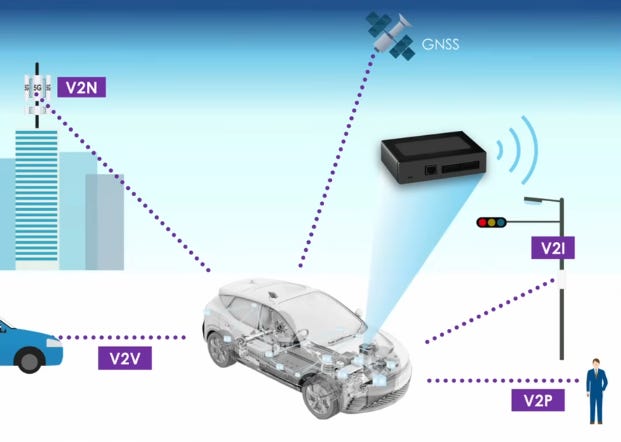
Now look where we are. Assorted data centers are rapidly going up, quite literally, everywhere.
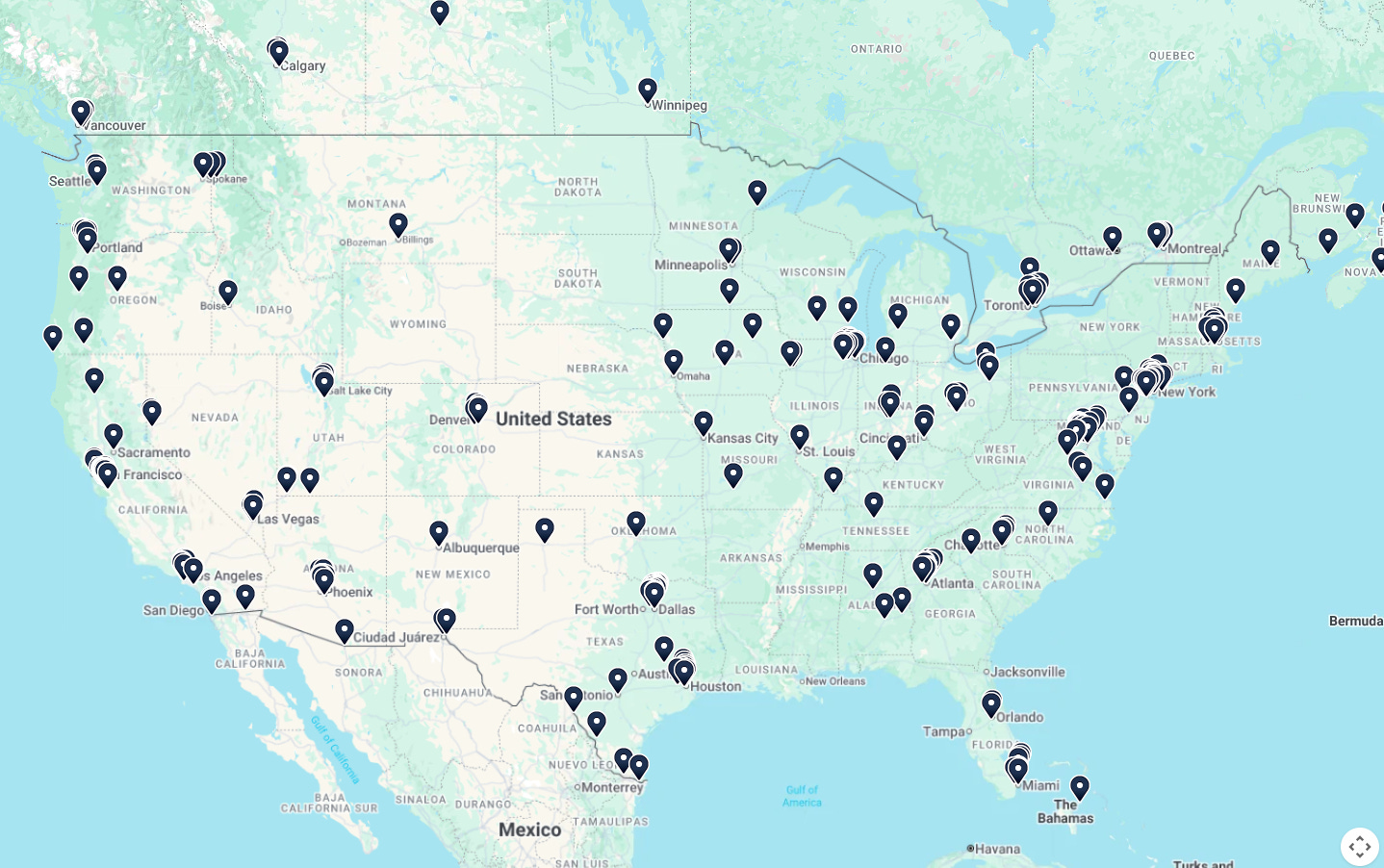
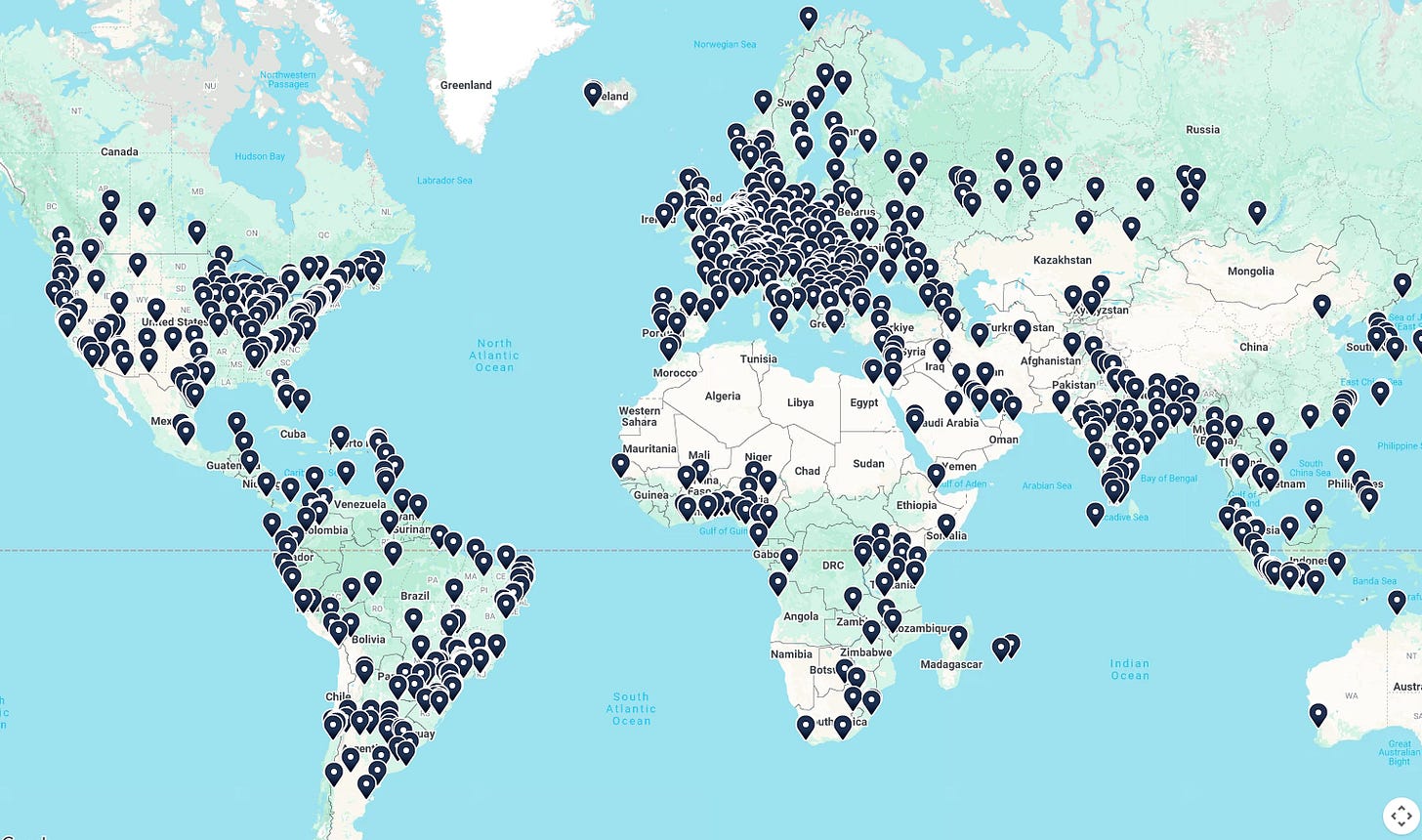
Once it is all linked together, anything we say, do, think, write, or type that is not approved will be punishable. Any place we go that we are not allowed will be punishable. Any product we buy that we have not been permitted to purchase will be punishable. Any action we take that AI feels is a danger to the “safe” society that they claim they are creating will result in repercussions. My spell check program is already telling me words to remove and sentences to change, not because the sentence is wrong or the words are incorrect, but because they are “conspiracy theory.” Soon, we will not be able to type these things at all.
This publication began as looking into Flock cameras but turned into something much larger. It turned into an exposé of data and its value, the AI police state, and what digital ID really is. It turned into the realization that it really is the end of the world as we know it.
Original Article: https://chemtrails.substack.com/p/is-flock-a-psyop-the-final-chapter
Note: Comments placed in [ ] are added by Truth11.com editor. For example; [Flu]
Comments ()