
The Extreme Corruption of Modern Warfare
FOCAL POINTS (Courageous Discourse™) | TheFocalPoints.com
John Leake
Yes; quaint and curious war is!
You shoot a fellow down
You’d treat if met where any bar is,
Or help to half-a-crown.
-Thomas Hardy, “The Man He Killed”

Some military historians have remarked that the Age of Chivalry in European warfare ended at the Battle of Agincourt (October 25, 1415) because Henry V’s English army used longbows to devastating effect against the French cavalry and infantry instead of sticking with the conventional style of close-quarter combat.
Shakespeare was aware of the perception that Henry had acted perfidiously with his longbowmen, but that didn’t stop him from giving his titular character, Henry V, the most rousing war drama lines in history.
This story shall the good man teach his son;
And Crispin Crispian shall ne’er go by,
From this day to the ending of the world,
But we in it shall be remember’d;
We few, we happy few, we band of brothers;
For he to-day that sheds his blood with me
Shall be my brother; be he ne’er so vile,
This day shall gentle his condition:
And gentlemen in England now a-bed
Shall think themselves accursed they were not here,
And hold their manhoods cheap whiles any speaks
That fought with us upon Saint Crispin’s day.
Though war has always involved ambition, cruelty, and injustice, its traditional conception was rooted in the understanding that those who pursued war would themselves bear much of its danger.
For centuries in Europe, the very notion of a young, able-bodied male of the ruling class hanging around the stock exchange instead of serving in a war that he advocated was unthinkable. Now it’s the norm.
Four developments in modern warfare have corrupted not only warfare, but have also (it seems to me) contributed to the general corruption of the minds, morals, and manners of modern man.
The first corruption is the separation of those who start wars from those who must fight them. As already noted, throughout much of European history, kings, princes, and aristocrats were expected to lead their armies into battle. Alexander the Great was repeatedly wounded in combat. Henry V used longbowmen, but nevertheless participated in the second, close combat phase of the battle. King Richard III of England was killed fighting at Bosworth Field in 1485.
In modern democracies, political leaders who choose war are not expected to expose themselves or their children to the dangers they impose upon others. This separation creates a moral hazard: the man making a consequential decision is insulated from its most terrible costs.
The second corruption is the concentration of military service in a tiny proportion of the citizenry. In the United States, active-duty military personnel constitute less than one percent of the population. Since the abolition of conscription in 1973, military service has become the responsibility of volunteers. The professionalization of the military has produced advantages in training, competence, and operational effectiveness.
However, it has also enabled the overwhelming majority of Americans to live their lives with little experience of war. Unlike the mass mobilizations of the two world wars, contemporary American military interventions require neither widespread conscription nor major sacrifices of goods and services back home. War is now experienced at home as a television spectacle. The burden of death, disability, and trauma falls on a small military community and its families.
The third corruption arises from the technological distancing of combatants from their victims. The development of strategic bombing, long-range missiles, and remotely piloted aircraft has made it possible to inflict devastating violence upon human beings thousands of miles away. The modern military lexicon reinforces this distance. Human beings are “targets,” destroyed homes are “battle damage,” and civilian deaths are “collateral damage.” A pilot releasing a precision-guided bomb or an operator directing a drone strike may never see the faces of those killed or maimed.
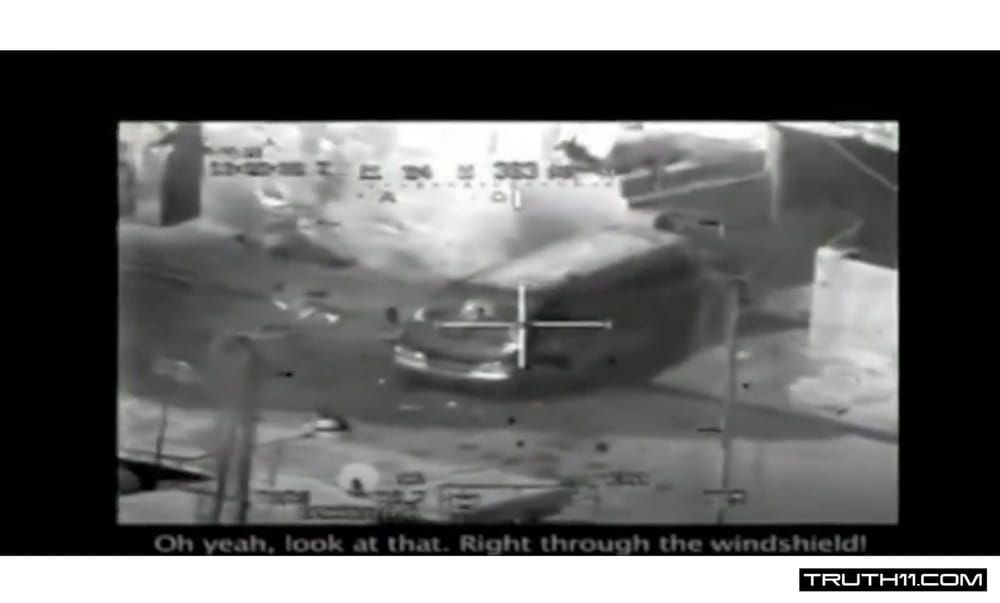
Back home, the public sees warfare through selected images of aircraft launches, missile trajectories, and explosions recorded by infrared cameras. The shattered bodies, grieving families, and lifelong disabilities produced by these weapons are not visible.
When Wikileaks published footage of unarmed civilians in Iraq being mowed down by a helicopter gunship hundreds of yards away, Julian Assange became the target of the US military-industrial-complex that prefers to keep the public in the dark about such incidents. What Assange says in his narration strikes me as true.
The fourth corruption is the financing of warfare through government borrowing. Historically, the necessity of raising taxes to finance military campaigns imposed an immediate political constraint upon rulers. Citizens who were required to surrender a substantial portion of their income to pay for war had a direct financial incentive to question its necessity and duration.
Modern governments, however, can finance prolonged military operations by issuing sovereign debt, thereby transferring a substantial portion of the financial burden to future taxpayers. The American wars in Afghanistan and Iraq illustrate this phenomenon. Much of their enormous cost was financed through borrowing rather than contemporaneous taxation.
Debt financing does not make war less expensive; it merely obscures its immediate cost and adds future interest obligations. It also permits political leaders to pursue military objectives without demanding that the electorate make an explicit choice between warfare and other public priorities.
One of the reasons why Eisenhower quickly ended the Korean War was because his predecessor, President Truman, had raised extremely unpopular taxes to pay for it. The Revenue Act of 1950 and Revenue Act of 1951 hiked corporate rates, individual income tax rates (with top marginal rates reaching 92%), and gas and excise taxes to fund the military effort. These were perceived by the electorate to be burdensome, and they made many wonder what exactly the war in Korea accomplished for Americans.
The four corruptions of modern warfare reinforce one another. Political leaders face little personal danger; most citizens face little prospect of military service; technologically mediated violence conceals much of the suffering inflicted upon foreign populations; and debt financing postpones the economic reckoning. Together, they weaken the mechanisms through which democratic societies might otherwise scrutinize decisions of war and peace.
Finally, the corruptions of modern warfare enable the majority of men to remain at home, manipulated by war propaganda, dazzled by video images of the technological prowess of American arms, with no concept of the purported “enemy” people or their suffering, and no clue about what could be done to find a peaceful solution.
Original Article: https://www.thefocalpoints.com/p/the-extreme-corruption-of-modern
Related:
Perpetual War
Truth11 Films 5th short film: We have been tricked into fighting perpetual wars of mass genocide for pointless profit. There is no enemy. The enemy is within the US government. All exterior enemies are created to justify the advancing military industrial complex.
There is only one way war will end. The masses must rise up, unite, and demand world peace.
This film contains the footage released by Chelsea Manning and Julian Assange.
Film Released In 2011
Drones
Truth11’s 9th short film discusses the purpose of the drone program and the actions of the US Government. Obamas drone program is CIA murder of innocent people and drones must be abolished.
Film Released In 2012
Comments ()