
The New Economics of Technocracy: “You Will Own Nothing” | Is Not a Slogan - It Is an Engineering Specification
Patrick Wood | substack.com/@patrickwood
Its Been A Long 50 Years
I have spent nearly fifty years documenting a system that most people refused to believe existed. For all of those 50 years, the elites foolishly swept me aside as a “conspiracy theorist.” But I am still here, and I won’t go away. The evidence speaks for itself.
The first time I put the endgame into words was in Technocracy Rising, published in 2015. I wrote then that if today’s technocrats were meticulously working toward a scientific dictatorship and applying a specific strategy to get there, they would have a specific list of criteria that must be met before “game over” is called. I asked: when that day comes, will they have the guts to shut the old world order down and simply declare the “system” as dictator?
That was eleven years ago. They have now called “game over.” And it is moving so fast that society and governments cannot keep up to regulate or stop it.
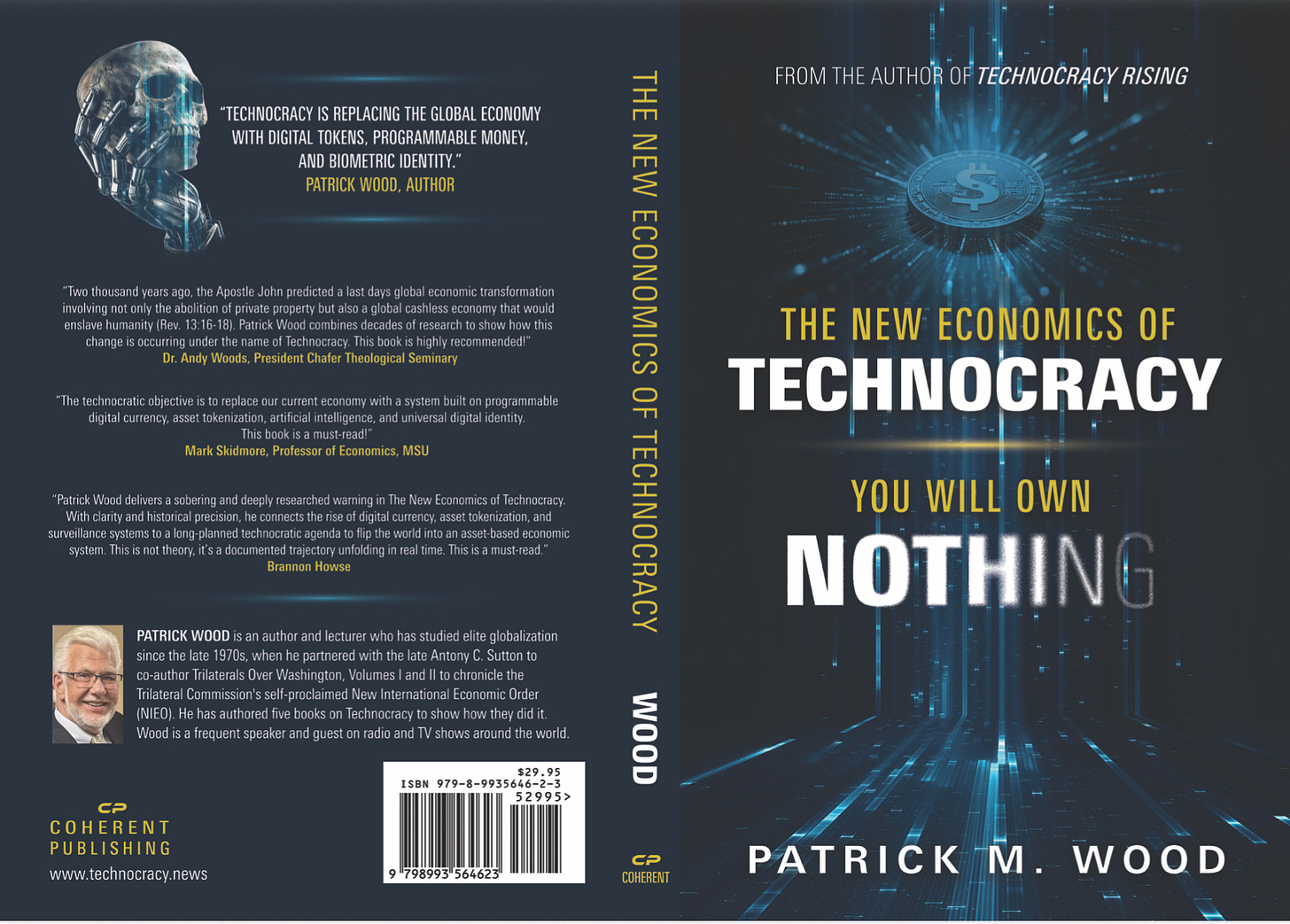
That is why I wrote and just released this Book:
‘The New Economics of Technocracy: You Will Own Nothing’
Why the Phrase “You Will Own Nothing” Is Not a Slogan — It Is an Engineering Specification
In November 2016, the World Economic Forum released a promotional video titled “8 Predictions for the World in 2030.” The first prediction declared: You’ll own nothing. And you’ll be happy. They later scrambled to reframe it as one possible “scenario” among many. But the sentence was honest in a way their subsequent documents have never been.
Most people interpreted it through a twentieth-century lens. Governments would confiscate property. Communism would return in new clothing. Jackbooted bureaucrats would knock on doors. But this fundamentally misunderstands the sophistication of the mechanism now being deployed. The architects of this system have no need for crude confiscation. They are building something far more elegant — a world in which ownership itself becomes a meaningless concept, replaced by tokenized access permissions administered through digital platforms that no individual can control or exit.
The subtitle of this book is not a slogan. It is an engineering specification. And to understand how it works, you need to understand a distinction that the financial media almost never discusses: the difference between a payment token and an asset token. These are the two instruments at the core of the system being built right now.
A payment token replaces your money. A stablecoin — a digital coin pegged to the dollar — looks and feels like a dollar, but every transaction is recorded on a blockchain, every purchase is traceable, and because the token is programmable, its behavior can be governed by computer code. The issuer can, in principle, embed conditions into the token: where you can spend it, what you can buy with it, when it expires, and whether your access can be revoked. A dollar bill is like water — it flows wherever you direct it, no questions asked. A programmable stablecoin is like water flowing through a pipe system that somebody else built, with valves somebody else controls.
An asset token does something even more fundamental: it replaces your property.
When a company tokenizes a real-world asset (RWA) — a building, a piece of land, a hotel — it divides that asset into thousands or millions of digital tokens, each representing a tiny fraction of the whole. The promoters call this “democratization.” What they don’t tell you is the most important thing in the entire book: fractional ownership is not ownership in any historically or legally meaningful sense. You cannot live in your fraction. You cannot will it to your children. You cannot paint the walls, plant a garden, or defend it. What you hold is a speculative financial instrument that exists entirely within the rules of a platform you did not build and cannot influence. If the platform operator decides to delist the token or revoke your access, your “ownership” evaporates. You hold a number on someone else’s computer.
This is not confiscation. It is redefinition.
The convergence of these two instruments — programmable money and tokenized assets — with a third layer of biometric digital identity, produces a closed loop. Nothing needs to be confiscated because nothing was ever truly owned. The word “own” simply loses its meaning.
The Unprecedented Acceleration Since November 2025
I predicted the logic that would produce these events. I did not predict their specific form or their staggering speed.
Consider what has led up to November of last year.
In 2021, Donald Trump called Bitcoin “a scam against the dollar.” By September 2024, his sons had launched World Liberty Financial — a cryptocurrency company that grew from zero to a $13 billion ecosystem in less than eighteen months. By March 2025, the company had issued USD1, a dollar-pegged stablecoin backed by U.S. Treasury securities and custodied by a federally chartered institution. By July 2025, Trump had signed the GENIUS Act into law, creating the federal regulatory framework that legitimized his own family’s stablecoin. No single individual in modern history has moved the technocratic transition forward with such speed, such audacity, and such structural completeness.
The revenue structure alone should demand public outrage. The Trump family is entitled to seventy-five percent of net token sale revenue from WLF. The stablecoin USD1 is backed by U.S. Treasury securities — instruments backed by the full faith and credit of the American taxpayer. The yield on those Treasuries is generated by the productivity and tax obligations of the American people. But that profit flows not to the American public, not to the U.S. Treasury, and not to any publicly accountable institution. It flows to a private holding company controlled by the president’s family — and to Tahnoun bin Zayed Al Nahyan, the UAE’s National Security Advisor, who secretly purchased a 49% stake in World Liberty Financial - just four days before the inauguration - in a deal not disclosed until February 2026. The public bears the risk. The private entity captures the reward.
Then came the events of early 2026 that removed any remaining doubt about the trajectory.
On February 18, 2026, World Liberty Financial launched WLF Tokenization as a separate Real World Asset division at a high-profile event at Mar-a-Lago. Its first offering tokenizes real estate loan revenue from the Trump International Hotel in the Maldives. The same Securitize platform powering this tokenization is also the infrastructure behind BlackRock’s BUIDL fund — the world’s largest tokenized Treasury fund. This is not a fringe experiment. This is institutional-grade financial infrastructure being deployed at sovereign scale.
The Board of Peace’s founding charter was signed on January 22, 2026, on the sidelines of the 56th World Economic Forum in Davos. Donald Trump declared himself to be Chairman-for-life with the right to pick his successor. He can’t be deposed or impeached, and he is accountable to no one. There was no mention of Gaza in the charter.
Gaza to the First Technocracy
Five days later, the Financial Times confirmed that the Board of Peace had selected the new governance body for postwar Gaza, co-chaired by Steve Witkoff, who is simultaneously Trump’s Special Envoy to the Middle East and co-founder emeritus of World Liberty Financial, which is exploring a dollar-pegged stablecoin to replace Gaza’s currency system. The description in that report fits USD1 precisely: already compliant, already custodied, already operational across ten blockchains. No new governance or infrastructure required.
Jared Kushner, Trump’s son-in-law, is providing the plan to rebuild Gaza into 5 smart cities, replete with total surveillance and biometric ID for all 2.3 million residents.
Follow the connections. Trump himself at the top. The Special Envoy who shapes Gaza’s political conditions. The sovereign fund that financed USD1’s credibility through a $2 billion deployment. The governance body overseeing reconstruction. The structure of the smart cities to be built. These are not three separate entities. They are one interconnected system. The conflict of interest is not a byproduct. It is the architecture.
Meanwhile, BlackRock CEO Larry Fink and COO Rob Goldstein published a joint column in December 2025 declaring that finance is entering “the next major evolution in market infrastructure” — one driven by blockchain tokenization. The world’s largest asset manager, with over $10 trillion under management, is telling you the plumbing of the entire financial system is being rebuilt.
How Asset Tokenization Forces You Out of Private Property Ownership
Now step back and see the full picture.
The goal is not to make it illegal to own property. The goal is to build a system in which the very infrastructure of economic life makes ownership structurally impossible. The process works in stages, and each stage is sold to you as progress.
Stage one: large financial players tokenize real estate into fractional shares. A person in Tokyo can now own 0.003% of a building in Phoenix. A pension fund in London can own a fraction. An algorithm in Dubai can own a fraction. Access. Democratization. Financial inclusion. Nobody mentions that when everyone owns a fraction of everything, no one owns anything in the traditional sense.
Stage two: because tokenized real estate is more liquid, more tradeable, and more programmable than actual property, institutional capital flows into tokenized funds rather than directly buying and holding physical properties. The Deloitte Center for Financial Services projects $4 trillion in tokenized real estate by 2035. BCG projects $3.2 trillion by 2030. As institutional demand for tokens grows, traditional owner-occupied models become economically less competitive.
Stage three — and this is where “democratization” becomes dispossession — a token is not a deed. The asset itself is held by a trust, a special purpose vehicle, or a custodian. That custodian is governed by smart contracts and the regulatory framework under which those contracts operate. The person who controls the platform controls the asset. The person who writes the smart contract writes the rules of ownership. And those rules can be changed, restricted, or revoked — not by your county courthouse, not by your elected legislature, but by the platform operator.
This is not new. The original Technocracy movement of the 1930s — first proposed at Columbia University — had a name for what is now being built. They called them Energy Certificates: non-transferable, individually registered, centrally monitored units that tracked consumption and controlled distribution, expiring at the end of each accounting period to prevent the accumulation of savings or wealth. Everything was to be centrally monitored and allocated. No private property. No savings. No accumulation.
The terminology has changed from “certificates” to “tokens.” The architecture has not changed at all. What the original technocrats could only dream about in the age of punch cards, their intellectual descendants are now implementing with blockchain, biometrics, and artificial intelligence.
The biblical framework makes the stakes of this unmistakably clear. In Genesis, God gives dominion to man — the right to possess, to steward, to be accountable for what is entrusted. The commandment “Thou shalt not steal” presupposes the legitimacy and sanctity of private ownership. The Mosaic Year of Jubilee — God’s own redistributive mechanism — operated by returning property to its original family, not by centralizing it under any authority. It was restoration, not redistribution: an acknowledgment that the land is held in trust by families, not by kings, not by priests, and certainly not by platform operators.
The tokenization model does not steal property. It does something more radical. It dissolves the concept entirely. The shift from owner to user is not merely economic. It is anthropological. It redefines what a human being is in relation to creation itself.
The System Is Being Installed, Present Tense
There is a word I chose carefully in the preface of this book. I did not write that this system is coming. I wrote that it is already being installed.
The distinction matters. Something coming can still be stopped. Something being installed is already in your walls. The wiring is already laid. The pipe system is already in place. What remains is to turn on the water — and to make sure the valves are where the engineers want them.
The GENIUS Act has passed. The regulatory scaffolding is in place. Sovereign nations are adopting USD1. The Board of Peace is exploring deploying stablecoins as the payment layer for a reconstructed territory with no existing currency system — the perfect laboratory, with no political resistance and no constitutional protections to navigate.
The time to understand what is being built is before it is finished, not after. When the majority of assets you interact with — your home, your savings, your income — exist as programmable tokens inside a governed financial infrastructure, the question of ownership becomes a question of access permissions. And access permissions can be granted, modified, suspended, and revoked.
You will own nothing. They will call it investing. They will call it progress. They will call it financial inclusion.
What they will not call it is what it is: the completion of a hundred-year plan — the replacement of a price-based system with a resource-management system in which human beings are treated not as persons endowed with dignity, but as biological resources to be optimized, managed, and, if necessary, financially excluded until they comply.
I have spent fifty years documenting this system. I have been warning about it since before most of my readers were born. The fact that the architecture is now visible to anyone willing to look is not vindication. It is the alarm bell.
The New Economics of Technocracy: You Will Own Nothing is the documentation. Read it. Share it. Understand it.
The evidence speaks for itself.
Original Article: https://patrickwood.substack.com/p/why-i-wrote-and-just-released-this
Comments ()