
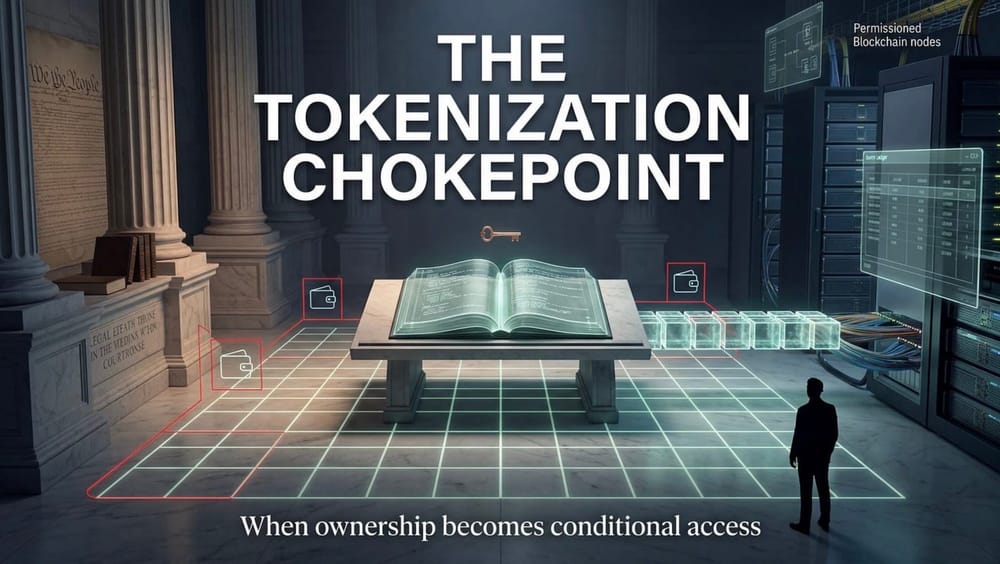
The Tokenization Chokepoint
Technocracy.news
A bridge can connect two systems. It can also decide which traffic is allowed to cross.
Courtenay Turner | courtenayturner.substack.com
Technocracy News & Trends has provided article after article, explaining tokenization. My new book, The New Economics of Technocracy: You Will Own Nothing, deals with it extensively. You must get your head around tokenization and understand that it will spell the end of private property, flipping us into an asset-based economic system just like Technocrats in the 1930s spelled out. Time is running out to send these grifters packing! ⁃ Patrick Wood. Editor.
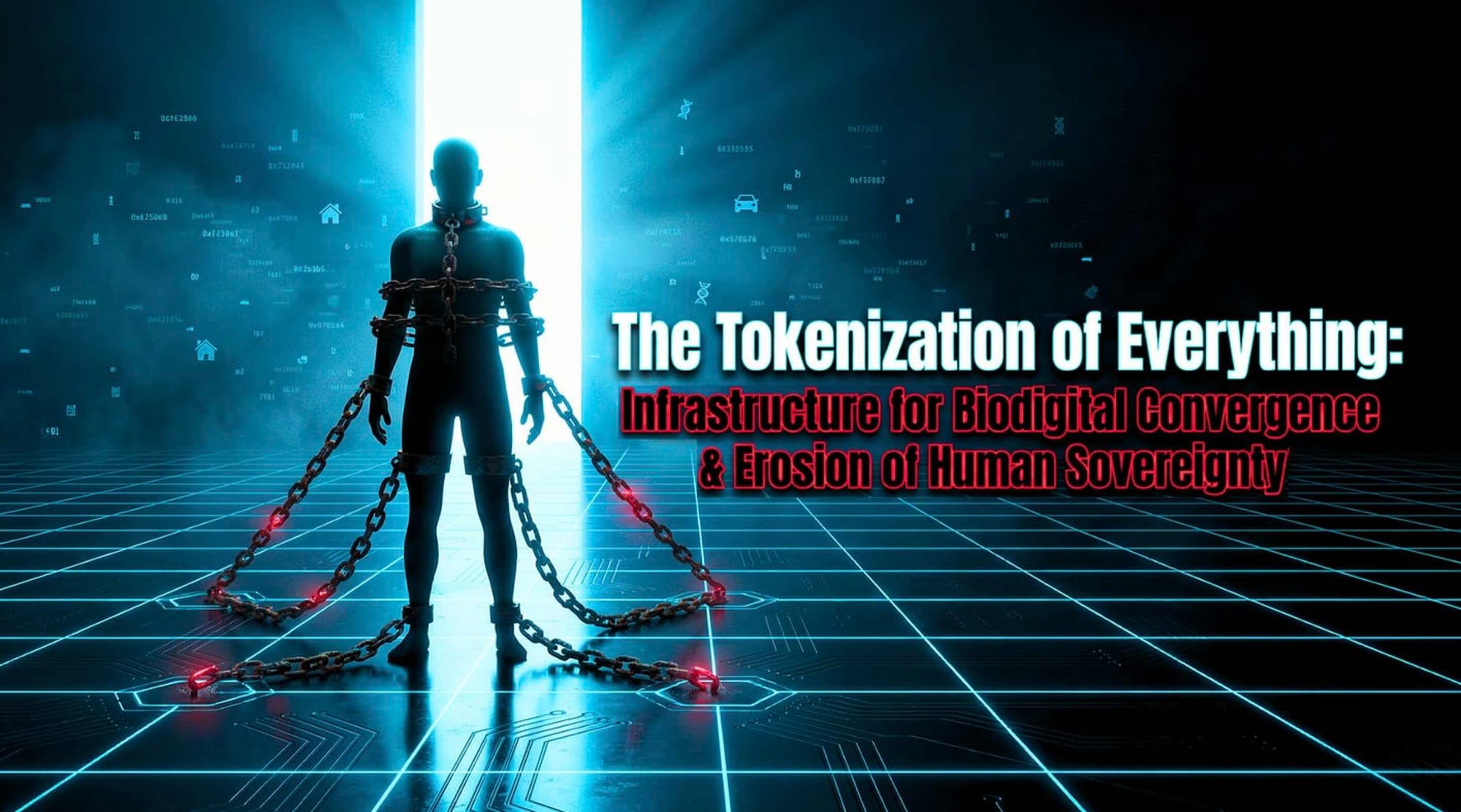
In January, I published “The Tokenization of Everything.” The argument was not that blockchain is evil or that every tokenized asset is a control device. The argument was narrower and more dangerous: once property, money, credentials, and access rights are converted into programmable digital instruments inside a regulated, bank-integrated ecosystem, ownership quietly mutates into conditional permission.
Tokens are not neutral representations of property. They are code that can be designed to expire, freeze, restrict, or revoke based on compliance scores, policy triggers, or algorithmic rules set somewhere upstream. I named the legislative scaffolding — the GENIUS Act, the CLARITY Act — and the institutional cheerleaders, from BlackRock’s Larry Fink to then–Commerce Secretary Howard Lutnick. The warning was structural: a subscription society where durable property rights are replaced by revocable permissions, and where opting out becomes impractical because the rails of daily life run through the new system.
In February, I published “The Proof of Persona: Decoding Patent 060606.” That essay went one layer deeper. Microsoft’s published patent application WO2020060606A1 describes a cryptocurrency system in which a task is issued to a user device, a sensor captures body activity, the resulting data is transformed into a compact proof, and a cryptocurrency reward is issued if the proof satisfies validity conditions defined by the system. The patent publication explicitly contemplates that a user can solve the validation problem “unconsciously.”
The point was not that this system is currently deployed. The point was that someone considered it feasible enough to file: a published blueprint for moving the credential from what you do to what your body does — proof-of-work to proof-of-response to proof-of-compliance. I called it the hash of the soul, and I argued that the deepest battle is not technical but metaphysical: whether persons are real prior to systems, or whether personhood is a status conferred by what a validation server can read and certify.
The two pieces, taken together, sketched a stack:
- Layer 1 — Programmable assets. Property, money, securities, and services rendered into tokens that obey rules embedded by issuers, custodians, and regulators.
- Layer 2 — Programmable persona. Identity, eligibility, attention, and eventually body-derived signals rendered into ledger-native attestations that condition access to Layer 1.
I argued that the danger of the stack is not in any single feature but in the convergence: a world in which both your assets and your standing are entries in a controlled ledger, and where the ledger doesn’t have to ask what you believe — only whether your wallet, your credential, or your body produced an acceptable profile.
That was the warning.
This is the rollout.
What DTCC Just Announced
On May 4, 2026, the Depository Trust & Clearing Corporation announced that its subsidiary, The Depository Trust Company, will facilitate initial, limited production trades of tokenized real-world securities in July 2026, with a planned full service launch in October 2026. The service has been developed with input from more than fifty financial industry firms. The published working group is not a marginal coalition. It is, in effect, the spine of the U.S. financial system plus the institutional crypto layer:
- Major banks: J.P. Morgan, Goldman Sachs, Morgan Stanley, Bank of America, Citi, Wells Fargo, HSBC, BNP Paribas, UBS, State Street, BlackRock, RBC Capital Markets, TD Securities, Lloyds Bank.
- Asset managers and clearing/custody: BlackRock, Franklin Templeton, Invesco, Charles Schwab, Apex Clearing, Broadridge, FIS, SEI, BetaNXT.
- Market makers and brokerages: Citadel Securities, DRW, Virtu Financial, Jefferies, StoneX, Robinhood, TradeStation, Raymond James, Marex.
- Exchanges and trading venues: Nasdaq, NYSE Group, Tradeweb, EDX Markets, Tel-Aviv Stock Exchange.
- Crypto-native infrastructure: Circle (issuer of USDC), Anchorage Digital, BitGo Bank & Trust, Fireblocks, Ondo Finance, Ripple Prime, Payward (parent of Kraken), Digital Asset (creators of the Canton Network), Talos, Bitwave, Backpack.
The eligible assets are not fringe instruments. They are the bloodstream of U.S. capital markets:
- Russell 1000 constituents (the largest U.S. publicly traded equities)
- ETFs tracking major indices
- U.S. Treasury bills, bonds, and notes
DTCC says The Depository Trust Company currently custodies more than $114 trillion in assets, and that DTCC’s subsidiaries collectively processed securities transactions valued at $4.7 quadrillion in 2025. The Federal Reserve identifies DTC as a central securities depository and securities settlement system, and lists it among the financial market utilities that the Financial Stability Oversight Council has designated as systemically important.
The service rests on a December 2025 SEC no-action letter authorizing DTC to offer a defined tokenization service for DTC Participants and their clients for three years, subject to representations and limitations. A no-action letter is not a statutory rewrite — the SEC staff explicitly noted that the response was based on the facts presented, did not necessarily endorse DTC’s legal conclusions, and could be modified or revoked. So the documented claim is not “the entire securities market is now tokenized.” The documented claim is this: the systemically important securities depository at the center of U.S. post-trade infrastructure has received regulatory cover to launch a regulated tokenization service for the most liquid assets in the country, and it has fifty of the world’s largest financial institutions in the working group.
That alone would be significant.
What makes it the rollout I warned about is the design.
“Same Rights” Wrapped Around a New Control Surface
DTCC’s public framing emphasizes continuity. Tokenized assets, the company says, will carry the same legal and economic rights, investor protections, and ownership entitlements as the underlying securities held in traditional form.
This is not corporate spin, and it deserves to be stated at its strongest. The SEC no-action letter is explicit on the point. DTC’s request letter, which the SEC published as an attachment to the staff response, states that “a Tokenization Instruction would not change the legal framework governing the Participant’s holdings of the Subject Securities. The Participant would (until it transfers the Tokens) remain the entitlement holder with a security entitlement to the Subject Securities subject to the full suite of Article 8’s provisions and protections.” Corporate actions, including cash dividends, would be processed exactly as they are for traditional book-entry holdings. Whatever voting rights and economic entitlements the underlying Russell 1000 stock or ETF carries today, the tokenized version carries tomorrow.
That matters. It distinguishes DTCC’s service from the rights-stripping critique that gets aimed at certain crypto-native “tokenized equity” platforms. This is not a memecoin with a marketing deck. The legal entitlement to the underlying security survives tokenization in full.
So the institutional reassurance is real on its own terms. The question is whether legal-rights continuity is the right frame for evaluating what is actually being built.
But the architecture documented in the SEC’s December 11, 2025 no-action letter — and in the underlying request letter from DTC, which the SEC published as an attachment — tells a different story.
The no-action letter establishes the following as documented features of the program. DTC will retain a “root wallet” on each approved blockchain, with keys that, in the letter’s own language, allow DTC to “convert, transfer, mint, or burn any of the Tokens, even without the private key for the Registered Wallet.” DTC’s broader tokenization service materials describe an expanded set of administrative controls — including Clawback, Pause/Unpause, and Freeze/Unfreeze — implemented through compliance-aware token standards such as ERC 3643, which DTC explicitly names in the request letter as one of the protocols it has identified as compliance-aware. A monitoring system called LedgerScan — an off-chain, cloud-based DTCC software that resides in a public cloud and scans the underlying blockchains — will track token movements and Registered Wallet holdings in near real time. And the line that matters most, lifted verbatim from the no-action letter: “For purposes of recording Tokenization Entitlements, LedgerScan’s record would constitute DTC’s official books and records.“
To put the architecture plainly — this is my own paraphrase — what is being built is an asset that DTC can convert, transfer, mint, or burn at will through a root wallet; that can only move between wallets the institution has approved; on blockchains the institution has approved; under tokenization protocols the institution has certified as “compliance aware” with “distribution control” and “transaction reversibility”; whose movements are visible to DTC in near real time through an off-chain cloud system; whose official ownership record is not the public chain but DTC’s own LedgerScan ledger; and where every wallet permitted to hold the asset has been independently sanctions-screened by DTC against the Office of Foreign Assets Control list.
That is precisely the structure I described in Part I, now built into the official securities layer.
The legal wrapper says: same rights, same protections, same entitlements.
The technical wrapper says: programmable, reversible, freezable, and permissioned by design.
Both are true at once. That is the point.
Source: https://courtenayturner.substack.com/p/the-tokenization-chokepoint
Original Article: https://www.technocracy.news/into-technocracy-the-tokenization-chokepoint/
Related:

Comments ()