
Total Eclipse of the Sun
MP | A Truth Warrior Reader Of Truth11.com
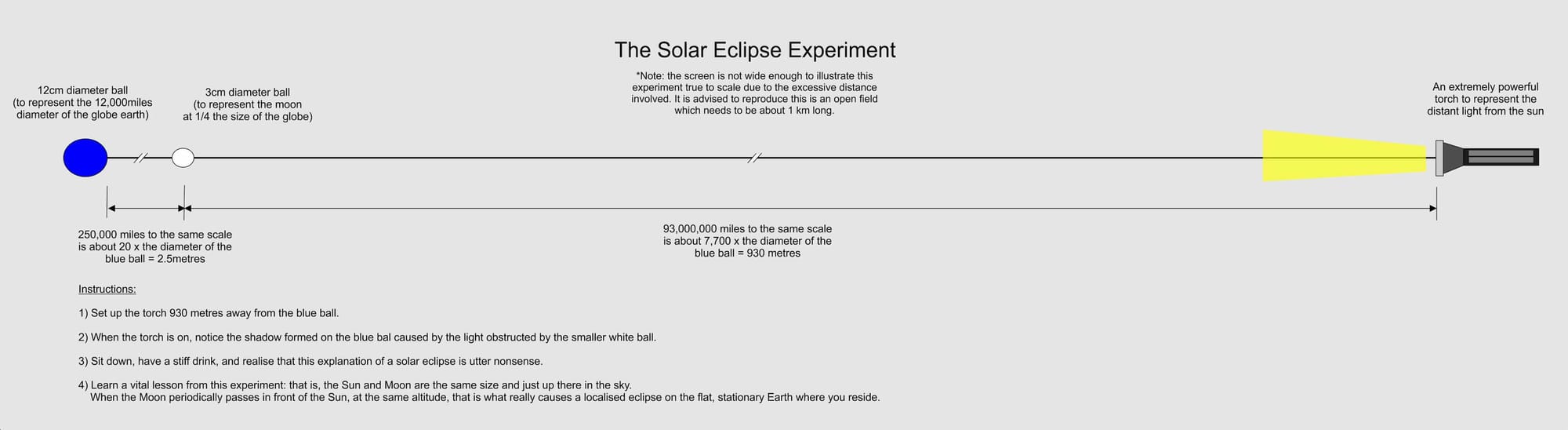
An eclipse of the Sun can easily be demonstrated on a map of a flat, stationary Earth. No spinning of a globe earth or orbiting of a moon far away in space is necessary. There is no need for a distant sun93,000,000 miles away or a distant moon 257,000 miles away, to explain how their relative sizes cause periodic eclipses. Real life, on the real Earth is much simpler than that.
Whilst reading this article, try to temporarily discard any belief that any mention of a flat Earth is just for crazy people. This response is expected in a world where everyone has been conditioned, since birth, to accept the spinning globe model without ever challenging it. Also consider that all real life observations are in fact those experienced from a flat, stationary Earth as opposed to a hypothetical rotating globe.
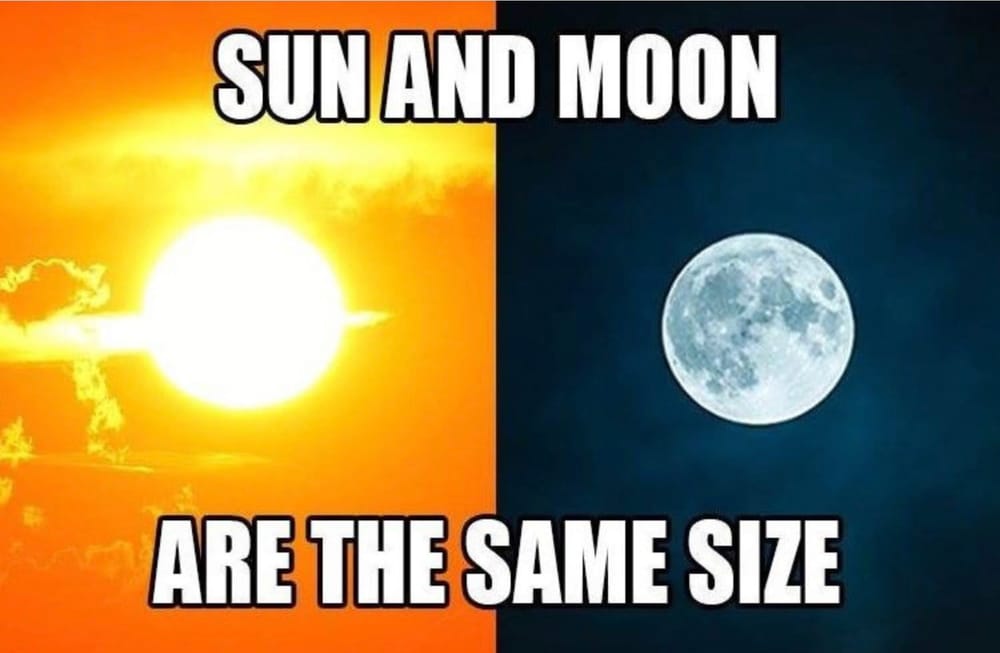
Before going into details of the coming eclipse, the first thing to consider is that the Sun and the Moon are in fact the same size. Furthermore, they both travel in regular circuits in the sky. Yes, just up there in the sky where you can see them with your own eyes.
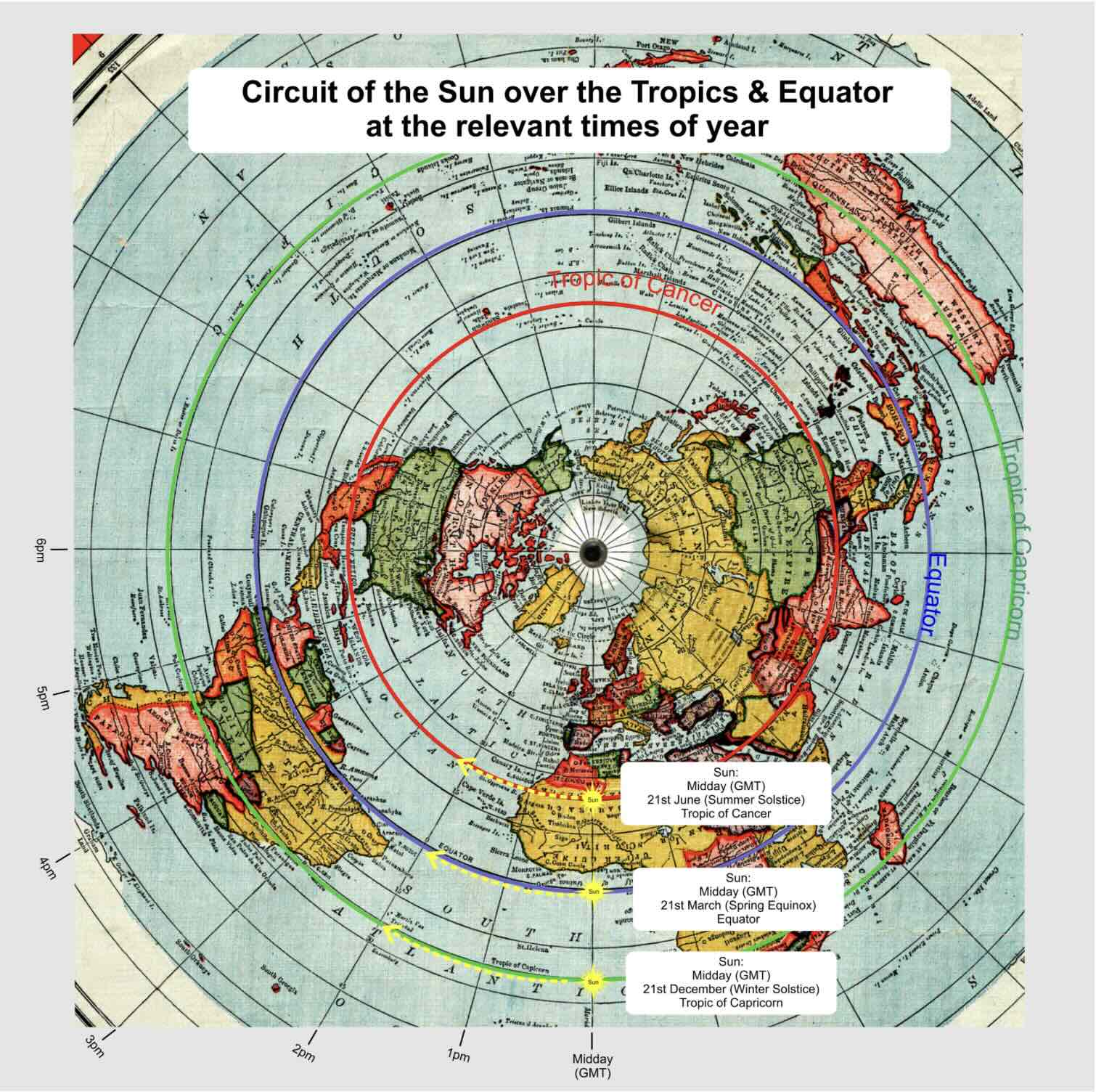
The Sun completes a circuit around the flat Earth every twenty-four hours. That is why, like clockwork, you can predict exactly where the Sun will be at a given time. As it travels in a daily circuit, it gradually moves from over the Tropic of Capricorn (21st December – Winter Solstice), arriving at the Equator (21st March – Spring Equinox) then reaches the Tropic of Cancer (21st June – Summer Solstice).
It takes six months to complete this journey between the Tropics. The largest circuit is while travelling overhead in Australia (Tropic of Capricorn), resulting in summer there. The daily circuits then gradually reduce in size until arriving closer to Europe and North America, resulting in summertime while Australia experiences winter. The amazing feature of this journey is that, despite the changes in circumference travelled, the daily circuit is always precisely twenty-four hours. This is just one example of how you cannot truly understand the astonishing wonders of life unless you comprehend the real nature of the Earth on which you live.
Once arriving at the Tropic of Cancer, the Sun then starts the six month return journey back to the Tropic of Capricorn. As its’ circuits increase in size, it becomes visibly lower in the sky. Simultaneously, the weather becomes cooler in America and Europe because the heat of the localised Sun is further away.
What most people don’t know, because they have never been taught the fact, is that the Sun travels slightly faster around the twenty-four hour circuit than the Moon. In fact, from the moment the Sun and Moon are in the same position, it takes twenty-eight days for the Sun to lap and overtake the Moon once more. This process of the Sun travelling faster than the Moon is why we experience the different phases of the Moon.
The 28-day Lunar Cycle:
Overlaid on top of the Gleesons maps below is the relevant position of the Moon at each of the quarter stages of the 28-day Lunar Cycle. The Sun is shown where it is always at Midday (GMT), which is due south from the timezone in London.
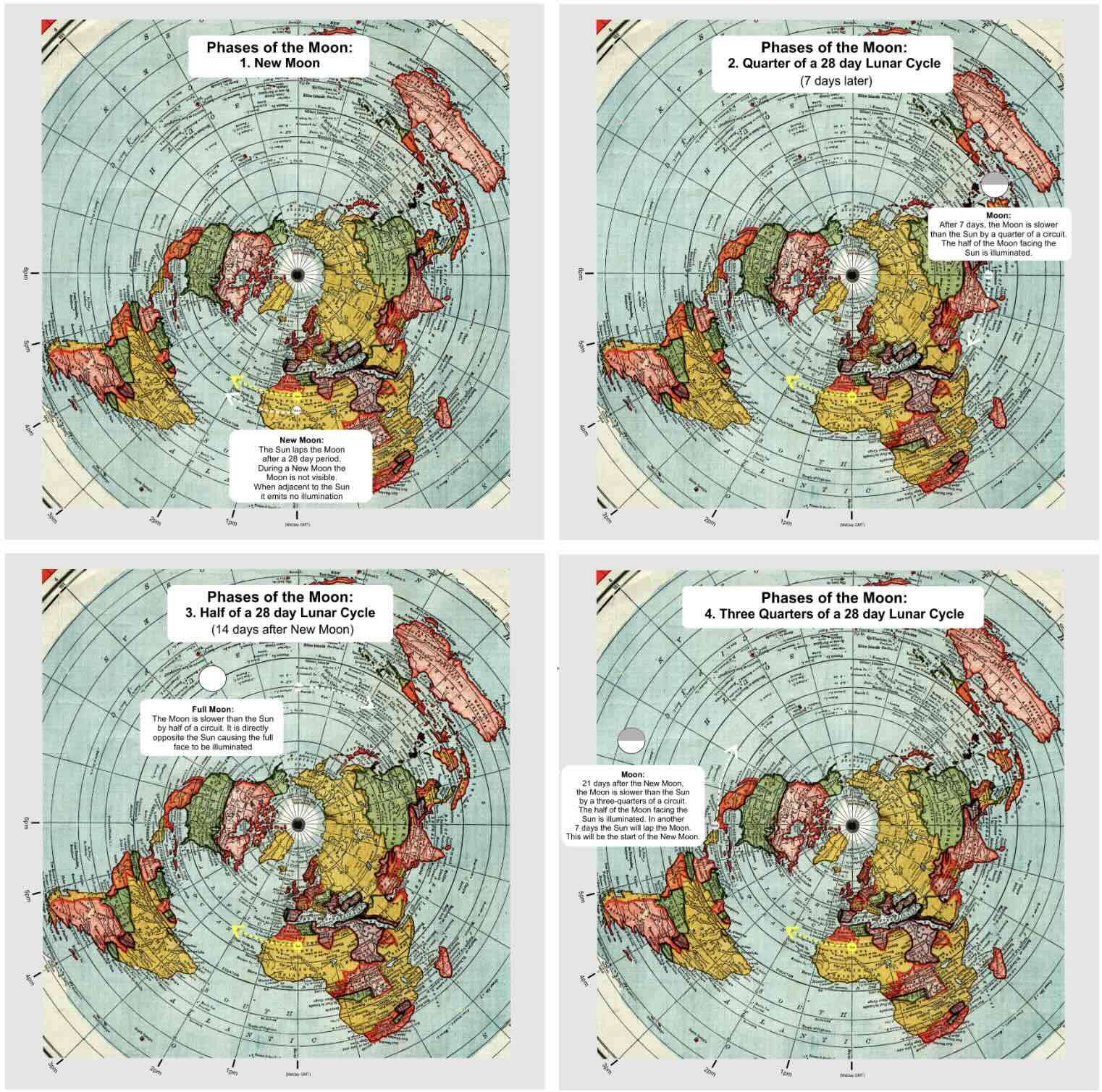
In illustration (2), at Midday, seven days after the New Moon, the Sun is a quarter of a circuit in front of the Moon. This is why the right half of the Moon, the part facing the Sun, is illuminated. By observing this in reality, at the same time each day the Moon will appear to be trailing slightly behind the Sun. As each day passes this distance increases. The daily incremental distance is equivalent to a full circle divided by twenty-eight (the number of days in a complete Lunar Cycle).
In illustration (3), at Midday, fourteen days after the New Moon, the Sun will have advanced further around the circuit to be directly opposite the slower Moon. This is when we experience a full Moon.
A week later, shown in illustration (4), the Sun will be three quarters of a circle in front of the Moon. It will therefore appear that the Sun is coming up behind the Moon, hence why the left half of the Moon will be illuminated.
Finally, after twenty-eight days, the Sun finally catches up with the Moon. This is known as the New Moon. It is impossible to see the Moon when the Sun and Moon are alongside each other, except, that is, during a Solar Eclipse. This is when the Moon, with no illumination, appears as a dark object in front of the Sun.
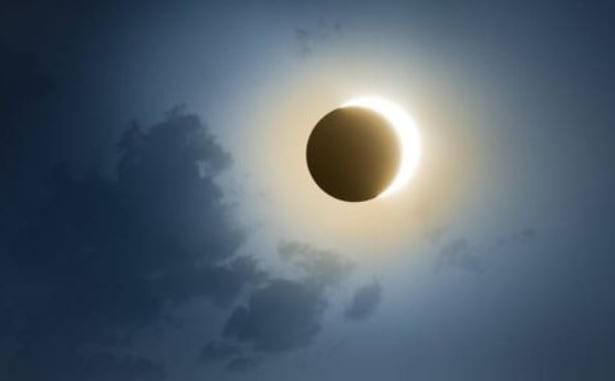
The other important fact that most people do not know is that the Moon travels in circuits between the Tropics every month. This can be proven by regular observations, watching the Moon as it gets higher and lower in the sky during each month. If the Moon is observed gradually getting higher in the sky each day, it is coming closer, travelling towards to Tropic of Cancer. Alternatively, if the Moon is observed getting lower in the sky each day, it is moving further away, circuiting towards the Tropic of Capricorn. A solar eclipse occurs periodically at the precise moment that there is a New Moon, combined with the altitude of the Moon being the same as that of the Sun. This means the Moon must be on a size of circuit almost equal to that of the Sun.
The dates of these periodical occurrences can be predicted centuries in advance. Only by understanding how this plays-out over a flat, stationary Earth, can you truly stand in awe at the wonders of nature.
This amazing spectacle is not occurring millions of miles away in a dark, cold abyss. Rather, it is happening just up there in the day-lit sky, just above your head!
Solar Eclipse 12th August:
For the purpose of this illustration, the daily circuit of the Sun on the 12th August will be drawn where it is in reality, between the Tropic of Cancer and the Equator. The precise location of the Sun at the listed time of the eclipse is known. This is illustrated on the map according to where it is at British Summer Time. It is then very easy to predict where the Moon will be at the listed duration of the full eclipse. The eclipse only lasts for two minutes and twenty-one seconds in the location of the observer. This is the time it takes for the Sun to overtake the Moon from the viewer’s perspective on the gorund.
The way to determine if the Moon will be inside the circuit of the Sun or outside of it can be determined by where the full eclipse will be seen. In this case, the Moon must be inside of the Sun for the eclipse to be witnessed in Siberia, Greenland, Iceland, NE America, and Europe.
Any observer, located at a Longitude further south than the circuit of the Sun, will not see the Moon completely passing in front of the Sun. Why? Because the Moon is on the opposite side of the Sun.
The following text describes the predetermined location and precise time in which the eclipse will occur:
“A total eclipse of the Sun on August 12. The path of totality begins over the Taymyr Peninsula in north-central Siberia and crosses the Arctic Ocean to the north of Servernaya Zemiya, the north-eastern part of Greenland, the north-western coast of Iceland, the north-eastern Atlantic Ocean, northern Spain, and ends over the Balearic Islands.
The partial phase is visible from the Arctic Ocean region, western Europe, the North-Atlantic Ocean, the north-eastern United States, Canada, Alaska and most of the Aleutian Islands.
The eclipse begins at 15h 34m (BST) and ends at 19h 58m (BST); the total phase begins at 16h 58m (BST) and ends at 18h 34m (BST). The maximum duration of totality is 2m 21s”.
The times indicated on the Gleeson Map below are for British Summer Time which is one hour ahead of GMT. This is to indicate the position of the Sun at the times listed for the duration of the eclipse. Because a solar eclipse coincides with the New Moon, drawing a line between the locations experiencing the eclipse and the Sun will give the location of the Moon.
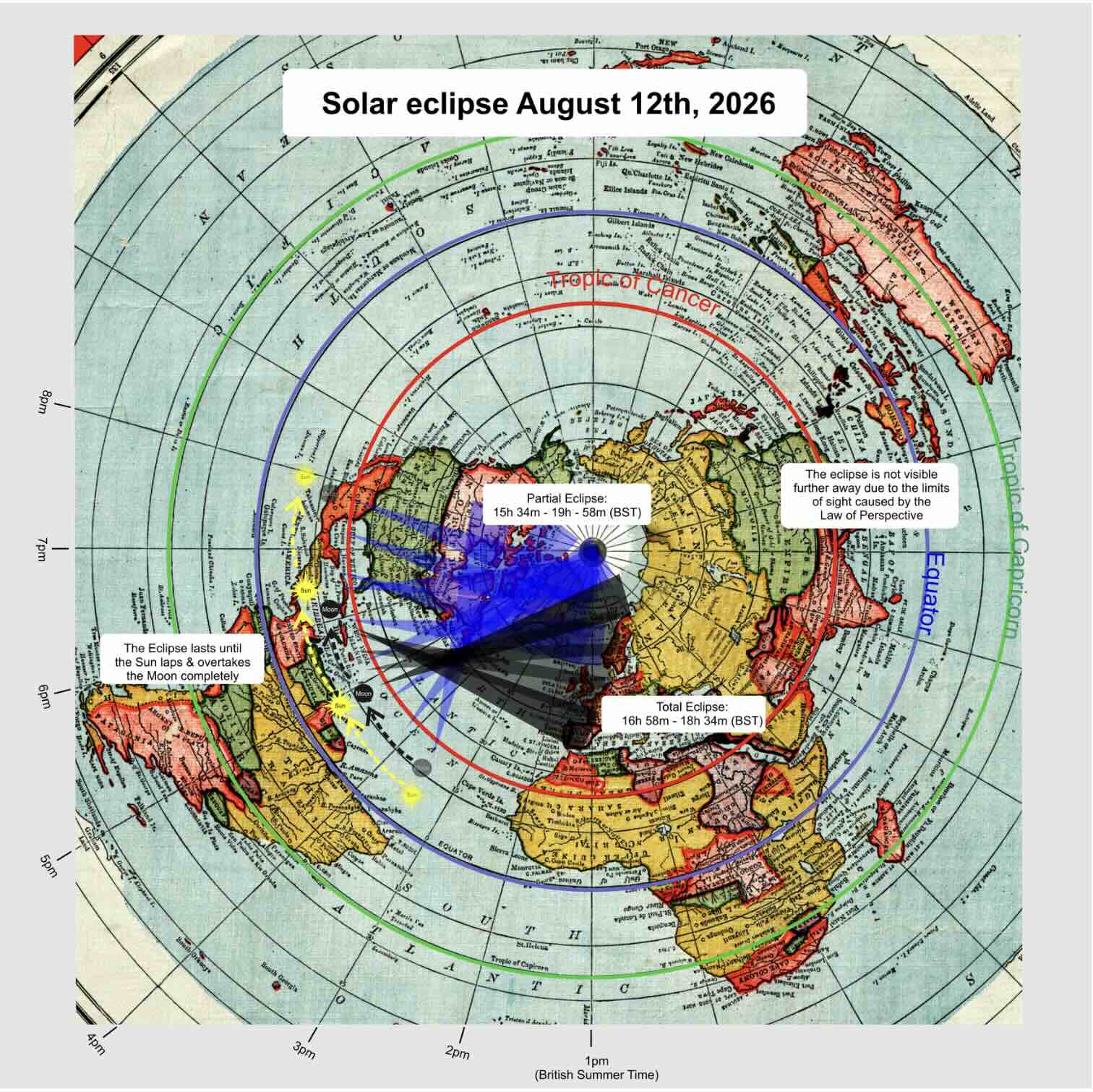
To conclude, please consider the information presented if you are fortunate enough to be in a location where you can experience the eclipse on the 12th August, 2026.
When it comes down to it, the natural world is both amazingly intricate but at the same time, very simple. The Sun periodically lapping and overtaking the same-sized Moon, while at the same altitude, just up there in the sky, is one of the simplest observations anyone can experience. Whether you disagree with this and need a complicated explanation involving distant planetary bodies hurtling across an endless abyss is up to you. The only thing to reflect on is whether the flat Earth reality seems quite logical compared to the spinning globe narrative.
Original Article: Sent to us by Email from MP
Comments ()