
Trump: ‘I Can Destroy Countries’
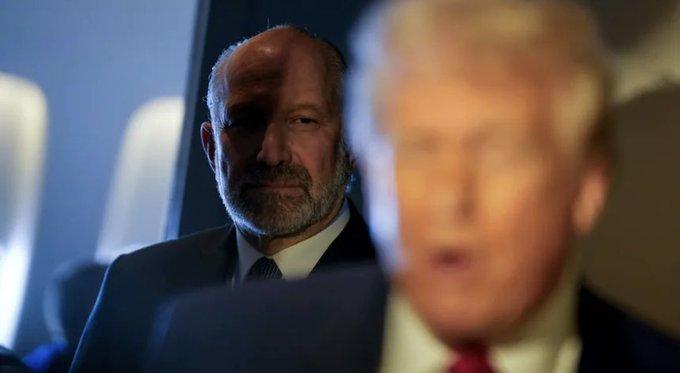
This guy is mentally-deranged like all psychopathic narcissistic tyrants, but no one around him has the guts to rein him in. Not least people like ultra-Zionist Lutnick, who seems to be always by his side, because Trump is doing exactly what Lutnick's masters demand - creating… https://t.co/RT68dCtG9V
— David Icke (@davidicke) February 21, 2026

A U.S. Supreme Court ruling against Donald Trump’s tariffs sent the 47th president into a rant that leaves little doubt who he is and what Constitutional crisis he is about to cause, writes Joe Lauria.
Joe Lauria | ConsortiumNews.com
Reacting to a U.S. Supreme Court decision ruling his tariffs policy unconstitutional, U.S. President Donald Trump launched into an unhinged rant on Friday confirming that he considers himself above the law as any tinpot authoritarian leader would.
The court ruled 6-3 that the U.S. Constitution makes clear that only Congress can levy tariffs, which are really taxes, on the U.S. population. Thus Trump’s extensive tariffs, imposed since January 2025, are illegal and American consumers and companies are due a refund of around $200 billion, the court said.
The ruling unleashed Trump in full psychotic mode, railing against justices as “fools and lapdogs;” the plaintiffs in the lawsuit the court ruled on as “sleazebags, major sleazebags” serving an unnamed foreign power and he announced a new 10 percent worldwide tariff “over and above our normal tariffs already being charged” in defiance of the court.
Trump argues he is still allowed to impose tariffs over the heads of Congress by the authority of the 1974 Trade Act. That act allows a president to unilaterally impose tariffs of up to 15 percent (hence the new 10 percent measures), but only for 150 days, after which Congress must continue them.
However, Friday’s ruling means he must vacate the existing tariffs, which he is so far refusing to do.
Trump tries to justify his existing tariffs as having been imposed under an emergency act. But the court struck that down, arguing in essence there is no economic or national security emergency in the United States today.
In his madness, Trump furiously claimed he had authority to impose embargoes and “destroy countries” but the Supreme Court dared rule he couldn’t even put a single dollar tariff on a nation’s imports. He exclaimed:
“I am allowed to cut off any and all trade or business with that same country. In other words, I can destroy the trade, I can destroy the country. I’m even allowed to impose a foreign country-destroying embargo. I can embargo, I can do anything I want, but I can’t charge one dollar because that’s not what it says, and that’s not the way it even reads. I can do anything I want to do to them, but I can’t charge any money. So I’m allowed to destroy the country, but I can’t charge them a little fee.
Think of that. How ridiculous is that? I’m allowed to embargo them, I’m allowed to tell them you can’t do business in the United States anymore, ‘we want you out of here,’ but I want to charge them $10. I can’t do that.
It’s incorrect, their decision is incorrect. But it doesn’t matter because we have very powerful alternatives … .”
In fact, Article I, Section 8 of the U.S. Constitution asserts Congress has the authority to “lay and collect Taxes, Duties, Imposts and Excises,” and to regulate commerce with foreign nations. Embargoes, such as those on Cuba, North Korea and Iran, have been imposed by Congress, not the White House.
With Trump having amassed a U.S. strike force poised to illegally attack Iran, the timing of his cry that he can destroy nations brings little comfort.
An Historic Constitutional Crisis

1808 British political cartoon ridiculing the ‘Embargo Act of 1807’. President Thomas Jefferson reassures his petitioners, ruined businessmen, that the embargo on warring Europeans may show good results in 15 to 20 years. (British Cartoon Prints Collection/U.S, Library of Congress/Wikimedia Commons)
Trump has uncorked a Constitutional crisis reminiscent of one of his favorite presidents, Andrew Jackson, who in 1832 defied a Supreme Court decision regarding Cherokee sovereignty in the state of Georgia that ultimately led to the tribe’s forcible removal in the Trail of Tears.
There have been a few other instances of presidents defying a federal court. Thomas Jefferson, in a case relevant to Trump’s, defied an order by Supreme Court Justice William Johnson in 1808, while Johnson was doing double duty sitting on the federal circuit court in South Carolina.
The ruling involved the Embargo Act of 1807, which forbade all U.S. foreign trade to stop British and French ships from harassing U.S. ships on the high seas. It was an even more extreme measure of economic warfare than Trump’s tariffs.
The South Carolina case involved a shipowner whose ship was impounded by federal customs officials and who sued to get it back.
Jefferson had appointed Johnson to the Supreme Court, but Johnson ruled that under the Embargo Act, only Congress could authorize the seizing of a ship. Jefferson ignored the ruling.
The case went to the Supreme Court in February 1808 but the court said it lacked appellate jurisdiction to review the case so Jefferson continued to defy the lower court’s order until the end of his term.
The Embargo Act was an economic disaster, even greater than that brought on by Trump’s tariffs. Exports plunged from $108 million to $22 million in just one year, sinking U.S. GDP by five percent before Congress repealed the Act in March 1809. The unpopularity of the Act led to the protest slogan of spelling embargo backwards: O grab me.

An 1807 political cartoon showing merchants caught by a snapping turtle named “Ograbme” (“Embargo” spelled backwards). The embargo was also ridiculed in the New England press as Dambargo, Mob-Rage, or Go-bar-’em. (Public Domain/Wikipedia)
In 1861, President Abraham Lincoln suspended habeas corpus to detain suspected Confederate sympathizers without trial. Sitting as a circuit judge, Supreme Court Chief Justice Roger Taney, who delivered the majority opinion in the 1857 Dred Scott case that African-Americans couldn’t be U.S. citizens and Congress couldn’t prohibit slavery in U.S. territories, ruled in 1861 that only Congress could suspend habeas corpus and he released an imprisoned Confederate, a member of the Maryland legislature.
Lincoln ignored the ruling. In 1863 he got Congress to authorize him to do so.
If Trump continues to defy the court he will add his name to this record. Indeed, he gave his clearest indication that he will defy the Supreme Court on the existing tariffs, which were struck down.
“All of those tariffs remain. They all remain,” he said. “I don’t know if you know that or not. They all remain. We’re still getting them and we will after the decision. I guess there’s nobody left to appeal to.”
It will be interesting to see how he interacts with Supreme Court justices who sit in their robes in the front row at Tuesday’s State of the Union address.
Comments ()