
BlackRock, Visa, Mastercard, Coinbase And 140 Other Global Companies Partner To Launch "Open USD" Stablecoin, 'A Shared Stablecoin For Global Financial Activity'

This is huge. The announcement comes as the Bank for International Settlements published its latest comments on stablecoins, still questioning their viability, but softening their previous tone.
The WinePress | substack.com/@thewinepress
BlackRock, along with the world’s largest fintechs and payment firms, asset managers, big-tech and crypto companies have come together to release a “shared” and unified stablecoin under a new custodian called Open Standard, which has created a token coin called Open USD (OUSD).
The company was founded by CEO Zach Abrams, the CEO of Bridge, the stablecoin framework firm acquired by payments app Stripe in 2024.
Stripe has been active in designing new stablecoin and tokenized rails for the new age of finance, launching tools for customers and businesses to create their own stablecoin with Stripe’s Bridge. Bridge allows stablecoin conversions between a variety of fiat currencies, and transfers these tokens and settles transactions instantly, 24/7, compared to old-fashioned rails. Bridge is “an entirely new payments platform, built with stablecoins, to simplify global money movement,” the company says on its website. “Bridge works with the US government, aid organizations and creator platforms to disburse payments via stablecoins,” the company adds.
Abrams and co. have now come together to create a unified stablecoin, Open USD, described as “a shared stablecoin for global financial activity,” and is touted as “the first stablecoin designed as open infrastructure,” giving “businesses the economics, governance, and reliability they need to move money.”
Per the announcement on June 30th, the company added:
Stablecoins are being rapidly adopted for their speed, cost, and programmability, with transaction volume approaching that of the ACH network. At the same time, businesses still face significant hurdles: fees to mint and redeem most stablecoins are prohibitively expensive at larger volumes; companies aren’t always able to benefit from the revenues earned on the underlying reserves; and developers have little recourse if the roadmaps of third-party issuers do not meet their needs.
Open USD introduces three key design principles:Build for scale. Businesses can mint and redeem Open USD at no cost and with no artificial limits on volume.Earn by default. Partners receive all of the earnings from Open USD’s reserves, less a small management fee to cover Open USD’s operational costs.Govern collaboratively. Open USD will be operated by Open Standard, an independent company with a board made up of Open USD’s partners, ensuring decisions are made for the collective interest, not a single entity.
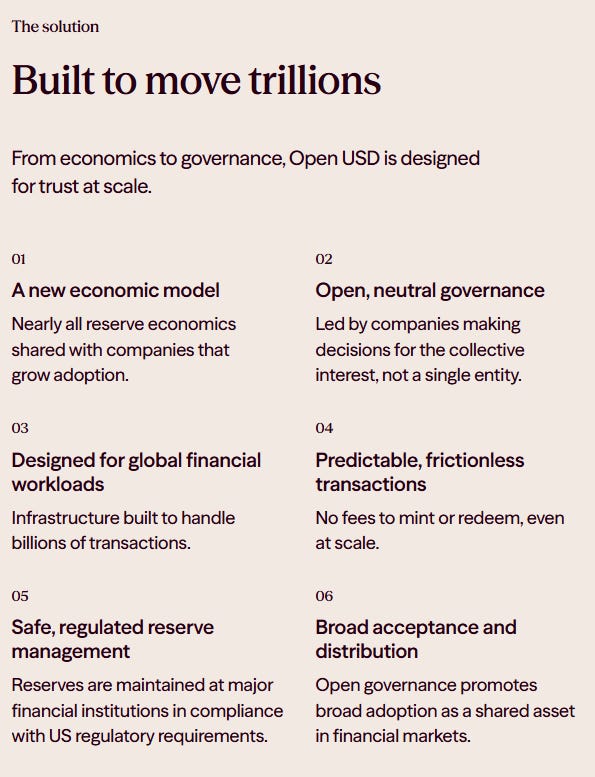
“Existing stablecoins have great strengths, but to use them at scale, businesses need something that’s open, low-cost, high-throughput, broadly accessible, and aligned to their interests,” said CEO Zach Abrams. “We’re thrilled to bring together over 140 businesses to launch Open USD. It’s a stablecoin built for the internet economy, designed by the businesses growing it.”
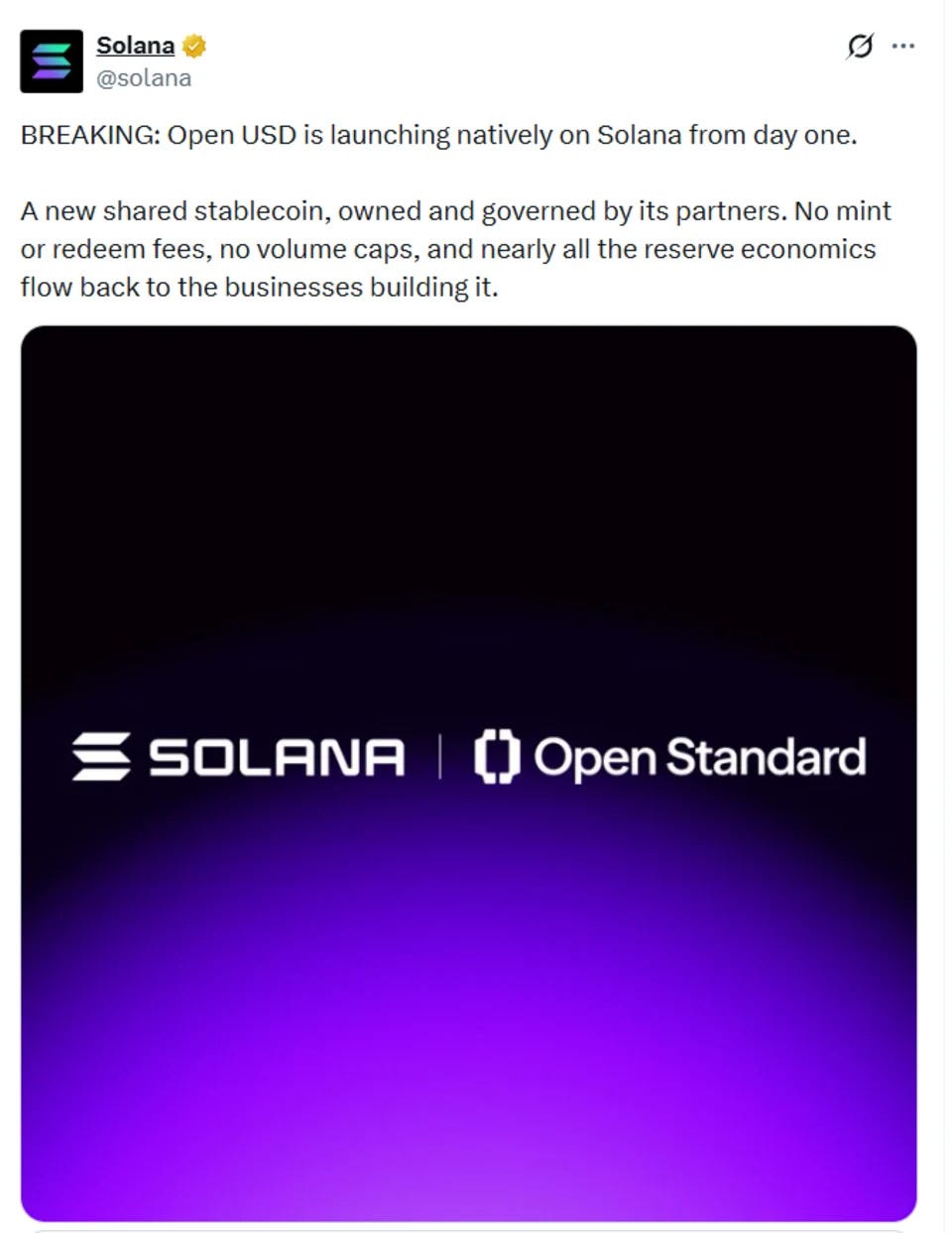
Open USD is backed by a litany of industry titans from around the world; the current list includes:
Visa, Stripe, Mastercard, American Express, Discover, Fiserv, Adyen, Cloudflare, Corpay, Jack Henry, Klarna, Affirm, Ramp, OnePay, Brex, Checkout.com, WEX, PayPay Corporation, Western Union, Nuvei, Remitly, Ria, Marqeta, MoneyGram, Nium, Worldline, Galileo, Highnote, i2C, Lithic, Thredd, Episode Six, Verituity, Félix, Taptap Send, CAL (Israel Credit Cards)
BlackRock, BNY, Standard Chartered, Commonwealth Bank of Australia, Sumitomo Mitsui Financial Group, Intercontinental Exchange, National Australia Bank, DBS Bank Ltd., U.S. Bank, BBVA, Mizuho Financial Group, Shinhan Financial Group, Westpac, Itaú, OCBC, ANZ, UOB, Chime, Banco Bradesco, Huntington Bank, Citizens Bank, KB Kookmin Card, Emirates NBD, Hanwha Life, Banorte, Bank Hapoalim, FNB South Africa, K Bank, SoFi, Woori Card, Absa, Kakao Bank, Samsung Card, Bank Leumi, Wenia by Grupo Cibest, Nedbank, Isbank, Abu Dhabi Islamic Bank ADIB, Banco de Crédito del Perú, Mashreq, RAK Bank, Hana Card, Hyundai Card, BCcard, Cross River, Grupo Aval, Davivienda, The Bancorp, Pathward, Banca Transilvania, Nonghyup Card, Neo Financial, Maya Bank, Netbank, Freedom Bank Kazakhstan, Lead Bank, Kapital, MAX
Google, Samsung Electronics, IBM, Shopify, Mercado Libre, Mercado Pago, Infosys, DoorDash, Wix, Grab, Rakuten Group
Coinbase, Tempo, Solana, Base, Sui, OKX, Ripple, Crypto.com, Fireblocks, Gemini, MetaMask, Aave, eToro, Galaxy, Dunamu, Ledger, MoonPay, Anchorage Digital, Digital Asset, Trust Wallet, Meow, Morpho, Ether.Fi, Lightspark, zerohash, Bitso, Bridge, Rain, BVNK, Mesh, Privy, Bitget Wallet, StraitsX, Yellow Card, Reap, Brale, RedotPay, Immersve, Stellar, Polygon, Aptos Labs, Plasma, KAST, Blossom, Lemon.
Other notable names on the list include MAX, which is the Russian all-in-one app launched earlier this year, emulating China’s WeChat, which is used to enforce the country’s social credit score.
Samara Cohen, Global Head of Market Development at BlackRock, said in a statement:
“We believe stablecoins can play an important role in the evolution of digital markets when supported by trusted infrastructure and practical utility. Open USD is a constructive step toward giving businesses more choice in how they access tokenized value and participate in internet native digital rails.”
Coinbase CBO Shan Aggarwal commented:
“Stablecoins are the most important thing happening in payments right now, and we’re committed to giving our customers access to the best options available – including Open USD and beyond. The more great infrastructure this industry builds together, the faster we close the gap between what payments are today and what they should be.”
Jorn Lambert, Chief Product Officer at Mastercard, also added:
“The technologies that changed the world, from the internet to mobile networks, succeeded because they became shared infrastructure that anyone could build on. As stablecoins become a new way to move value globally, we believe the infrastructure behind them should follow the same path: open, interoperable and broadly accessible. Open Standard is an effort to help build that foundation.”
And Alicia Pertusa, Head of CIB Partnerships & Innovation at BBVA, stated:
“By bringing stablecoins to our retail and corporate clients, we are fundamentally changing how money moves—making financial transactions frictionless and available 24/7.”
The creation of OUSD is indeed quite disruptive to the industry.
CCN via Yahoo! Finance reported:
Will Harborne, co-founder and CEO of Rhino.fi, a stablecoin infrastructure provider for enterprises, told CCN the consortium model changes the competitive dynamic in a way previous stablecoin rivalries never did.
When asked whether OUSD is just more fragmentation layered onto the existing USDT-versus-USDC split, Harborne pushed back.
“Historically, USDT and USDC have mostly lived in different lanes, by geography and use case,” he said. “OUSD is different because it will overlap with the same businesses that previously favored USDC, so competition and migration will happen in real time, not gradually.”
On timing, Harborne said the operational impact won’t wait for full rollout.
“On cross stablecoin complexity, the problem becomes real as soon as OUSD launches,” he noted. “If the incentives are strong enough, you’ll see apps start migrating quickly, and that creates immediate confusion for businesses that now have to support multiple stablecoins in the same flow.”
He located the first point of breakage not in the back end, but in front of the customer.
“For consumer facing businesses, that’s where the friction bites first,” Harborne said. “Payments start getting sent in one stablecoin and received in another, refunds become messy, and support teams end up explaining why money moved, but not quite in the way anyone expected.”
Alvin Kan, COO at Bitget Wallet, told CCN the launch should be read as a structural test rather than a product announcement.
“Open USD should be seen less as another stablecoin launch and more as a test of whether stablecoins can move into mainstream payment infrastructure,” he noted. “The stablecoin market is already around $312 billion, but much of that activity still sits in trading, settlement, and treasury use cases. The next frontier is merchant payments, institutional settlement, and real-time cross-border commerce.”
Kan pointed to the distribution model as OUSD’s sharpest competitive edge.
“Zero-fee minting and redemption, combined with partner revenue sharing, gives payment networks and financial platforms a stronger reason to support adoption,” he said. “If partners such as Stripe and Visa can make stablecoin settlement feel invisible to merchants and users, Open USD could become infrastructure rather than just another token.”
On what the market needs to see to take OUSD seriously, Kan pointed to several key metric:
“USDT remains dominant, while USDC is already well established with institutions,” he argued. “Open USD will need to prove real usage through circulating supply growth, partner-led mint and redeem activity, merchant payment volume, institutional settlement flows, multi-chain adoption starting with Solana and Ripple integrations, and sustained peg stability.”
He set out a two-horizon test. “Near term, the market should watch whether Open USD can build liquidity beyond announcements,” he said. “Mid-term, if real payment demand grows, it could become a meaningful step toward stablecoins becoming core financial infrastructure.”
Forbes also wrote an interesting article several days after the announcement, highlighting the significance of this move and what it means moving forward:
Open USD’s guest list matters more than the coin itself. When a single dollar token launches with more than 140 partners that include the world’s largest asset manager, two card networks that compete every day, a global custody bank, the biggest merchant-software platform and a wall of crypto firms, the coin is almost beside the point. Every layer of the financial stack has decided it needs a seat at the same table.
Step back from the individual names and the pattern is the message. Asset managers want the reserves. Merchants want the checkout. Banks want to defend deposits. Crypto firms want distribution. Card networks want to keep the toll booth. Big Tech wants to sit in the payment flow of an agent-driven internet. Every one of them looked at stablecoins and reached the same conclusion: this is becoming shared financial infrastructure, and the cost of being outside it is higher than the discomfort of sharing it with rivals.
The coin may take a year to ship, and it could stumble on the governance that makes it interesting. But the guest list has already delivered its verdict. Stablecoins have graduated from a product one company sells into infrastructure an industry co-owns, and the firms that saw it first made sure they would not have to rent it from someone else.
In a separate press release, Fireblocks, the world’s most trusted digital asset infrastructure company and one of the partners with OUSD, said, “This is an inflection point: digital assets are becoming a crucial part of how value moves around the world, underpinning and transforming business critical payment flows.”
Fireblocks has previously described the new financial system for many countries as the “Three Corners of a Money Triangle;” comprising CBDCs, stablecoins, and tokenized assets.
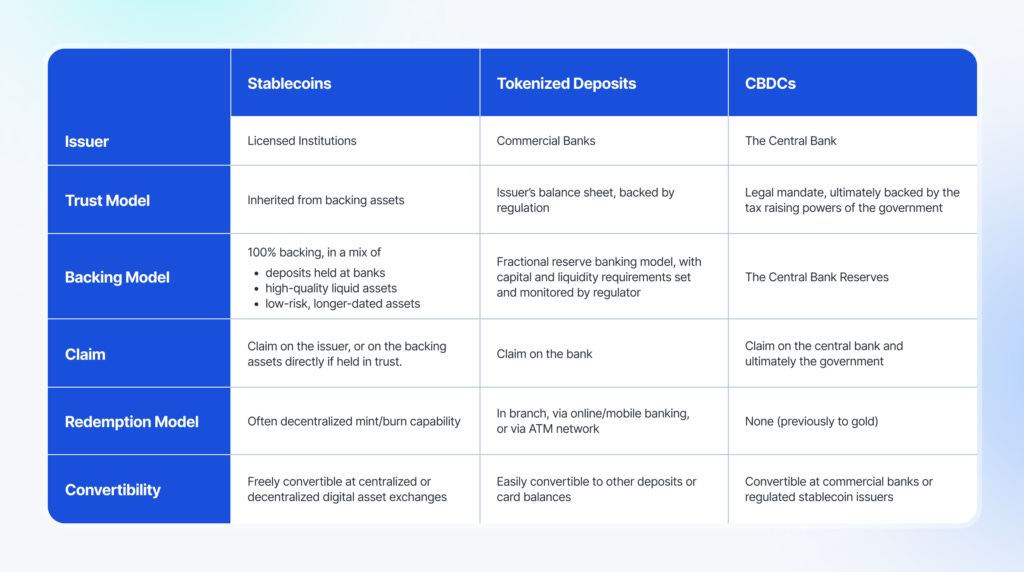
The key to all of this is interoperability, writing:
“The key is ensuring what is known as the singleness of money — their full interchangeability at par value — to ensure frictionless, trusted interactions, just as we expect today.
“Ultimately, we need to stop thinking about these three forms of money as competitors. As the system matures, it’s clear they will co-exist as three corners of a new digital money triangle, just as different forms of money do today.
“Interoperability will help to unlock the power of programmability and composability on blockchains. This will allow us, for example, to program a tokenized deposit to move funds instantly to the merchant at the moment goods are delivered, while allowing the delivery driver to simultaneously receive their fee in a stablecoin of their choosing, and programmatically pay what is owed to the tax office in the form of a CBDC in real-time, all while eliminating the need for manual reconciliation.”
Though some of the companies that have all agreed to collaborate on OUSD seem a bit paradoxical on the surface, as Forbes notes in its article, this is a clear signal that companies around the world are fully embracing tokenization and programmable payments.
Standard Chartered, a London-based bank also collaborating with OUSD, is banking heavily on tokenization. CEO Bill Winters — who controversially said earlier this year he is laying-off thousands of his “low-value human capital” employees in favor of AI — thinks tokenization and AI money is wonderful, he said at Davos earlier this past January.
He told CNN (emphasis mine):
“Banking is now thoroughly digital. What’s coming next is that money itself, the actual instrument of money, is becoming digital.
“It starts with cryptocurrencies, but it’s also not linked to a fiat currency. These things called stablecoins or central bank digital currencies or tokenized bank deposits, they’re also cryptocurrencies, they’re tokens. Those are now being used to move money around the world instantaneous, 24-7, indelible ledger where these things can be tracked, financial crime can be screened out, etc. That’s the future of money and it’s happening right now.
“If you don’t already have it, you’ll have a digital wallet and your digital wallet will sit on your phone or on your computer and instead of tapping into your bank account, you’re going to go into your digital wallet, which is not going to be owned by a bank. It’s going to be backed by digital money and that digital payment can go anywhere in the world instantaneously with 100% traceability.”
“[…] We’re pretty innovative, but we are very trustworthy and we’re trusted by the state and by our clients. And that’s crucial. It’s critical. It’s not understood in a sense. It will be understood as these tools are really adopted in the mainstream. They’ve been adopted thoroughly in the crypto world.
In the cryptocurrencies, it’s 100% digital. But that’s a very self-contained universe. It’s now branching into the fiat world, or some people would call it trad-fi, traditional finance. We are trad-fi. But we are the most active trad-fi player in the crypto world. We’re the third largest converter of cryptocurrency to fiat currency. So we’re the bridge. And that bridge is going to become a multi-lane highway.”
When asked if the consumer will need to understand all the inner workings of tokenization to operate in this new system, Winters said:
“If you’re a consumer, not if we’re doing our job well. Our job is to make it really easy for you to do what you want to do. And you want it to be safe, you want it to be transparent, and you want it to be cheap. That’s what you want. And that’s what we have to give you.”
In other words, a silent takeover, a quiet, covert slavery into digital chains. Only when people realize what has happened, then it will be too late.
This past month, VISA announced new tokenization and stablecoin tools at the Visa Payments Forum 2026. Jack Forestell, Chief Product & Strategy Officer, said in a press release, “AI is transforming the front end of commerce. Stablecoins are reshaping the back end. Visa’s role is to enable it to work securely, reliably and at global scale for every participant in the ecosystem.”
The company also detailed how they are creating better and more detailed tokens, and helping in “Modernizing the Back End of Money Movement with Stablecoins.” VISA revealed (emphasis mine):
Enhancing Tokens for AI-Driven Commerce
Visa announced significant enhancements to its tokens, focused on bringing more data, context and assurance into the credentials used in digital commerce.
Today, tokens already carry a highly secure data set purpose-built for digital payments. As commerce extends to new channels and agents, Visa is enriching the data to provide more details on the transaction type, where the token is being used and who is making the payment.
A second key advancement is a token assurance signal. Token use is evaluated throughout its lifecycle—based on provisioning and behavioral history—to generate a signal of trust behind each transaction.
These enhancements provide issuers with stronger signals for authorization decisions, helping reduce false declines for merchants while minimizing friction for consumers.
Designed for AI-driven commerce, these developments embed identity, permissions and behavioral signals more deeply into credentials—allowing trust to travel with the transaction across devices, channels and use cases, including those initiated autonomously by AI agents.
Modernizing the Back End of Money Movement with Stablecoins
Visa also shared progress in modernizing settlement and value transfer through stablecoins and blockchain-based infrastructure.Tokenized Deposits: Visa announced it will build the technology layer that can allow banks to turn traditional deposits into programmable, always-on digital money. This gives banks a way to match the speed and flexibility of stablecoins while keeping funds on balance sheet.Stablecoin Settlement : Visa is expanding stablecoin settlement pilots across multiple regions, blockchains and currencies. Building on its first stablecoin settlement pilots in early 2025, Visa has moved billions of dollars in stablecoins across VisaNet, with an annualized run rate of approximately $7 billion as of March 2026. With issuing banks already settling seven days a week onchain with Visa, Visa is also working to extend seven-day settlement to include acquirers, increasing flexibility and frequency across the entire ecosystem.Stablecoin-Linked Cards : Visa continues to expand stablecoin-linked card programs, enabling consumers and businesses to spend stablecoin balances anywhere Visa is accepted. With more than 160 programs live or in development globally, adoption is expected to accelerate.
Meanwhile, their competitor Mastercard is doing something similar. In a press release published around the same time “plans to expand its settlement capabilities with additional intraday, weekend and holiday card settlement, supporting both fiat currencies and on-chain card settlement using regulated stablecoins.”
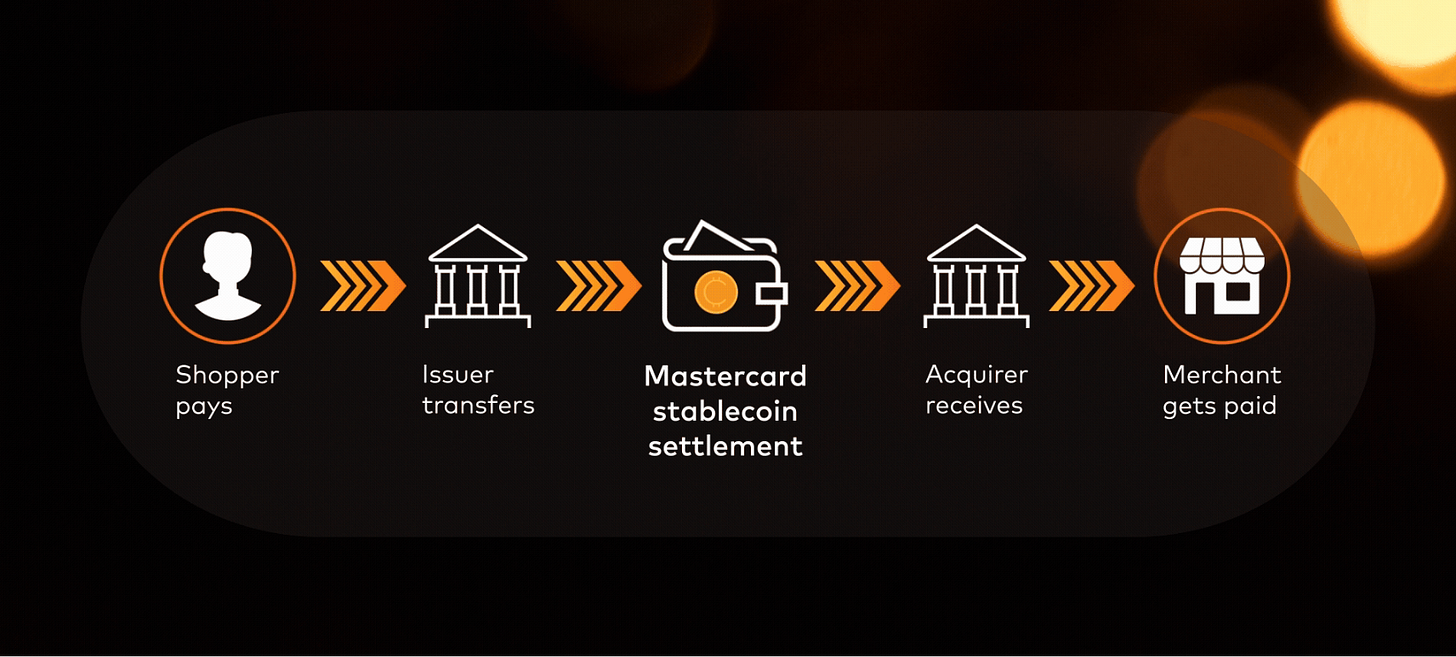
“The next phase of stablecoin adoption is about real-world utility, especially in settlement, where timing and liquidity matter most,” said Raj Dhamodharan, executive vice president, Blockchain & Digital Assets at Mastercard. “By introducing intraday and weekend on settlement options across our global network, we’re expanding how partners manage liquidity and operate in an always-on digital economy while maintaining the trust, resilience and safeguards they expect from Mastercard.”
Moreover, on July 6th Mastercard published a blog post discussing the “interoperable payments stack,” comprised of stablecoins, AI and real-time payments. The company calls upon lawmakers around the world to promote guardrails that make this system safe and protected; in particular with cybersecurity, enhanced data-sharing and digital ID.
“Incentivize ecosystem-wide threat information sharing among financial institutions, fintechs and network providers to share real-time anonymous data on fraud patterns, digital identity breaches and system vulnerabilities, specifically those involving AI deployment. Information sharing on cyber vulnerabilities and fraud patterns across industries and borders is increasingly important, as threat actors tend to exploit information asymmetries, adapt much faster than any individual institution or industry with new attacks, and are often able to exploit different payment rails to move illicit funds across borders and evade law enforcement.”
AUTHOR COMMENTARY
Open USD, while just announced, is massive. This is no joke: these companies (and probably more to join later) are all joining together to create a decentralized, privatized, unified, tokenized, programmable currency. Again (!), stablecoins are the same thing as central bank digital currencies (CBDCs) only real difference being that stablecoins are privatized and therefore not subject to as much federal oversight as a CBDC would be. For this reason, comparing rotten apples to rotten oranges, both are bad, but it is why some have and make a fair argument that stablecoins are even worse than CBDCs because at least there are some better guardrails and oversight, whereas the privatized version allows for even more corruption, duplicitous and dubious behavior; and not the least of which being that these corporations, fintechs, banks, and big-tech will now have greater control over your personal data and spending habits, and therefore can leverage and monetize that data like never before!
This is why when Trump signed the GENIUS Act almost a year ago to the date, I said that this marked the end of financial freedom, as the Genius Act established legal framework for stablecoins and the creation of digital dollars.
Trump said last year, referring to the Genius Act, that “behind the scenes, the technical backbone of the financial system” is out of date is and says it is undergoing an “upgrade” using “state-of-art crypto technology,” presumably referring to tokenization and blockchain technology.
You almost have to give it to the orange fox because he pulled off one of the greatest bait & switches of all time: signing executive orders to purportedly ban a CBDC, his audience cheers, and then signs the Genius Act when the masses were distracted with the Epstein Files, which establishes a framework for stablecoins and, per the text of the bill, says “A permitted payment stablecoin issuer shall be treated as a financial institution.” So now BlackRock, in technical terms, can be seen as a “bank.” Unbelievable! And even with that, stablecoins still link back to the Treasury and the Federal Reserve anyways! On top of that, the Genius requires new ID systems be created, so there is your digital framework.
If you recall at the time, I covered in that report that BlackRock was looking into creating and managing their own stablecoins, as were others such as Walmart, Amazon, and more.
Fast forward to now and we have Open USD, coalescing some of the biggest players around the world into a single, decentralized, privatized and programmable tokenized coin! Incredible.
And that is just the Genius Act. Right now a sister bill called the CLARITY Act is being debated and an amended bill should be taken to a vote somewhat soon; and that bill “establishes a regulatory framework for digital commodities, defined by the bill as digital assets that rely upon a blockchain for their value,” according to a summary of the bill. The hiccup has been establishing if these custodians can earn yield on stablecoins, something Coinbase has been beating the drum for, but competitors such as Jamie Dimon and JP Morgan Chase (who was notably absent from Open USD) have raised issues with the Clarity Act because they believe this will dis-incentivize customers from partnering with their banks because Coinbase and others can offer the same thing but with yields.
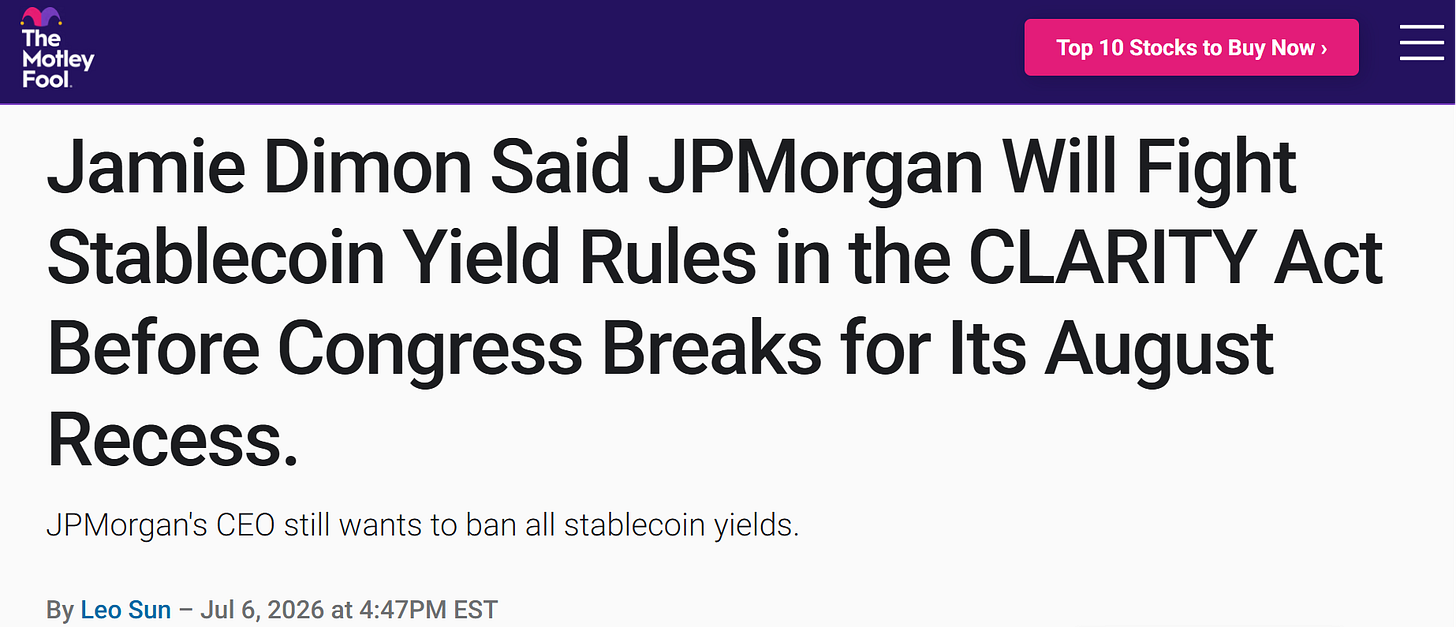
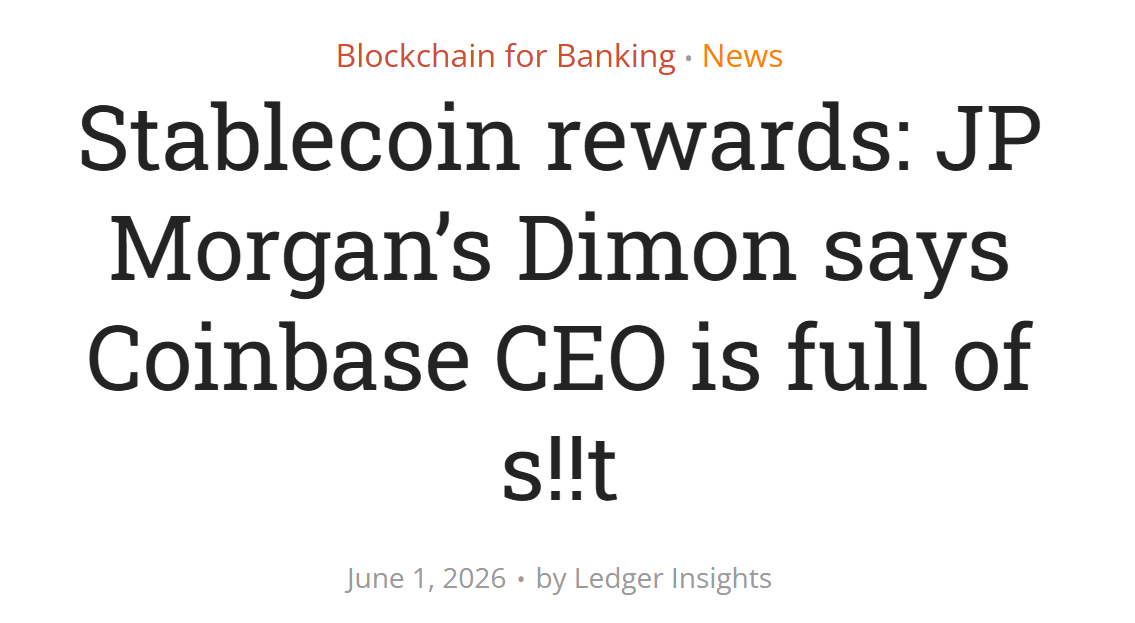
The timing of this announcement is interesting because the Bank for International Settlements (BIS) just came out with its annual economic report last week, and an entire section was dedicated to their current stance on stablecoins. In June of last year, a little less than a month before Trump signed the Genius Act, BIS strongly emphasized tokenization is the future financial monetary system (which is what I have been beating the drum about and warning is coming rapidly - more on this in the future), but said stablecoins are “unsound money.”
“While stablecoins’ future role remains uncertain, their poor performance on the three tests suggests they may at best serve a subsidiary role.
“Society has a choice. The monetary system can transform into a next-generation system built on tried and tested foundations of trust and technologically superior, programmable infrastructures. Or society can re-learn the historical lessons about the limitations of unsound money, with real societal costs, by taking a detour involving private digital currencies that fail the triple test of singleness, elasticity and integrity. Bold action by central banks and other public authorities can push the financial system along the right path, in partnership with the financial sector.”
BIS also published another paper in July cautioning on stablecoins and their inherent risks, though Ledger Insights, a publication dedicated to tokenization, says both recent papers by the BIS are biased and do not give stablecoins a fair shake, only highlighting their risks.
Fast forward to their most recent annual report, and BIS’ posture is a little softer this time, but they are still prejudiced against stablecoins.
“Stablecoins display some of tokenisation’s potential to support faster and programmable payments, but current designs fall short on foundational properties of money and threaten financial integrity. Widespread adoption would raise further challenges that depend in part on the composition of stablecoin reserves and the scale of foreign demand.
“Advancing the future monetary system requires coordinated efforts by policymakers along two main dimensions: tackling weaknesses in current stablecoin arrangements to mitigate risks; and bringing the technological advances of tokenisation into the two-tier system to establish trusted forms of programmable money.”
However, these frameworks are being addressed more rapidly than BIS admits to in its latest paper, and clearly BlackRock and all these other institutions around the world are leaping into them anyway.
That being said, “Every prudent man dealeth with knowledge: but a fool layeth open his folly” (Proverbs 13:16).
By calling stablecoins “unsound money” and ragging on about the regulations surrounding them, they have inadvertently exposed the current fiat/debt-based currency systems are also “unsound money;” because stablecoins via the Genius Act are backed 1:1 with the dollar and U.S. treasuries, and since stablecoins are simply a bridge from conventional fiat to programmable fiat, the BIS has exposed themselves and central banking for promoting inflationary and manipulated fiat for generations, as neither stablecoins nor fiat promissory notes are sound money!! Oh the irony, oh the hypocrisy!
Nevertheless, indeed, stablecoins and tokens are not money at all: they are programmable pieces of code that track and trace what is spent, how it was spent, when and where it was spent, what time the transaction took place, how many people held and used that token, etc.; as again emphasized in VISA’s aforementioned press release.
Back in January I wrote what was arguably one of my more important pieces I have written, which discussed ‘the plan’ to destroy and devalue existing currencies to force tokenization and stablecoin adoption — something that BlackRock explicitly wrote in 2019 in one of their policy papers, calling for “helicopter money” and the explicit goal of inflation to force adoption of digital payments.
Beyond that, I explained how the scam works:
If the cryptocurrency industry grows, then the demand for U.S. stablecoins will grow, which will increase the need for new treasury bills to be created by the government, and if the demand for those T-bills grows, then the interest rates on that debt will be lower, thus allowing the government to borrow money at a cheaper rate.

Trump and his sons also operate a stablecoin firm called World Liberty Financial, so they too benefit from this. So now we add another layer to this:
Trump himself has been buying up tens of millions of bonds.


The scam is simple: if interest rates go down, bond prices rise, meaning Trump will profit handsomely from this. Moreover, the more people who hold USD1 as they would digital dollars, the more real dollars the Trumps can hold in a bank account and collect interest on.
So as the dollar continues to lose value, the world continues to de-dollarize, the Federal Reserve continues to print more inflation, the Trump family will profit; and eventually they will pull out, leaving holders of devalued U.S. debt holding the bag. It’s not so much about clearing the debt versus exporting more of it and profiting from it before the dollar system presumably crashes. The more inflation increases, the more the traditional bank system becomes illiquid and insolvent, the more it will precipitate and force people — not just in the U.S., but around the world as other central banks devalue their currencies as well — into the new tokenized, CBDC and stablecoin system.
Now you factor in the likes of BlackRock and all these other institutions involved with Open USD: they too must now hold U.S. debt as collateral. Here’s what Forbes also highlighted in its article:
BlackRock’s presence is the one to study first. A stablecoin’s reserves are its economic engine, and those reserves sit in short-term Treasuries and money-market instruments, exactly the assets BlackRock manages. A dollar token at scale is, from an asset manager’s chair, a very large and very sticky pool of cash that needs a manager. BlackRock already runs the tokenised money-market products that sit next door to stablecoins. Joining Open USD puts it inside the reserve business of a coin built to reach hundreds of partners, rather than outside it competing for the mandate.
That mandate is not a side prize. A dollar coin at the scale its backers imagine would hold tens of billions in Treasuries and cash, a pool that earns income every day it exists. Whoever manages it collects fees on the largest and most predictable balance in the system. BlackRock choosing to be a member rather than a vendor signals it expects Open USD to be big enough that the reserve business is worth owning a piece of the coin to win.
It is an illusion: now the U.S. government and treasury can then offload its bad, toxic debt off of their books into these corporations and banks, and then eventually the government can devalue that debt, and then everyone is left holding the bag, owning nothing and being [un]happy. Truth be told, the U.S. isn’t looking into a crypto reset the way some have presented it. Given that the dollar is still the world reserve currency, this is the same old trick of spreading inflation and the burden of that debt around the world in a more effective manner. It’s just rearranging the chairs on the deck of the Titanic.
That’s why all these people are so gung ho about this: these magicians give the scammed investor the illusion of having both an investment and already-earned cash (counterfeit), when in reality they are left holding the virtual bag of counterfeit currency, while the perpetrators get away with the real cash currency — the same problems the BIS identified but carefully worded it so you would not clearly see the scam, because eventually this too will run it’s course — “For by thy words thou shalt be justified, and by thy words thou shalt be condemned” (Matthew 12:37) — but nonetheless this is why the BIS initially called stablecoins “unsound money.”
Now THAT, my friends, is a scam!
Proverbs 28:11 The rich man is wise in his own conceit; but the poor that hath understanding searcheth him out.
1 Timothy 6:17 Charge them that are rich in this world, that they be not highminded, nor trust in uncertain riches, but in the living God, who giveth us richly all things to enjoy;
Like I said, you almost have to give Trump and his cronies credit because it is genius the game they are playing.
Based on what I have researched and understand, my current opinion on this is I think stablecoins are the bridge from fiat to programmable, until that too inevitable fails in the long-run. But it gives enough time for that beast system to be built and eventually to prepare for the ‘final solution.’
Revelation 13:16 And he causeth all, both small and great, rich and poor, free and bond, to receive a mark in their right hand, or in their foreheads: [17] And that no man might buy or sell, save he that had the mark, or the name of the beast, or the number of his name. [18] Here is wisdom. Let him that hath understanding count the number of the beast: for it is the number of a man; and his number is Six hundred threescore and six.
The sad part is that most people won’t understand or bother to notice what is happening.
Manuel Godoy, CEO and Co-founder of Félix, a Mexican and Latin-based money app and partner with Open USD, said in a statement:
“At Félix, we learned very early that the customer does not care what rail moves the money. They care that their family receives local currency quickly, reliably, and at a fair price. That is where stablecoins become useful in the real world: not as a product itself we ask people to understand, but as infrastructure that makes money movement work better behind the scenes. Open Standard’s approach is interesting to us because it points in that direction, toward stablecoin infrastructure that is more open, more interoperable, and built for practical use cases like remittances.”
So there you have it, and he’s right. Ignorance and convenience. People simply don’t care other than they want it now, and most people don’t care about the wider implications, nor its effects on themselves and others around them. Meanwhile, this infrastructure is all being done quietly and subtly so very few people understand what is happening; and when they do realize it will be too late…
In the meantime, we will be watching what comes of Open USD, but there is no question in my mind that this is a big leapfrog for stablecoins and tokenization.
Source: https://thewinepress.substack.com/p/blackrock-visa-mastercard-coinbase
Original Article: Truth Warrior Suggested
![HHS Locks In 660 Million P[l]andemic Flu Doses Under RFK Jr](https://cdn.getmidnight.com/0b0f9daf495199bed1eaf719adc55c4f/size/w600/2026/10/HHS-Locks-In-660-Million-Pandemic-Flu-Doses-Under-RFK-Jr-2.jpg)


Comments ()