
Technocrats Called for Dictatorship and Technocracy In 1932 + 2026
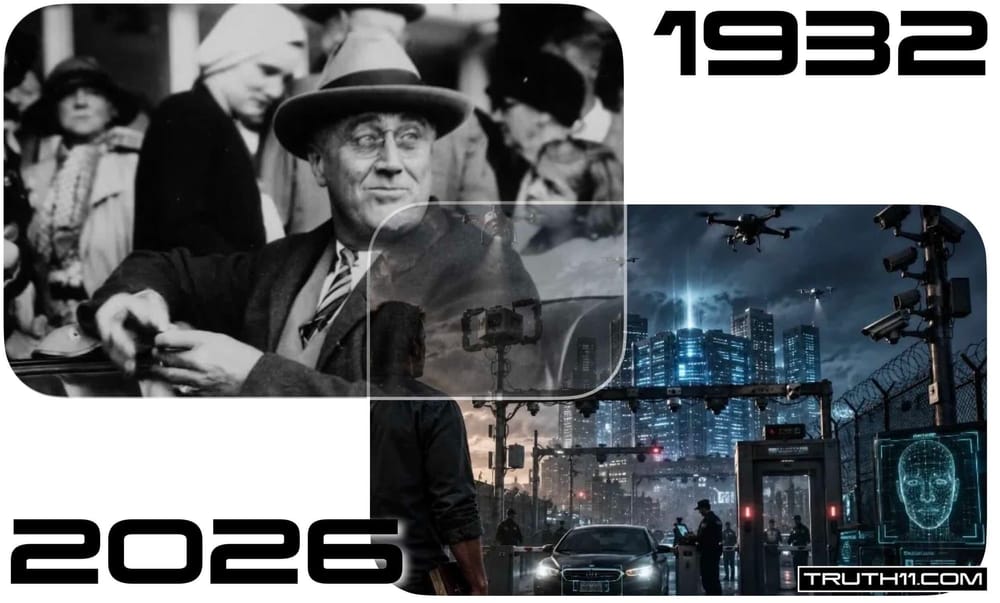
Parts I: 1932, and II: 2026

Part I: Technocrats Called for Dictatorship and Technocracy In 1932
Patrick Wood | technocracy.news
In my tattered copy of Henry A. Porter’s Roosevelt and Technocracy (1932), an early reader drew a careful bracket around a single passage on page 72. It reads: “Radical and immediate changes in both our political and economic systems will be necessary.
This can best be accomplished by vesting supreme and emergency power in some one man who has the confidence and respect of a majority of the American people. That man is FRANKLIN D. ROOSEVELT — to whom should be given dictatorial powers in the approaching crisis.”1
It is one thing to know, as a generalization, that respectable Americans flirted with dictatorship in the winter of 1932–33. It is quite another to hold a commercially published book in which the proposition is worked out in numbered steps by a financial analyst, and to see that a contemporary reader found the decisive sentence and marked it. Whether that reader bracketed the passage in alarm or in agreement, the pencil does not say. The ambiguity is fitting, because the country itself had not decided.
Porter is nearly invisible to history, and that is precisely what makes him valuable. His title page bills him as a “Nationally known Economist and Financial Analyst” and lists his other works — Profitless Prosperity, Gentlemen of America, Romance of Natural Gas, Research or Retrogression, America’s Greatest Tragedy — titles that place him not in any university but on the investment-commentary circuit of the day.2
His publisher, the Wetzel Publishing Company of Los Angeles, was a small regional house. I have located no academic appointment, no archive of papers, no obituary of substance. In the ordinary run of intellectual history this would disqualify him from attention. For my purposes it does the opposite. The views of Howard Scott were the views of a movement’s impresario; the views of Columbia’s prestigious engineers were the views of an elite faction. Porter is evidence of something else: how far the technocratic idea had seeped into the commercial milieu — the men who wrote market letters, advised investors, and considered themselves hard-headed realists. When a proposal to abolish constitutional government appears in that literature, dressed in the sober vocabulary of financial analysis, the proposal has ceased to be fringe.
The book’s internal architecture makes the point sharper, because Porter did not begin as a radical. Chapter XII, “What Will Roosevelt Do?”, opens on page 55 with sentiments any Hoover-era financial conservative would have signed: “Many people believe that the government is primarily responsible for prosperity, and likewise for depression, when the fact is that the relations of government to prosperity or depression are negative rather than positive.”
Commerce, he continues, “is carried on by the people without government assistance,” its relations “determined by themselves.”3
This is orthodox laissez-faire, stated as a recognized fact. Seventeen pages later, the same author is demanding a dictatorship. The distance between those two positions — traveled within a single short chapter by a self-described practical man — is, I would argue, the single most instructive thing about the book. The depression had not converted such men to collectivism by argument; it had convinced them that the machinery itself, price system and Congress alike, had failed, and that technocratic rationality was the only thing left standing.
Porter’s method of getting from the one position to the other was prophecy. In a chapter grimly titled “Postponing the Inevitable,” he set out a numbered forecast of the collapse he believed the interregnum winter would bring. Dissolution of the Reconstruction Finance Corporation, he wrote, “may be expected to bring about the complete collapse of the stock market,” followed by, among other items: “7. Suspension of stock exchanges. 8. Government ownership of railroads and public utilities in an effort to maintain the solvency of our savings banks and insurance companies. 9. A ‘dole’ for the unemployed.” And then the sequence arrives at its destination: “a national awakening which, overnight, may well be expected to herald the news to every corner of the nation of the inauguration of the ‘new deal’ by 10. FRANKLIN D. ROOSEVELT — Dictator.”
Lest anyone mistake the dictatorship for the goal rather than the instrument, Porter closes the chapter: “Drastic as these changes from the present order of things may be, they will serve their purpose if only to pave the way for the Economic Revolution — and TECHNOCRACY.”4 Notice the small typographic fossil embedded there: “new deal” sits in lowercase, inside quotation marks. When Porter wrote, the phrase was still a fresh coinage from Roosevelt’s Chicago acceptance speech of July 1932, not yet the proper name of an era. The book belongs unmistakably to the narrow window between the election and the inauguration, when everything about the incoming administration was still projection.
The page-72 passage the old reader bracketed completes the argument.
“Assuredly Technocracy will come,” Porter writes. “It is plain that its coming will be delayed by political maneuvering and financial chicanery.”
The nation “shall have to pass through a period of Chaos”; its severity “is wholly within the control of the people”; and the way through is the vesting of “supreme and emergency power” in the one man commanding majority confidence.5
Two things are worth stating precisely here. First, Porter was not proposing a coup. His dictatorship seemed self-evident, and in his imagination, temporary — the old Roman logistics model, a magistrate for the emergency, legitimated by “the confidence and respect of a majority.” Second, and more remarkable, the dictatorship is not even the point. It is scaffolding. Congress is to be dismissed and supreme power concentrated so that the technicians can be installed “from top to bottom” and the price system dismantled. Among the era’s many calls for emergency power, this is what makes Porter’s distinctive: he fused the two most electric ideas of that winter — presidential dictatorship and Technocracy — into a single program, each justifying the other.
Dating matters enormously here, and it is a point my research has forced me to insist on: Porter wrote before Technocracy, Inc. existed! The membership organization, with its gray suits, its monad insignia, and Howard Scott’s increasingly wild-eyed pronouncements, was not founded until late 1933.
What Porter knew in 1932 was Technocracy in its first, unorganized incarnation: the public craze. Nobody can call Porter a disciple of Howard Scott.
Walter Rautenstrauch’s Committee on Technocracy at Columbia, formed in the summer of 1932, had lent Scott’s Energy Survey of North America the university’s prestige, and through the last weeks of 1932 the newspapers were saturated with ergs, energy certificates, and the imminent doom of the price system. “Technocracy” in those months was not an organization one joined; it was an idea in the air, unowned and undefined, and precisely because of that, a writer like Porter could pour his own content into the word.6
His Technocracy is not Scott’s in detail — it is a financial analyst’s take on a movement that did not yet have a catechism. The book thus preserves something the later literature obscures: what the technocratic idea looked like during its brief window of mainstream respectability, before it acquired uniforms and became a sect.
Nor was the dictatorship half of Porter’s program eccentric in its moment. The leaderless winter produced an entire literature of respectable authoritarianism. Walter Lippmann, the most influential columnist in the country, told Roosevelt to his face at Warm Springs that he might have “no alternative but to assume dictatorial powers,” and told his readers that the danger was not that Congress would give Roosevelt too much power but that it would give him too little. Eleanor Roosevelt herself remarked that if the crisis demanded it, a benevolent dictator might be the only way through.7
Barron’s, the prestigious weekly of the financial establishment (e.g., Porter’s own tribe), editorialized in February 1933 for “a genial and lighthearted dictator.”8 William Randolph Hearst, the publishing magnate of that day, put the fantasy on film: Gabriel Over the White House, rushed into theaters weeks after the inauguration, shows a president who dissolves Congress and governs as a benevolent strongman, and Hearst intended it as counsel, not satire.9 And when Roosevelt, in the inaugural itself, warned that if Congress failed him he would ask for “broad Executive power to wage a war against the emergency, as great as the power that would be given to me if we were in fact invaded by a foreign enemy,” the line drew the loudest applause of the address — applause that, by her own account, frightened the new First Lady.10 Porter, in other words, was not shouting from the margin. He was saying loudly and systematically what the American center was murmuring.
What of the book’s own reception? After considerable searching, I found that it barely had one, no substantial review in the major press, no evidence of a second printing, no sign that anyone in the incoming administration acknowledged it — and Roosevelt, of course, did not respond to the offer of a crown from a Los Angeles market analyst. The book survives today in a scattering of library copies; the University of California’s copy has been digitized, which is how the text can now be checked against page numbers by anyone.11 Its bibliography entry in the movement’s historiography is a line item, not a discussion. But the obscurity of the artifact should not be mistaken for the marginality of its ideas.
The two halves of Porter’s program — Technocracy and emergency dictatorship — each received a spectacular public verdict within months of publication, and tracing those verdicts is the real reception history of this book.
The Technocracy half collapsed first, and theatrically. On January 13, 1933, Howard Scott, pressed by his Columbia sponsors to answer mounting press skepticism, delivered a nationally broadcast address at the Hotel Pierre in New York that was by every account a rambling disaster. Within days, reporters finished demolishing his credentials — the celebrated engineer had no engineering degree at all — and Columbia cut the Committee on Technocracy loose. By spring, “technocracy” was a vaudeville punchline.
The movement splintered: Harold Loeb’s Continental Committee on Technocracy took the respectable-study route, while Scott regrouped his loyalists and incorporated Technocracy, Inc. in late 1933 — an organizational salvage operation conducted in the wreckage of the craze.6 The consequence for Porter’s book was brutal: within ninety days of the inauguration it had become a fossil. Its title yoked Roosevelt to a word that had passed from front page to punchline in a single season, and no one in 1934 needed a tract urging the president to adopt a discredited fad. But fossils are what stratigraphy is made of. Precisely because Porter wrote before the collapse and before the incorporation, his book records the high-water mark — the moment when a financial analyst could believe, in print, that Technocracy was simply coming, “assuredly,” and that the only question was how much chaos would precede it.
The dictatorship half received its verdict in March 1933, and the verdict was subtler: Roosevelt took the emergency powers and declined the dictatorship. The sequence is worth setting against Porter’s numbered prophecy, because the analyst’s scorecard is better than one might expect. The banking system did collapse; the New York Stock Exchange did suspend trading, closing with the banks in the first week of March — Porter’s item 7, briefly literal. The federal government did assume responsibility for relief within weeks (item 9, in the form of federal emergency relief), and it did go into the utility business on a scale unimaginable in 1932 (item 8, partially, in the Tennessee Valley). The Emergency Banking Act was passed, famously, in hours, by congressmen who in some cases never saw the text they approved — government by acclamation if ever the republic practiced it.12 What never arrived was item 10.
The extraordinary powers of the Hundred Days flowed through Congress, not around it; they were statutory, revocable, and litigated, and when the Supreme Court struck down the National Industrial Recovery Act in 1935, the revocability was demonstrated in the most public way possible.13 Roosevelt governed the emergency with the forms of the Constitution intact — which is, historically, the precise thing that separates what happened in Washington in 1933 from what happened in Berlin the same spring. Porter had predicted the crisis accurately and the constitutional outcome wrongly, and the wrongness is the most reassuring fact in this whole story.
And yet, on a third count — the one nobody was polling — Porter half-won. He had wanted Technocrats appointed “from top to bottom,” and while no Technocrat with a capital T ever ran the government, the type arrived in force. Rexford Tugwell, the most Veblen-marinated of Roosevelt’s Brain Trust, spent the decade being denounced in the press as precisely the technocrat-planner Porter had prayed for. Arthur Morgan’s early Tennessee Valley Authority was as near to a working technate as this country has built — engineers, dams, regional planning, and utopian community-building under one federal charter. The National Recovery Administration’s code apparatus, the Resources Planning Board, the rural electrification engineers: the New Deal absorbed the technocratic impulse so thoroughly that the organized movement suffocated for lack of a grievance.14
This, I think, is the correct frame for Porter’s book in the longer arc I have been tracing from 1932 to 1938: the Technocracy movement failed as a constitutional proposition in the same season it succeeded as a personnel policy. The country refused the dictatorship of the engineers and then, quietly, hired the engineers.
That is why this obscure book repays the attention I have given it. It compresses into ninety-odd pages the entire mechanism by which the technocratic temptation works on practical men: begin with efficiency, proceed through despair of politics, arrive at rule by experts, and treat the constitutional question as a detail of implementation.
Porter traveled that road in seventeen pages, in public, under his own name, with a straight face. His was the sober, business-district version of an idea that was simultaneously being preached in gray flannel by Howard Scott. The road did not close in 1933. It reopens, in politer dress, in every era that loses confidence in its deliberative institutions and finds its engineers still standing; readers may supply their own examples from the present century. Somewhere in 1933 a reader worked through this book, reached page 72, and set a pencil bracket around the sentence offering Franklin D. Roosevelt a dictatorship. The bracket is still there. The question it marks — whether a frightened democracy can borrow the competence of its technicians without surrendering the government to them — is still open, and it is the question my research on these years keeps returning to.
[Part II: Technocrats Call For Dictatorship And Technocracy In 2026 Below Endnotes]
Endnotes
- Henry A. Porter, Roosevelt and Technocracy (Los Angeles: Wetzel Publishing Co., 1932), 72. Capitalization as in the original.
- Porter, Roosevelt and Technocracy, title page.
- Porter, Roosevelt and Technocracy, 55.
- Porter, Roosevelt and Technocracy, 62–63. The chapter is titled “Postponing the Inevitable”; items 1–6 of the forecast precede the page reproduced here.
- Porter, Roosevelt and Technocracy, 72.
- William E. Akin, Technocracy and the American Dream: The Technocrat Movement, 1900–1941 (Berkeley: University of California Press, 1977), which remains the standard account of the Columbia Committee on Technocracy (organized under Walter Rautenstrauch, summer 1932), the press craze of December 1932–January 1933, Howard Scott’s Hotel Pierre address of January 13, 1933, the exposure of his credentials, and the movement’s subsequent splintering into Harold Loeb’s Continental Committee on Technocracy and Scott’s Technocracy, Inc., incorporated in late 1933.
- Jonathan Alter, The Defining Moment: FDR’s Hundred Days and the Triumph of Hope (New York: Simon & Schuster, 2006), on Lippmann’s Warm Springs counsel (“you may have no alternative but to assume dictatorial powers”), his February 1933 columns to the same effect, and Eleanor Roosevelt’s private remarks on the possible necessity of a benevolent dictator.
- “A genial and lighthearted dictator”: editorial, Barron’s, February 13, 1933.
- Gabriel Over the White House, dir. Gregory La Cava (Cosmopolitan Productions/MGM, 1933); produced with William Randolph Hearst’s financing and script interventions, from the novel Rinehard by Thomas F. Tweed.
- Franklin D. Roosevelt, First Inaugural Address, March 4, 1933. On the applause and Eleanor Roosevelt’s reaction, see Alter, The Defining Moment.
- The University of California copy is digitized at HathiTrust (catalog record 006517511), permitting page-level verification: babel.hathitrust.org/cgi/pt?id=uc1.$b273822.
- David M. Kennedy, Freedom from Fear: The American People in Depression and War, 1929–1945 (New York: Oxford University Press, 1999), on the March 1933 bank holiday, the concurrent suspension of trading on the New York Stock Exchange, and the passage of the Emergency Banking Act of March 9, 1933.
- A.L.A. Schechter Poultry Corp. v. United States, 295 U.S. 495 (1935).
- Akin, Technocracy and the American Dream, on the New Deal’s absorption of the technocratic impulse and the movement’s consequent decline; Kennedy, Freedom from Fear, on Tugwell, the Brain Trust, and the planning agencies. On the early TVA as applied technocracy, see also Arthur Morgan’s own writings and the TVA’s founding statute of May 1933.
Original Article: https://www.technocracy.news/deja-vu-technocrats-called-for-dictatorship-and-technocracy-in-1932/
Part II: Technocrats Call For Dictatorship And Technocracy In 2026

Patrick Wood | technocracy.news
On my desk are two texts separated by seventy-five years and joined by a single idea. The first is a physical object: Henry A. Porter’s Roosevelt and Technocracy, published by a small Los Angeles house in 1932, in which a self-described “Nationally known Economist and Financial Analyst” urged the incoming president to accept “dictatorial powers in the approaching crisis,” dismiss the machinery of representative government, and install Technocrats from top to bottom.1
The second exists only as archived pixels: Unqualified Reservations, the blog Curtis Yarvin began writing in 2007 under the name Mencius Moldbug, in which a San Francisco software engineer urged Americans to accept that democracy had failed, that the government should be run by a chief executive with the powers of a monarch, and that the officer class of the new regime should be drawn from the people who know how to build things.2
Who cares about Curtis Yarvin? Well, arch-Technocrat Peter Thiel reveres Yarvin as his “house philosopher.” J.D. Vance, as a protégé of Thiel, has repeatedly quoted Yarvin’s ideas over an extended period. Specific Yarvin policies, like RAGE, have been explicitly enacted during the Trump Administration. Yarvin matters!
I have spent years with the first text, and the more time I spend with the second, the more convinced I become that they are the same essay written twice — once in the vocabulary of the engineer, once in the vocabulary of the startup founder.
Some precision about names is required first, because the genealogy is loose in the popular telling. Yarvin did not coin the phrase “Dark Enlightenment”; the British philosopher Nick Land did, in a 2012 essay of that title that described, systematized, and extended what Yarvin had been writing for five years.3 Yarvin’s own name for his school of thought was “neoreaction.” Nor is there any documented organizational pipeline running from Howard Scott’s Technocracy Inc. to Yarvin’s movement; no membership rolls handed down, no succession of institutions. The connection is of the kind I have traced elsewhere between the Technocracy movement and the Cold War defense intellectuals: a continuity of ideas, incubated in the same elite class and reactivated by the same conditions.
The Dark Enlightenment stands to the 1930s Technocracy movement roughly as the Cold War technostructure did — a descendant that would indignantly deny the ancestry, and whose family resemblance is for that reason all the more instructive. It is the recurring conviction that the deliberative institutions are obsolete machinery, and that the people who demonstrably make complex systems work have a superior claim to run the state.
What makes the comparison exact rather than merely suggestive is that both programs converge on the same man. Porter made his offer prospectively: writing in the middle of the winter of 1932–33, he prophesied collapse in numbered steps, culminating in “FRANKLIN D. ROOSEVELT — Dictator,” and argued that supreme and emergency power vested in “some one man who has the confidence and respect of a majority” was the necessary passage to Technocracy.4
Yarvin makes the same argument retrospectively. Across his writing, and as recently as his January 2025 interview with the New York Times, he has held up Roosevelt as his central American precedent: the president who, in Yarvin’s telling, governed as an elected monarch; commanding a compliant Congress, ruling through new agencies staffed by his own people, adored rather than resisted.5 Yarvin does not offer this history as a warning. He offers it as proof of concept.
The presidency, he argues, contains a throne. Roosevelt sat in it. The republic loved him for it. Therefore, the next occupant may sit in it too, this time with a better org chart.
Porter is the prophecy, Yarvin is the application.
Set side by side, the two programs share a complete logical skeleton. Both begin by declaring the existing system not merely failing but already fake. For Porter and the Technocrats, the price system and the Congress that served it were obsolete machinery, kept running past their natural death by “political maneuvering and financial chicanery.”6
For Yarvin, electoral democracy is a facade behind which an unelected consortium of universities, media, and permanent bureaucracy actually governs. He calls this “the Cathedral.” 7 Both then conclude that the remedy is formal, concentrated, personal power: better an open executive than a hidden oligarchy. Both are explicit that the strongman is not the destination but the instrument — scaffolding for the installation of a new administrative class of Technocrats.
Porter wanted his dictator to appoint Technocrats from top to bottom; Yarvin wants his chief executive to retire the entire civil service — his old acronym was RAGE, “Retire All Government Employees” — and restaff the state with founders and engineers.8 And both close with the same soothing clause: Porter’s dictator holds “the confidence and respect of a majority of the American people,” while Yarvin’s monarch answers to a board and can be removed like any failing CEO. In each case the reassurance is hollow, and in each case it is the weakest joint in the structure, for reasons the actual history of the 1930s supplies.
Even the legitimating figure is the same figure, updated for a new economy. In 1932 the engineer stood at the peak of his cultural authority: he had electrified the continent, raised the dams and the skyscrapers, and could plausibly claim to be the one man in American life who demonstrably made things work while the politicians talked.
The Technocracy craze and Porter’s book converted that authority into a political claim. In the 2010s and 2020s the startup founder occupies precisely that position: the builder of platforms and rockets, the one figure who visibly ships while institutions deliberate. Yarvin’s innovation was to convert that authority into a political claim, and his prescription — run the government “like a startup,” with a founder-CEO wielding undivided authority — is Porter’s prescription with the slide rule swapped for the term sheet.
Ninety years apart, the same professional class petitions for the same commission on the same grounds: that competence should replace consent.
The differences are as instructive as the parallels. Scott’s Technocracy was, in its economics, radically anti-capitalist. It proposed to abolish the price system outright and to replace money with energy accounting, which is one reason respectable America could flirt with it only briefly.9
Yarvin inverts the economics completely. His “gov-corp” is capitalism absolutized — the state reimagined as a joint-stock corporation, sovereignty as equity, citizens as customers. Private property should be turned over to the gov-corp to manage.
Technocracy dreamed of rule by a faceless technical committee; Yarvin, whose intellectual debts run to Carlyle rather than Veblen, insists on a person, a sovereign, a name. The temperaments differ accordingly: Technocracy was scientistic and positivist, all charts, surveys, and thermodynamics, while the Dark Enlightenment is literary.
The movements’ social forms differ too — Technocracy was a genuine mass movement, with lecture halls, membership sections, and gray uniforms, where neoreaction was born on a blog and traveled through elite patronage, most prominently Peter Thiel’s.10 And the surrounding weather differs most of all. Porter wrote amid twenty-five percent unemployment and a banking system in genuine collapse; the emergency was not rhetorical. Yarvin writes amid prosperity and polarization, and must therefore manufacture the sense of terminal crisis that 1932 supplied free of charge.
Yet the reception histories rhyme in the way I have come to expect from this material. Porter’s book sank without a review worth finding; within months its title had yoked Roosevelt to a word that had passed from front page to vaudeville punchline, and the book became a fossil.
But the technocratic type was absorbed into the New Deal almost immediately — Tugwell in the Brain Trust, Arthur Morgan on the Tennessee Authority, the planners in a dozen new agencies — so that the idea lost as a constitutional proposition in the very season it won as a personnel policy.
Yarvin’s trajectory inverts the tempo but repeats the shape. His blog was a fringe curiosity for fifteen years, and then the absorption began: a sitting vice president has cited him by name,11 his RAGE proposal was widely recognized as a template for the mass federal workforce removals of 2025,12 and mainstream interviewers now travel to ask him whether democracy is finished.
There remains the historical question on which the whole comparison turns, and here I part company with both of my subjects. Yarvin’s proof-of-concept, like Porter’s prophecy, requires that March 1933 be read as the moment America accepted a monarch. It was not, and the distinction is not trivial — it is the entire point. Offered exactly the crown Porter described, in exactly the crisis he prescribed, Roosevelt took extraordinary powers through Congress rather than over it: statutory, revocable, and litigated.
The stock exchanges closed and reopened; the banking act passed in hours;13 and two years later the Supreme Court struck down the centerpiece of the recovery program in Schechter Poultry Corp. v. United States, and the president — adored, unprecedented, at the height of his mandate — complied.14 The forms held.
I keep returning to the pencil bracket in my copy — the mark some reader of 1933 set around the sentence offering Franklin D. Roosevelt a dictatorship. I once assumed the bracket belonged to a closed chapter, a curiosity from the era my research covers. I no longer believe that. The technocratic temptation is not a chapter but a recurring season: it arrives whenever a confident technical class meets a discouraged democracy, in 1932 wearing the engineer’s gray flannel, in 2012 posting under a pseudonym, and in our own decade briefing statesmen.
Porter and Yarvin, the obscure analyst and the celebrated blogger, mark two visitations of the same scenario, and the question the bracket asks has not changed in ninety years: whether a frightened or merely frustrated republic can borrow the competence of its builders without handing them the government.
Twice now, America’s answer has been to take the builders and refuse the crown. The Dark Enlightenment is, at the bottom line, a wager that the third time will be different.
Porter was an obscure figure rising out of the financial industry in 1932. Yarvin is a pedestrian philosopher who rose from Silicon Valley in the 2010s. It’s the same playbook to create a coup to implement Technocracy. Reject it all.
References
- Henry A. Porter, Roosevelt and Technocracy (Los Angeles: Wetzel Publishing Co., 1932), 72 and title page. Capitalization as in the original.
- Curtis Yarvin, writing as Mencius Moldbug, Unqualified Reservations (blog, 2007–2014), archived at unqualified-reservations.org.
- Nick Land, “The Dark Enlightenment” (essay serialized online, 2012).
- Porter, Roosevelt and Technocracy, 62–63 (“Postponing the Inevitable”).
- David Marchese, “Curtis Yarvin Says Democracy Is Done. Powerful Conservatives Are Listening.” New York Times, The Interview, January 18, 2025 — also the source for the run-the-government-”like a startup” and FDR-as-monarch discussions.
- Porter, Roosevelt and Technocracy, 72.
- Mencius Moldbug, “A Gentle Introduction to Unqualified Reservations” (2009), where “the Cathedral” receives its fullest exposition.
- The RAGE proposal (“Retire All Government Employees”) dates to Yarvin’s 2012 lecture “How to Reboot the US Government”; he revisits it in the Marchese interview, note 5.
- William E. Akin, Technocracy and the American Dream: The Technocrat Movement, 1900–1941 (Berkeley: University of California Press, 1977), on the abolition of the price system, energy accounting, and the movement’s organizational forms.
- James Pogue, “Inside the New Right, Where Peter Thiel Is Placing His Biggest Bets,” Vanity Fair, April 2022.
- JD Vance’s on-the-record citations of Yarvin, beginning with 2021 podcast remarks on mass replacement of the civil service, are documented in, e.g., Ian Ward, “The Seven Thinkers and Groups That Have Shaped JD Vance’s Unusual Worldview,” Politico Magazine, July 2024.
- For contemporaneous reporting connecting Yarvin’s program to the incoming administration and the 2025 federal workforce reductions, see Jason Wilson, “He’s Anti-Democracy and Pro-Trump: The Obscure ’Dark Enlightenment’ Blogger Influencing the Next US Administration,” The Guardian, December 21, 2024, and subsequent 2025 coverage.
- David M. Kennedy, Freedom from Fear: The American People in Depression and War, 1929–1945 (New York: Oxford University Press, 1999), on the bank holiday, the Emergency Banking Act, and the Hundred Days.
- A.L.A. Schechter Poultry Corp. v. United States, 295 U.S. 495 (1935).
- See, e.g., the syndicated commentary “The Dubious History of America’s Most Famous Monarchist,” Salt Lake Tribune, January 25, 2025, among the historians’ responses to Yarvin’s readings of FDR and Lincoln.
Original Article: https://www.technocracy.news/part-ii-technocrats-call-for-dictatorship-and-technocracy-in-2026/




Comments ()