
How to Get Pfizer and Moderna mRNA Out of Your Body
Pharmacokinetics of synthetic mRNA: distribution, metabolism, and elimination
Dr. Peter McCullough | GlobalResearch.ca
The most common question I receive from vaccine-regretters is: “how do I get the vaccine out of my body.”
Primer on Synthetic mRNA: Distribution, Metabolism, and Elimination
The introduction of lipid nanoparticle (LNP)-encapsulated synthetic messenger RNA (mRNA) into the human systemic circulation via intramuscular injection represents a novel pharmacological intervention. Unlike endogenous mRNA, which is highly unstable and rapidly degraded, the synthetic variants utilized in the Pfizer-BioNTech and Moderna platforms are chemically modified—most notably through the substitution of uridine with N1-methylpseudouridine—to enhance stability and translation efficiency and reduce their susceptibility to breakdown by human ribonucleases.
Engineered Stability: The Role of Nucleoside Modification
The primary mechanism utilized to evade the human immune system and resist degradation by ribonucleases (RNases) is the replacement of uridine with N1-methylpseudouridine (Ψ).
- Immune Evasion: Natural human cells are programmed to identify and degrade foreign, single-stranded RNA. By replacing standard uridine with N1-methylpseudouridine, the vaccine mRNA effectively “cloaks” itself. This modification reduces the recognition of the mRNA by pattern-recognition receptors (such as TLR3, TLR7, and TLR8), which would otherwise initiate an inflammatory cascade and lead to the rapid enzymatic destruction of the molecule.
- Enhanced Stability: This modification does more than just hide the mRNA; it significantly increases the stability of the molecule within the cellular environment. By altering the physical and chemical properties of the RNA strand, it prevents it from being recognized as “foreign” and degraded by the body’s native RNase machinery.
Systemic Clearance: The Hepatic and Renal Pathways
Following injection, the LNP-mRNA complexes are rapidly distributed throughout the body. Pharmacokinetic studies in animal models and human observational data suggest that the liver is a primary site of accumulation. Within the hepatic parenchyma, the LNP particles are internalized by hepatocytes. Once inside, the acidic environment of the endosome facilitates the release of the mRNA into the cytosol. The subsequent, partial degradation of this exogenous mRNA is hopefully mediated by intracellular ribonucleases (RNases) that can overcome the N1-methylpseudouridine (Ψ). The metabolic byproducts—nucleosides and nucleotides—are recycled into the endogenous nucleotide pool or undergo catabolism through established hepatic pathways which can be enhanced by campanion use of Ultra NAC from The Wellness Company.

Renal clearance plays a secondary, albeit critical, role in the elimination of the LNP components (such as polyethylene glycol-lipids) and smaller metabolic fragments of the synthetic mRNA. While the mRNA itself is largely degraded intracellularly, the excretory systems serve as the ultimate sink for the constituent elements of the LNP delivery vehicles. Despite this, emerging evidence indicates that these synthetic materials exhibit a longer-than-anticipated tissue persistence, raising significant questions regarding the duration of spike protein expression and the potential for long-term physiological interference.
Extracellular Clearance and Secretory Pathways
Beyond the primary organs of elimination, there is a mounting body of evidence suggesting that synthetic mRNA, or its associated lipid-mRNA complexes, may be sequestered and subsequently excreted through various secretory pathways. This systemic distribution highlights the limitations of the “local-only” hypothesis initially posited during the rapid rollout of these interventions.
Breast Milk and Endocrine Secretion
The presence of synthetic mRNA in human breast milk has been a subject of intense scrutiny. The lipid-rich nature of milk provides an ideal environment for the partitioning of LNP complexes. Research indicates that these particles can traverse the blood-mammary barrier, leading to the potential exposure of the nursing infant. This pathway represents a significant, unintended route of elimination that demands exhaustive longitudinal study, particularly concerning the impact on the developing infant immune system.
Oral and Genital Secretions
The detection of foreign genetic material in blood, oral, placental, and genital samples (Mordechay, et al, 2025) further underscores the systemic mobility of these LNPs. These mucosal surfaces function as active sites for the clearance of various systemic toxins. The presence of spike protein-coding material in these fluids suggests that the body is attempting to shed these synthetic components through natural secretory mechanisms. These findings necessitate a re-evaluation of the potential for horizontal transfer or unintended exposure through intimate contact, a topic that has been largely marginalized in mainstream clinical literature.
.
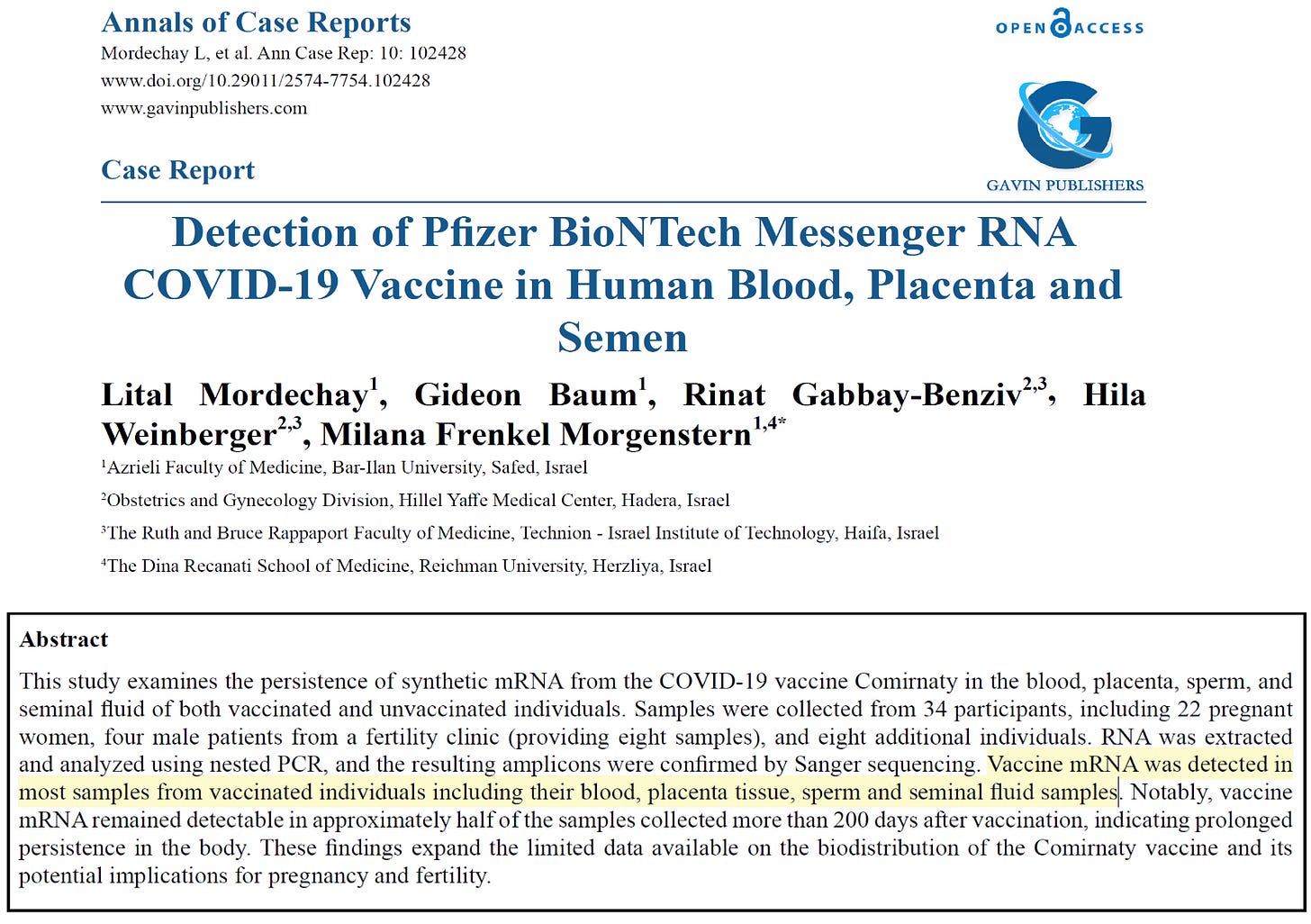
Mordechay L, Baum G, Gabbay-Benziv R, Weinberger H, Morgenstern MF. (2025). Detection of Pfizer BioNTech Messenger RNA COVID-19 Vaccine in Human Blood, Placenta and Semen. 10: 2428. https://doi.org/10.29011/2574-7754.102428
Therapeutic Perspiration: The Role of the Integumentary System
The human skin is the body’s largest organ of detoxification. Sweat, while primarily composed of water and electrolytes, is an effective vehicle for the excretion of heavy metals, environmental pollutants, and metabolic waste. This raises the intriguing and hopeful hypothesis that therapeutic perspiration—induced via high-intensity exercise and controlled hyperthermia (sauna therapy)—may serve as a viable, non-invasive protocol for accelerating the elimination of residual Pfizer and Moderna mRNA and their associated lipid components.
The mechanism of “sweat-mediated clearance” relies on the mobilization of these particles from the interstitial spaces into the dermal glands. By increasing peripheral blood flow and inducing significant diaphoresis, individuals may be able to facilitate the excretion of lipid-bound synthetic material that has evaded traditional hepatic or renal clearance pathways. Furthermore, the heat-shock protein response triggered by sauna use may assist in repairing the cellular dysregulation caused by the exogenous mRNA, effectively “resetting” the body’s natural tumor surveillance mechanisms.
This proactive approach to detoxification offers a potential roadmap for those seeking to mitigate the long-term biological footprint of genetic interventions. While clinical data on the efficacy of sweat-based clearance of mRNA is still in its infancy, the biological plausibility—combined with the known benefits of exercise and thermotherapy—suggests that therapeutic perspiration may be a crucial tool in modern wellness and recovery protocols.
Sources
Bustos, L., et al. (2024). “Mechanisms of mRNA-LNP Persistence and Potential for Oncogenic Interference.” Journal of Biomedical Sciences.
Bansal, S., et al. (2021). “Cutting Edge: Circulating Exosomes with COVID Spike Protein Are Induced by BNT162b2 (Pfizer–BioNTech) Vaccination prior to Development of Antibodies: A Novel Mechanism for Immune Activation by mRNA Vaccines.” The Journal of Immunology, 207(10), 2405–2410.
Mordechay L, Baum G, Gabbay-Benziv R, Weinberger H, Morgenstern MF. (2025). Detection of Pfizer BioNTech Messenger RNA COVID-19 Vaccine in Human Blood, Placenta and Semen. 10: 2428. https://doi.org/10.29011/2574-7754.102428
Marrot, L., et al. (2024). “Multimodal profiling of biostabilized human skin modules reveals a coordinated ecosystem response to injected mRNA-1273 COVID-19 vaccine.” Experimental Dermatology, 33(9), e15132. doi: 10.1111/exd.15132.
University of Pittsburgh Modeling Group. (2023). “Spike Protein Interaction with DNA Repair Surveillance Systems.”
Kalia, Y. N., et al. (2022). “Effect of mRNA Delivery Modality and Formulation on Cutaneous mRNA Distribution and Downstream eGFP Expression.” Pharmaceutics, 14(1), 151.
Liu, J., et al. (2020). “Infection of human sweat glands by SARS-CoV-2.” Cell Discovery, 6(1), 85.
Original Article: https://www.globalresearch.ca/get-pfizer-moderna-mrna-out-body/5924077


Comments ()