
Phase Two | WHO Runs Pandemic Simulation ‘Exercise Polaris II’
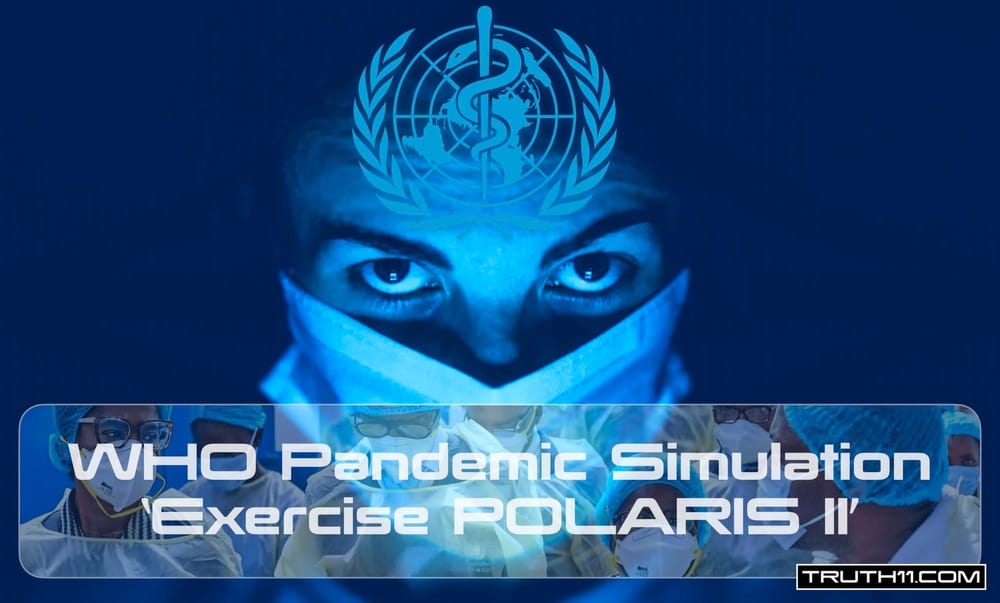
26 countries, 600 emergency experts, and more than 25 global health agencies and response networks participate in WHO’s expanding multinational outbreak simulation.
Jon Fleetwood | modernity.news | jonfleetwood.substack.com
Last month, the World Health Organization (WHO) conducted a 2-day pandemic simulation, convening 26 countries and territories, 600 health emergency experts, and more than 25 international partners.
The move represents a major deepening of WHO-directed global p[l]andemic coordination and emergency control systems, further embedding multinational outbreak management, cross-border policy alignment, and centralized health governance structures.
According to a WHO press release:
The World Health Organization (WHO) wrapped up Exercise Polaris II, a 2-day high-level simulation exercise, based around an outbreak of a fictional new bacterium spreading across the world. Bringing together 26 countries and territories, 600 health emergency experts and over 25 partners, the exercise, which took place on 22 and 23 April, allowed countries to test their preparedness for pandemics and other major health emergencies, including activating their emergency workforce structures, information flow and coordination with each other, partners and WHO.
You can contact the WHO here to voice your opposition to unelected foreign organizations orchestrating future pandemics.

The WHO conducted Polaris I in April 2025, which centered on a fictional virus.
But Polaris II “saw a larger number of countries participate and collaborate through new networks such as the recently launched Health Emergency Leaders Network for Africa and the Eastern Mediterranean.”
Both exercises were meant to enhance “coordination across the emergency workforce” by “simulating the spread of a dangerous pathogen under real-life conditions.”
The recent drill rehearsed coordinated multinational surge support and technical deployment from more than 25 global, regional, and national health agencies and emergency response networks.
The exercise also provided an opportunity to practice a coordinated provision of technical expertise and surge support to countries from over 25 national, regional and global health agencies and organizations, including Africa Centres for Disease Control and Prevention, the International Federation of Red Cross and Red Crescent Societies, Médecins Sans Frontières, Robert Koch Institute, UK-Med, UNICEF, and emergency networks such as the Global Outbreak Alert and Response Network, the Emergency Medical Teams initiative, Standby Partners, and the International Association of National Public Health Institutes.
Exercise Polaris II is part of HorizonX, the WHO’s multi-year simulation exercise program for emergency zoonotic outbreak orchestration.
Just before the COVID-19 [flu renaming] p[l]andemic began, the WHO participated in Event 201, a Johns Hopkins pandemic tabletop exercise that simulated a novel coronavirus outbreak.
During COVID-19 [scam], the WHO rapidly transformed from an advisory body into the central driver of global p[l]andemic policy—shaping surveillance, emergency declarations, lockdown frameworks, and vaccine [bioweapon injection] deployment—making its expanding Polaris II simulation and future p[l]andemic systems especially concerning to critics who view the organization as steadily consolidating international outbreak control.
Moreover, Congress’s Select Subcommittee on the Coronavirus Pandemic concluded that the WHO’s COVID-19 response was an “abject failure,” accusing the organization of subordinating its international public health responsibilities to Chinese Communist Party influence, prioritizing China’s political interests over global transparency, and advancing new pandemic treaty powers that could further threaten U.S. sovereignty.
For critics, that finding makes WHO’s expanding Polaris II emergency simulation and multinational response systems especially alarming, as it places growing global outbreak coordination authority in the hands of an organization Congress concluded previously failed under foreign political pressure and may seek broader international control.
Polaris II signals that the same unelected global institution Congress condemned for catastrophic COVID-era failures [aka running the scam] is not retreating from p[l]andemic power, but is instead expanding permanent multinational outbreak rehearsal, surveillance, and emergency coordination systems that critics warn could further entrench WHO-directed control over future global health crises.
Source: https://modernity.news/2026/05/04/phase-two-who-runs-pandemic-simulation-exercise-polaris-ii/
Original Article: https://henrymakow.com/2026/05/may-6---the-elephant-in-the-ro.html
Note: Comments placed in [ ] are added by Truth11.com editor. For example; [Flu]
Related:




Comments ()